
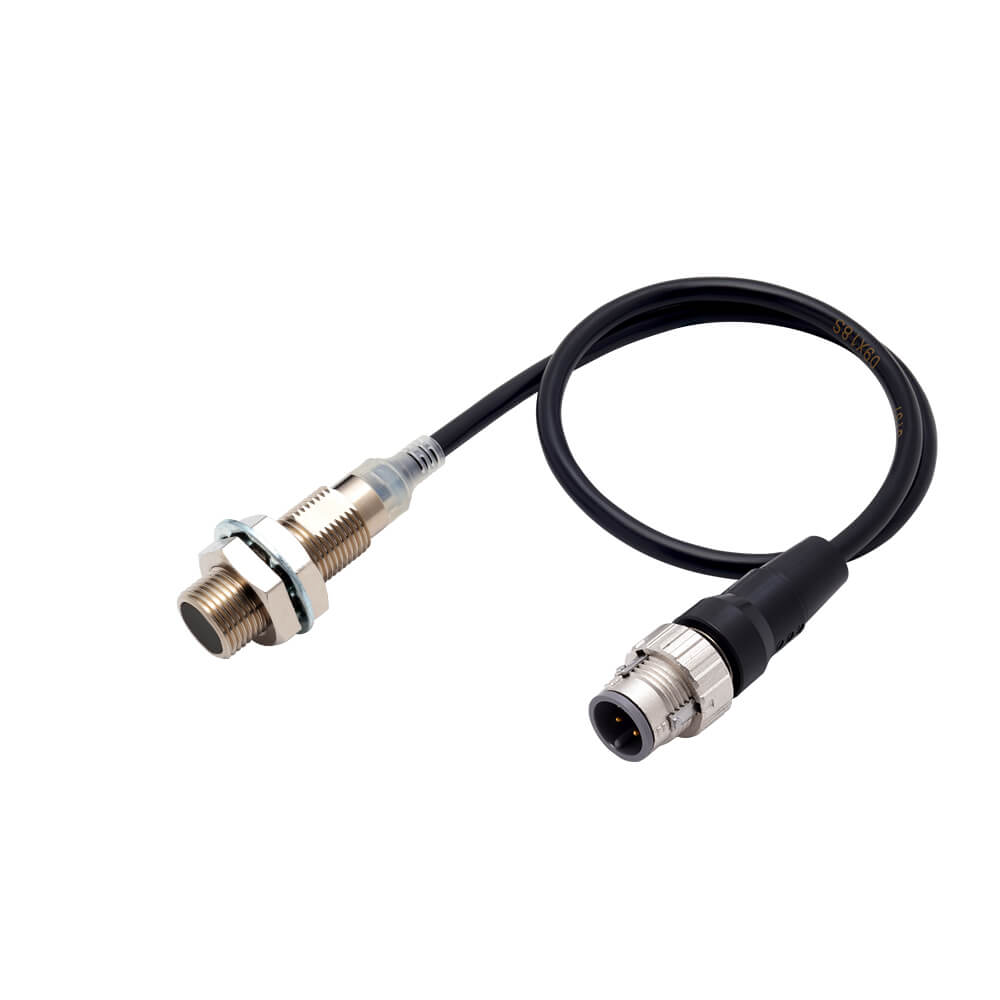
Omron E2E-X4C112-M1TJ 0.3M Inductive Proximity Sensor
| Feature | Value |
|---|---|
| Sensor Type | Inductive Proximity Sensor |
| Series | E2E NEXT |
| Housing Size | M12 |
| Sensing Distance | 4 mm |
| Mounting Style | Shielded |
| Output Type | NPN Normally Open |
| Supply Voltage | 10 to 30 VDC |
| Connection Method | M12 SmartClick Connector with 0.3 m Cable |
| Response Frequency | 1 kHz |
| Housing Material | Nickel-Plated Brass |
| Protection Rating | IP67 / IP67G / IP69K |
| Operating Temperature | -25°C to +70°C |
| Thread Size | M12 x 1 |
| Length | 47.1 mm |
Technical Description
The Omron E2E-X4C112-M1TJ 0.3M Inductive Proximity Sensor is engineered for reliable detection of metallic targets in industrial automation systems. Unlike fixed-cable models, this version incorporates a SmartClick M12 connector with a short 0.3-meter pigtail cable, simplifying installation and maintenance procedures in modular machine designs.
The sensor belongs to the E2E NEXT family and is intended for applications requiring stable proximity detection under demanding environmental conditions. Its shielded sensing construction enables controlled detection zones while maintaining installation flexibility in compact equipment.
Working Principle
The Omron E2E-X4C112-M1TJ 0.3M Inductive Proximity Sensor generates a high-frequency electromagnetic field at the sensing face. When a conductive metal target enters this field, eddy currents are induced in the object.
The resulting energy change is monitored by the sensor electronics. Once the target reaches the specified sensing range, the output state changes, allowing PLCs, controllers, and industrial I/O systems to receive a detection signal.
This contactless operating principle eliminates mechanical wear and supports long-term performance in repetitive industrial processes.
Key Technical Features
- 4 mm sensing distance
- M12 cylindrical housing
- NPN normally open output
- 10–30 VDC operating voltage
- SmartClick connector system
- Shielded sensing technology
- 1 kHz response frequency
- IP67, IP67G, and IP69K protection
- Nickel-plated brass construction
Application Areas
The Omron E2E-X4C112-M1TJ 0.3M Inductive Proximity Sensor is commonly integrated into equipment requiring fast replacement and simplified maintenance.
- Modular assembly machines
- Automated inspection systems
- Robotic work cells
- Packaging equipment
- Conveyor automation
- Machine tools
- Electronic manufacturing systems
- Automated handling equipment
Industrial Applications
Robotic Automation
Robotic systems frequently require reliable feedback regarding metal fixture positions and end-of-travel verification. The sensor provides repeatable detection without mechanical contact.
Assembly Equipment
Production stations use proximity sensors to verify the presence of metal parts before initiating assembly sequences.
Electronics Manufacturing
Automated production lines can use the sensor to monitor tooling positions and metallic carriers throughout the manufacturing process.
Advantages
- Quick-connect installation concept
- Reduced wiring complexity
- Fast maintenance and replacement
- Stable metal target detection
- Compact installation footprint
- High environmental resistance
- Reliable switching performance
Omron E2E-X4C112-M1TJ 0.3M Additional Omron sensor solutions are available for applications requiring different sensing technologies and mounting configurations.
Omron E2E-X4C112-M1TJ 0.3M Considerations When Selecting This Sensor
- Required sensing distance
- Connector compatibility
- Machine wiring architecture
- Environmental exposure
- Control system requirements
- Target material properties
- Maintenance accessibility
The Omron E2E-X4C112-M1TJ 0.3M Inductive Proximity Sensor is particularly suitable for installations where connector-based maintenance strategies are preferred over fixed cable solutions.
Frequently Asked Questions
What is the sensing distance?
The rated sensing distance is 4 mm.
What type of connector is used?
The sensor uses an M12 SmartClick connector with a 0.3-meter cable.
What output type is provided?
NPN normally open output.
What supply voltage is required?
10 to 30 VDC.
Can it detect non-metallic materials?
No, it is designed for metallic targets.
What protection ratings are available?
IP67, IP67G, and IP69K.
What industries commonly use this model?
Automation, robotics, machine building, and manufacturing industries.
What is the housing material?
Nickel-plated brass.