
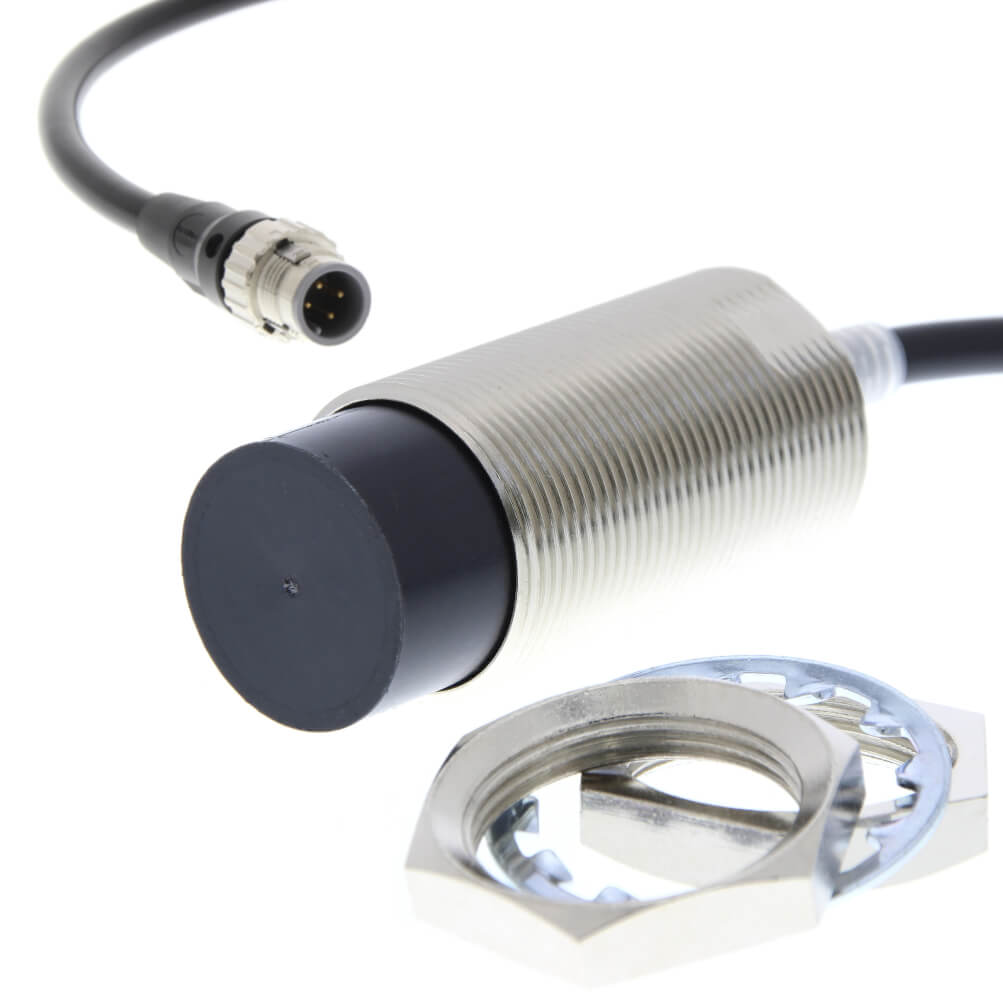
Omron E2E-X40MB1TL30-M1TJ 0.3M Inductive Proximity Sensor
| Specification | Value |
|---|---|
| Manufacturer | Omron |
| Product Type | Inductive Proximity Sensor |
| Sensing Distance | 40 mm |
| Sensing Object | Ferrous Metals |
| Output Type | PNP Normally Open |
| Supply Voltage | 10 to 30 VDC |
| Connection Type | M12 Connector with 0.3 m Cable |
| Housing Shape | Cylindrical Threaded |
| Housing Size | M30 |
| Protection Rating | IP67 |
| Operating Temperature | -25°C to +70°C |
| Shield Type | Unshielded |
The Omron E2E-X40MB1TL30-M1TJ Inductive Proximity Sensor is designed for non-contact detection of metallic targets in industrial automation systems. It belongs to the E2E series, which is widely used for position monitoring, machine control, and object detection tasks in manufacturing environments. The sensor incorporates a robust cylindrical housing and provides stable sensing performance in demanding industrial conditions.
With a 40 mm sensing distance and M30 threaded body, the device is suitable for applications where longer detection ranges are required. The sensor supports reliable target detection without physical contact, reducing mechanical wear and extending service life in automated systems.
Technical Description
The Omron E2E-X40MB1TL30-M1TJ Inductive Proximity Sensor operates using electromagnetic induction principles. An oscillating magnetic field is generated at the sensing face. When a metallic object enters this field, eddy currents are induced within the target material. These currents alter the oscillation characteristics, allowing the sensor to detect the presence of the object.
The sensor utilizes a PNP normally open output configuration and operates from a 10 to 30 VDC power supply. Its unshielded construction enables a longer sensing range compared to shielded alternatives of similar size.
The Omron E2E-X40MB1TL30-M1TJ Inductive Proximity Sensor is particularly suitable for installations requiring increased sensing distance while maintaining reliable switching performance.
Omron E2E-X40MB1TL30-M1TJ Working Principle
The sensor continuously generates a high-frequency electromagnetic field around its sensing surface. When a conductive metal object approaches the sensing zone, electromagnetic energy is absorbed by the target through induced eddy currents.
The internal detection circuit monitors changes in oscillation amplitude and frequency. Once the variation exceeds a predetermined threshold, the output state changes and a switching signal is transmitted to the connected controller, PLC, or automation system.
This detection method eliminates mechanical contact and allows consistent operation even in environments exposed to vibration, dust, or repetitive motion.
Omron E2E-X40MB1TL30-M1TJ Key Features and Advantages
- 40 mm sensing distance for extended detection capability.
- PNP normally open output suitable for common industrial control systems.
- M30 threaded housing for secure mounting.
- IP67 protection rating for harsh industrial environments.
- Non-contact sensing reduces maintenance requirements.
- Stable operation across a wide temperature range.
- Connector-based installation simplifies maintenance procedures.
- Suitable for automated machinery and material handling systems.
Typical Areas of Use
The Omron E2E-X40MB1TL30-M1TJ Inductive Proximity Sensor can be integrated into a wide range of industrial processes where metallic object detection is required.
- Machine tool positioning systems
- Automated conveyor installations
- Packaging machinery
- Material transfer equipment
- Automated assembly stations
- Industrial robotics
- Metal processing machines
- Warehouse automation systems
Additional information about Omron sensor products can be useful when selecting compatible sensing technologies for industrial automation projects.
Industrial Applications
Automotive Manufacturing
In automotive production facilities, the sensor can detect metal body components, tooling fixtures, and workpiece positioning elements throughout assembly operations.
Packaging Systems
The sensor can monitor machine positions, moving metal components, and actuator positions within automated packaging equipment.
Material Handling Equipment
Conveyor systems and transfer mechanisms frequently use inductive sensors to confirm pallet positions, metal carriers, and moving assemblies.
Machine Building
Equipment manufacturers integrate proximity sensors into custom machinery to provide position feedback and process monitoring functions.
Considerations When Selecting the Sensor
Several factors should be evaluated before implementing an inductive proximity sensor in an automation project.
- Required sensing distance.
- Target material composition.
- Available installation space.
- Output type compatibility with the control system.
- Environmental protection requirements.
- Temperature conditions.
- Connector and wiring preferences.
- Mechanical mounting constraints.
The Omron E2E-X40MB1TL30-M1TJ Inductive Proximity Sensor is generally selected when extended sensing distance and cylindrical mounting are important project requirements.
Maintenance and Reliability
Inductive proximity sensors typically require minimal maintenance because no physical contact occurs during operation. Routine inspections should focus on connector integrity, mounting stability, and accumulation of debris around the sensing surface.
Periodic verification of switching performance can help ensure continued accuracy in critical automation applications.
Frequently Asked Questions
What type of sensor is the Omron E2E-X40MB1TL30-M1TJ?
It is an inductive proximity sensor designed for non-contact detection of metallic objects.
What is the sensing distance of this model?
The nominal sensing distance is 40 mm.
What output configuration does the sensor use?
The sensor provides a PNP normally open output.
Can the sensor detect non-metallic materials?
No. Inductive sensors are intended primarily for conductive metallic targets.
What supply voltage is required?
The sensor operates from 10 to 30 VDC.
Is the sensor suitable for outdoor industrial environments?
Its IP67 protection rating supports operation in demanding industrial conditions where dust and moisture may be present.
Where is this sensor commonly installed?
Typical installations include conveyors, machine tools, robotic cells, packaging systems, and assembly equipment.
Why choose a non-contact sensing method?
Non-contact detection minimizes mechanical wear, improves operational reliability, and reduces maintenance requirements.