
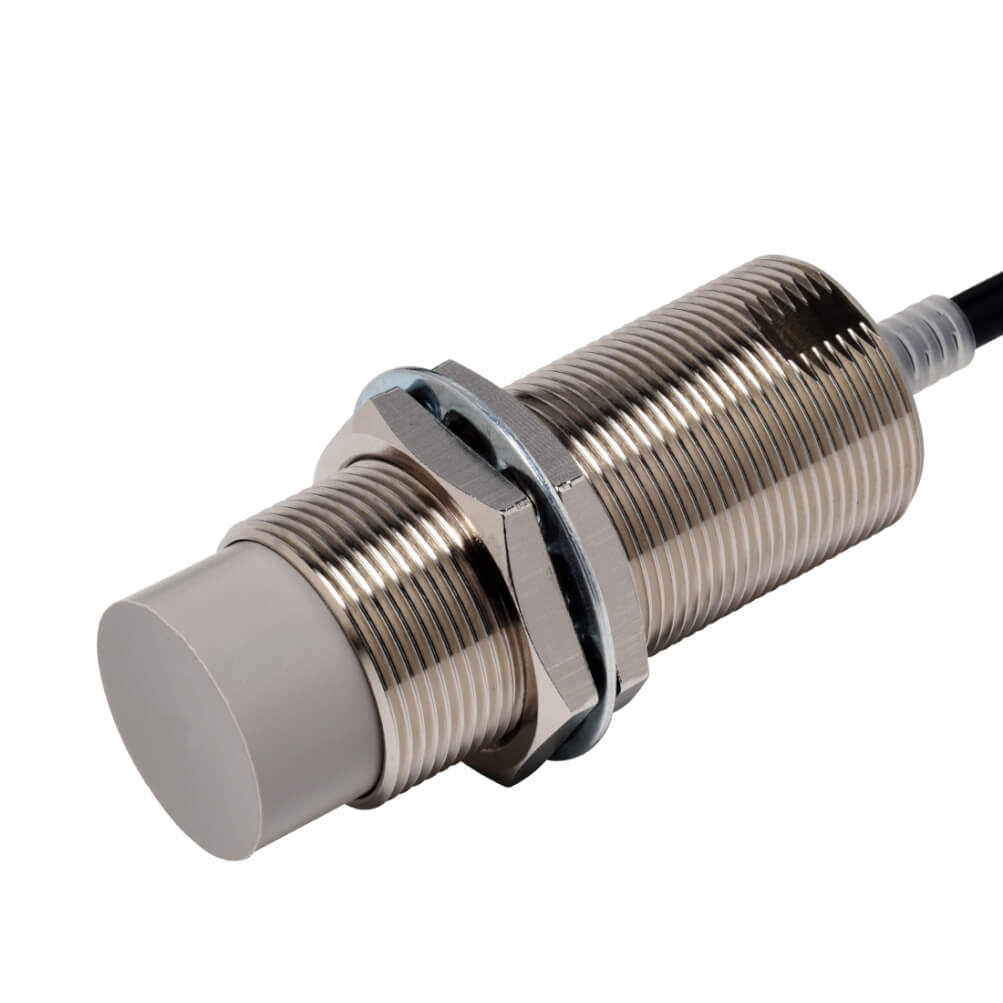
Omron E2E-X30MC3L30 2M Inductive Proximity Sensor
| Feature | Value |
|---|---|
| Sensor Type | Inductive Proximity Sensor |
| Series | Omron E2E NEXT |
| Size | M30 |
| Mounting Type | Non-flush |
| Sensing Distance | 30 mm |
| Output Type | NPN |
| Operation Mode | NO (Normally Open) |
| Connection Method | Pre-wired Cable |
| Cable Length | 2 m |
| Housing Material | Nickel-Plated Brass |
| Thread Length | 50 mm |
| Overall Length | Approximately 82.3 mm |
| Protection Rating | IP67 / IP67G / IP69K |
The Omron E2E-X30MC3L30 Inductive Proximity Sensor is designed for non-contact detection of metallic objects in industrial automation systems. As part of the E2E NEXT series, it combines extended sensing distance with a robust mechanical structure suitable for demanding environments. Its M30 cylindrical housing and long sensing range allow engineers to increase installation tolerances while maintaining reliable object detection.
The Omron E2E-X30MC3L30 Inductive Proximity Sensor is commonly used in automated production lines, material handling systems, machine tools, and conveyor-based applications where stable metal target detection is required.
Technical Overview
This sensor operates using electromagnetic induction to detect metallic targets entering its sensing field. The M30 housing provides a larger sensing surface, enabling a nominal sensing distance of 30 mm. The non-flush design further contributes to extended detection performance by allowing a broader electromagnetic field around the sensing face.
The sensor features an NPN normally open output and a 2-meter oil-resistant cable connection. Its nickel-plated brass housing provides mechanical durability while maintaining resistance to common industrial contaminants.
The Omron E2E-X30MC3L30 Inductive Proximity Sensor is engineered for installations where longer sensing distances reduce the likelihood of mechanical contact between the sensor and moving machine components.
Operating Principle
Like other inductive proximity sensors, this device generates a high-frequency electromagnetic field at its sensing face. When a metallic object enters this field, eddy currents are induced within the target material. These currents absorb energy from the oscillation circuit, causing a detectable change in amplitude.
The internal electronics continuously monitor these changes and switch the output state when the detection threshold is reached. Because detection is based on electromagnetic interaction rather than physical contact, wear on the sensing element is minimized.
This operating method makes the sensor suitable for repetitive industrial processes where high cycle counts and consistent detection are required.
Typical Application Areas
- Automated assembly systems
- Conveyor position monitoring
- Metal component detection
- Packaging machinery
- Material transfer systems
- Machine tool positioning
- Automated storage equipment
- Industrial handling systems
In many manufacturing environments, the sensor is used to verify the presence of metal carriers, fixtures, pallets, or machine components before subsequent process steps begin.
Omron E2E-X30MC3L30 Industrial Applications
Automotive Manufacturing
Production lines frequently utilize inductive sensors for detecting metal body panels, fixtures, and transfer mechanisms. The extended sensing range helps maintain reliable detection despite vibration and installation tolerances.
Packaging Equipment
Packaging machines often require confirmation of actuator positions and metal guide components. The long sensing distance can simplify machine design by providing additional installation flexibility.
Material Handling Systems
Automated transport systems rely on position feedback from metallic carriers and machine elements. The sensor supports consistent operation even in environments exposed to dust and washdown procedures.
Machine Building
Machine manufacturers use proximity sensors for position verification, end-of-travel detection, and safety-related machine status monitoring where metallic targets are present.
Advantages
- Long 30 mm sensing distance
- Non-contact metal detection
- Reduced risk of sensor impact
- Durable nickel-plated brass housing
- Oil-resistant cable construction
- Suitable for harsh industrial environments
- IP67, IP67G, and IP69K protection ratings
- Stable operation in automated machinery
Additional information about Omron sensor products can be useful when selecting compatible sensing technologies for larger automation projects.
Omron E2E-X30MC3L30 Factors to Consider During Product Selection
When selecting an inductive proximity sensor, engineers should evaluate sensing distance requirements, available installation space, electrical interface compatibility, environmental conditions, and target material characteristics.
For applications involving washdown procedures or exposure to oils and coolants, ingress protection ratings and cable durability should be carefully reviewed. The Omron E2E-X30MC3L30 Inductive Proximity Sensor is often selected where environmental protection and extended sensing distance are important design considerations.
Sector-Specific Usage Examples
- Monitoring steel pallets in logistics systems
- Detecting machine carriage positions in CNC equipment
- Verifying actuator positions in automated assembly stations
- Monitoring transfer mechanisms in automotive production
- Detecting metallic trays in packaging facilities
- Position confirmation in robotic handling systems
Frequently Asked Questions
What type of sensor is the E2E-X30MC3L30 2M?
It is an inductive proximity sensor designed for detecting metallic objects without physical contact.
What is the sensing distance?
The nominal sensing distance is 30 mm.
What output configuration does it use?
The sensor provides an NPN normally open output.
Is the sensor suitable for outdoor industrial environments?
Its IP67, IP67G, and IP69K protection ratings support use in demanding industrial conditions, depending on system design requirements.
What is the housing size?
The sensor uses an M30 cylindrical threaded housing.
Can it detect non-metallic materials?
No. Inductive sensors are specifically designed to detect metallic targets.
What connection method is provided?
The model is supplied with a 2-meter pre-wired cable connection.
Why is a long sensing distance beneficial?
A longer sensing range can reduce installation constraints and lower the risk of mechanical contact between moving equipment and the sensor face.