
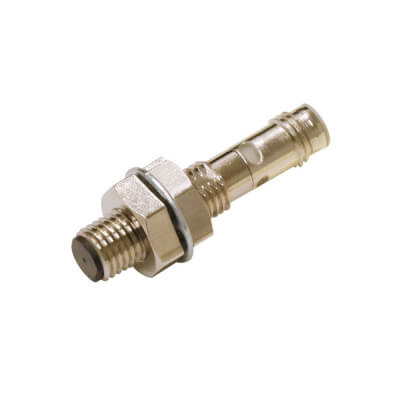
Omron E2E-X3B1T8-M3 Inductive Proximity Sensor
| Feature | Value |
|---|---|
| Sensor Type | Inductive Proximity Sensor |
| Series | E2E NEXT |
| Housing Diameter | M8 |
| Sensing Distance | 3 mm |
| Mounting Style | Quasi-flush |
| Output Type | PNP Normally Open |
| Supply Voltage | 10 to 30 VDC |
| Connection Method | M12 Connector |
| Housing Material | Nickel-plated Brass |
| Protection Rating | IP67 / IP67G / IP69K |
| Operating Temperature | -25°C to +70°C |
| Thread Length | 21 mm |
| Overall Length | 37.8 mm |
The Omron E2E-X3B1T8-M3 Inductive Proximity Sensor is designed for accurate detection of metallic objects in industrial automation environments. Featuring a compact M8 cylindrical housing and a 3 mm sensing distance, the sensor is suitable for machinery where installation space is limited and reliable position detection is required. As a member of the E2E NEXT family, it is engineered to provide stable sensing performance even in demanding operating conditions.
Omron E2E-X3B1T8-M3 Technical Description
The Omron E2E-X3B1T8-M3 Inductive Proximity Sensor utilizes electromagnetic induction technology to detect conductive metal targets without physical contact. Its sensing element continuously generates a high-frequency electromagnetic field. When a metallic object enters the sensing zone, the field is disturbed, allowing the internal electronics to recognize target presence and activate the output signal.
The sensor incorporates a PNP normally open output configuration and is intended for integration with PLCs, machine controllers, industrial I/O systems, and automation networks. The M12 connector design supports efficient installation and replacement procedures in industrial equipment.
The Omron E2E-X3B1T8-M3 Inductive Proximity Sensor is commonly selected for applications requiring reliable metal detection, compact dimensions, and high environmental resistance.
Working Principle
Inductive proximity sensors operate through the generation of an oscillating electromagnetic field at the sensing face. When a conductive metal target approaches the sensor, eddy currents develop within the target material. These currents absorb energy from the oscillation circuit and reduce the oscillation amplitude.
The sensor electronics monitor this change and switch the output when a predefined threshold is reached. Because the detection process occurs without physical contact, wear is minimized and long-term operational consistency can be maintained.
This principle makes the sensor suitable for repetitive industrial processes where mechanical limit switches may experience wear or contamination.
Typical Areas of Use
- Automated production equipment
- Material handling systems
- Conveyor line automation
- Assembly machinery
- Metalworking equipment
- Packaging systems
- Robotic workstations
- Industrial transport mechanisms
The compact housing allows installation in areas where larger sensors would be difficult to accommodate.
Industrial Applications
Conveyor Monitoring
Manufacturing facilities often require confirmation of pallet stops, carrier positions, and actuator movement. The sensor can provide precise switching signals when metallic machine components reach designated positions.
Packaging Equipment
Packaging machines rely on accurate position monitoring to coordinate moving assemblies. The sensor can detect mechanical components such as guides, pushers, and metal carriers throughout the packaging cycle.
Metal Processing Systems
In metal fabrication equipment, sensors are frequently used to verify the position of workpieces, tooling components, and machine elements before machining or assembly operations begin.
Robotic Production Cells
Industrial robots often require feedback from fixtures, grippers, and positioning mechanisms. The compact M8 body allows installation within tooling structures and robotic end-effectors.
Advantages
- Compact M8 cylindrical design
- Reliable 3 mm sensing distance
- Non-contact metal detection
- PNP normally open output configuration
- High resistance to industrial contaminants
- IP67, IP67G, and IP69K protection ratings
- Nickel-plated brass housing for durability
- Suitable for automated manufacturing systems
Omron E2E-X3B1T8-M3 Sector-Specific Usage Examples
- Detecting metal carriers in automotive assembly lines
- Monitoring actuator positions in packaging machinery
- Verifying fixture engagement in robotic welding stations
- Position sensing in pharmaceutical packaging equipment
- Monitoring transport systems in logistics facilities
- Detecting machine component movement in food processing equipment
Omron E2E-X3B1T8-M3 Considerations When Selecting an Inductive Sensor
Several engineering factors should be evaluated before selecting a proximity sensor. These include available mounting space, required sensing distance, target material characteristics, electrical interface requirements, environmental conditions, and system architecture.
The Omron E2E-X3B1T8-M3 Inductive Proximity Sensor is intended for applications where compact dimensions and reliable metal detection are primary requirements.
Engineers seeking additional sensing technologies and related products can review Omron sensor serileri for broader automation system integration options.
Omron E2E-X3B1T8-M3 Frequently Asked Questions
What type of target can this sensor detect?
The sensor is designed to detect metallic objects using inductive sensing technology.
What is the nominal sensing distance?
The nominal sensing distance is 3 mm.
Which output type does the sensor provide?
The device uses a PNP normally open output configuration.
Can it be used in wet environments?
Yes. The sensor supports IP67, IP67G, and IP69K protection ratings for demanding industrial environments.
What housing size does the sensor use?
The sensor features a compact M8 threaded cylindrical housing.
Which industries commonly use this sensor?
It is frequently used in automotive manufacturing, packaging, logistics, robotics, and machine building applications.
How does inductive sensing work?
The sensor generates an electromagnetic field and detects changes caused by nearby conductive metal targets.
Can the sensor replace mechanical limit switches?
Many applications use inductive sensors as a non-contact alternative to mechanical position detection devices.
What connection method is used?
The sensor uses an M12 connector for electrical connection and system integration.
Why is non-contact detection beneficial?
Non-contact operation reduces mechanical wear and supports long-term reliability in repetitive industrial processes.