
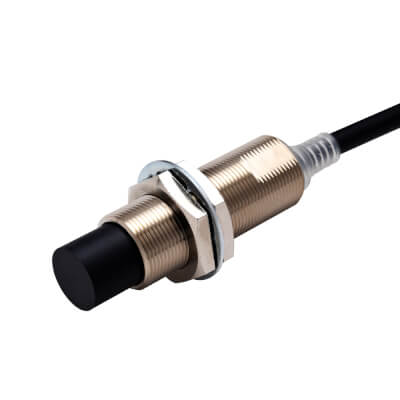
Omron E2E-X30MC1L18 2M Inductive Proximity Sensor
| Feature | Value |
|---|---|
| Sensor Type | Inductive Proximity Sensor |
| Series | E2E NEXT |
| Sensing Distance | 30 mm |
| Mounting Type | Non-flush (Unshielded) |
| Output Type | NPN, Normally Open (NO) |
| Supply Voltage | 10 to 30 VDC |
| Connection Method | 2 m PVC Cable |
| Response Frequency | 200 Hz |
| Current Consumption | Max. 16 mA |
| Housing Material | Nickel-Plated Brass |
| Protection Rating | IP67, IP67G, IP69K |
| Operating Temperature | -25°C to +70°C |
| Body Size | M18 Long Body |
| Overall Length | 77.3 mm |
The Omron E2E-X30MC1L18 2M Inductive Proximity Sensor is designed for non-contact detection of ferrous metal objects in industrial automation systems. As part of the E2E NEXT series, it incorporates a long sensing distance within a compact M18 cylindrical housing. The sensor is intended for installations where reliable metal detection is required despite environmental challenges such as moisture, oil exposure, vibration, and frequent washdowns.
Technical Description
The Omron E2E-X30MC1L18 2M Inductive Proximity Sensor operates with a 30 mm sensing distance and uses an unshielded sensing structure to achieve extended detection capability. The sensor features a DC 3-wire configuration with an NPN normally open output. Its nickel-plated brass housing provides mechanical durability while maintaining resistance to corrosion in demanding industrial environments.
The integrated protection circuits include short-circuit protection, output reverse polarity protection, power supply reverse polarity protection, and surge suppression. These protective functions contribute to stable operation within automated production systems.
Operating Principle
Like other inductive proximity sensors, the Omron E2E-X30MC1L18 2M Inductive Proximity Sensor generates an electromagnetic field at its sensing face. When a ferrous metal target enters the sensing zone, eddy currents are induced within the target material. These currents alter the oscillation characteristics of the sensor, triggering the switching output.
Because the sensor performs detection without physical contact, there is no mechanical wear during operation. This principle supports long service life and consistent performance in repetitive sensing applications.
Key Advantages
- Extended 30 mm sensing distance for increased installation flexibility.
- IP67, IP67G, and IP69K protection ratings for harsh industrial environments.
- Reliable operation across a wide temperature range.
- Robust nickel-plated brass housing.
- Integrated electrical protection circuits.
- Non-contact detection reduces mechanical wear.
- Suitable for automated machinery and conveyor systems.
Typical Applications
The Omron E2E-X30MC1L18 2M Inductive Proximity Sensor is commonly integrated into automated manufacturing equipment where metal object detection is essential for process control and machine safety.
Material Handling Systems
In conveyor installations, the sensor can monitor the position of metal carriers, pallets, or transport fixtures. The extended sensing distance allows installation away from moving mechanical components.
Packaging Equipment
Packaging machines often use proximity sensors for position verification of metal tooling, indexing mechanisms, and machine assemblies. Reliable switching performance helps maintain process consistency.
Assembly Automation
Automated assembly lines use the sensor to verify the presence of metallic parts before subsequent production stages. Detection feedback can be integrated into PLC-controlled systems.
Machine Tools
Metalworking machinery frequently utilizes inductive sensors for tool position monitoring, fixture verification, and machine sequencing functions.
Industrial Sectors Using This Sensor
- Automotive manufacturing
- Packaging and processing industries
- Material handling facilities
- Machine building and OEM equipment
- Metal fabrication operations
- Automated warehousing systems
- Food and beverage machinery with washdown requirements
- Industrial robotics applications
Engineers seeking additional sensing technologies may also review Omron sensor product ranges for broader automation system integration.
Selection Considerations
When selecting the Omron E2E-X30MC1L18 2M Inductive Proximity Sensor, several application-specific factors should be evaluated.
- Required sensing distance relative to target size.
- Available installation space for the M18 long-body design.
- Control system compatibility with NPN outputs.
- Environmental exposure to water, oil, or cleaning processes.
- Target material characteristics and geometry.
- Cable routing requirements and electrical noise conditions.
The Omron E2E-X30MC1L18 2M Inductive Proximity Sensor is particularly suitable when long sensing distance and environmental durability are primary design requirements.
Frequently Asked Questions
What type of objects can this sensor detect?
The sensor is primarily designed to detect ferrous metal objects. Detection performance may vary when non-ferrous metals are used.
What is the sensing distance of the sensor?
The rated sensing distance is 30 mm.
Does the sensor require physical contact with the target?
No. Detection is performed through an electromagnetic field without physical contact.
What output configuration does it use?
The sensor provides an NPN normally open (NO) output.
Can it operate in wet environments?
Yes. The sensor carries IP67, IP67G, and IP69K protection ratings for demanding industrial environments.
What supply voltage is required?
The operating voltage range is 10 to 30 VDC.
Is the sensor suitable for conveyor applications?
Yes. It is commonly used for metal object detection, positioning, and verification in conveyor systems.
What is the operating temperature range?
The sensor is designed to operate between -25°C and +70°C.
How is the sensor connected?
The model includes a permanently attached 2-meter PVC cable.
Why choose a non-flush sensor design?
Non-flush sensors provide greater sensing distances than flush-mounted designs, making them suitable for applications requiring larger detection ranges.