
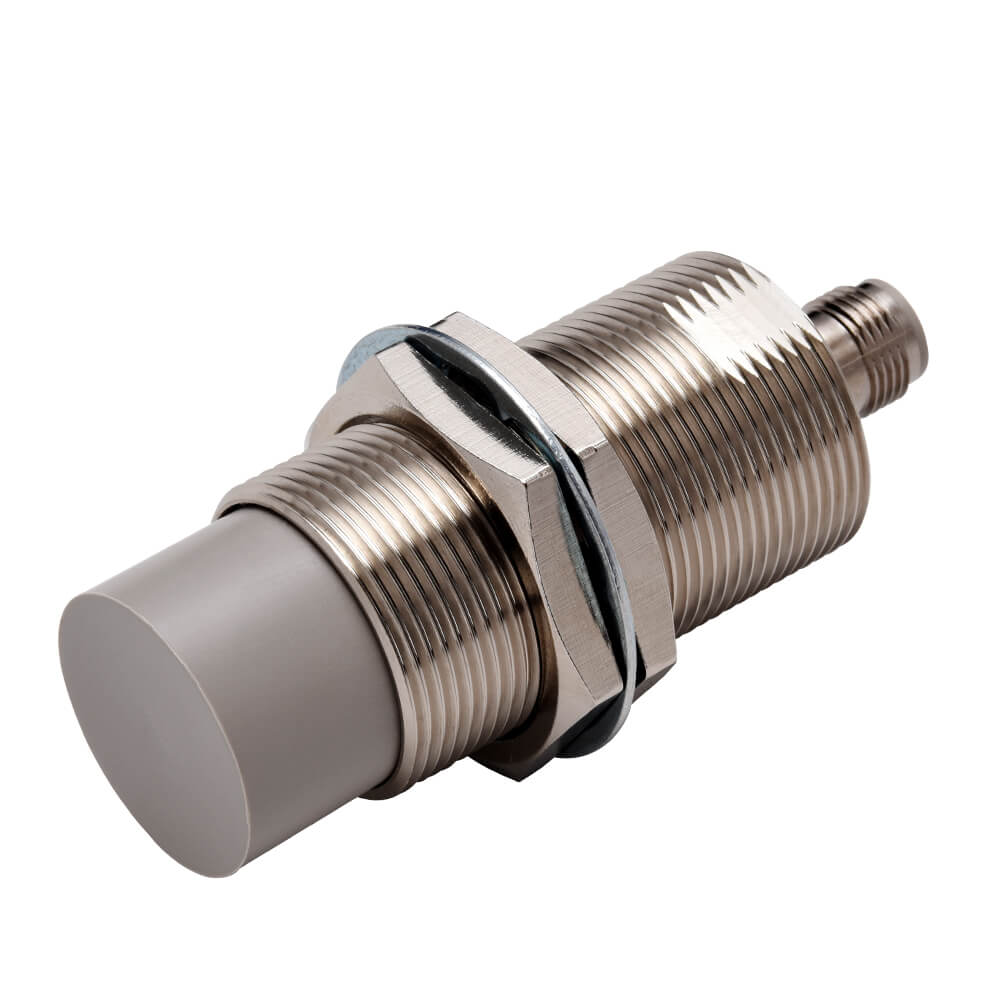
Omron E2E-X30MB1TL30-M1 Inductive Proximity Sensor
| Feature | Value |
|---|---|
| Sensor Type | Inductive Proximity Sensor |
| Series | E2E NEXT |
| Housing Size | M30 |
| Mounting Type | Non-flush |
| Sensing Distance | 30 mm |
| Output Type | PNP NO |
| Communication | IO-Link COM3 (230.4 kbps) |
| Supply Voltage | 10 to 30 VDC |
| Connection Method | M12 Connector |
| Housing Material | Nickel-Plated Brass |
| Response Frequency | 100 Hz |
| Overall Length | 80 mm |
| Thread Length | 50 mm |
| Protection Rating | IP67 / IP69K |
| Operating Temperature | -40°C to +85°C |
The Omron E2E-X30MB1TL30-M1 Inductive Proximity Sensor is designed for non-contact detection of metallic targets in industrial automation systems. As part of the E2E NEXT series, this sensor combines extended sensing distance, robust environmental protection, and IO-Link communication capabilities. Its M30 threaded cylindrical housing and non-flush design make it suitable for machinery where longer sensing ranges are required without physical contact between the sensor and the target.
Technical Overview
The Omron E2E-X30MB1TL30-M1 Inductive Proximity Sensor utilizes electromagnetic field generation to detect metallic objects within a sensing distance of 30 mm. The sensor operates using a DC power supply and provides a normally open PNP switching output. Integrated IO-Link functionality enables bidirectional communication with compatible controllers and IO-Link masters.
The nickel-plated brass housing provides mechanical durability while maintaining resistance to industrial contaminants. With IP67 and IP69K protection ratings, the sensor is suitable for environments exposed to dust, moisture, washdown procedures, and demanding operating conditions.
Working Principle
The operating principle of the sensor is based on electromagnetic induction. The sensing face generates a high-frequency electromagnetic field. When a metallic object enters the detection zone, eddy currents are induced within the target material.
These eddy currents absorb energy from the oscillator circuit inside the sensor. Once the change reaches a predefined threshold, the internal switching circuit activates the output signal. Since the detection process is entirely contactless, mechanical wear is minimized and long-term operational stability can be maintained.
In addition to switching functionality, IO-Link communication enables process data exchange, parameter configuration, and diagnostic monitoring.
Typical Applications
The Omron E2E-X30MB1TL30-M1 Inductive Proximity Sensor is commonly used in applications where reliable metal detection is required under varying environmental conditions.
- Automated assembly systems
- Material handling equipment
- Conveyor position monitoring
- Packaging machinery
- Automotive production lines
- Robotic workstations
- Metal fabrication equipment
- Industrial transfer systems
The extended sensing distance allows installation farther from moving targets, reducing the possibility of mechanical impact and improving installation flexibility.
Industrial Applications
Automotive Manufacturing
In automotive production facilities, the sensor can monitor the presence and position of metal components during welding, assembly, and transfer operations.
Packaging and Logistics
Packaging machines frequently require precise position feedback for metallic machine parts. The sensor supports consistent detection while operating in high-cycle production environments.
Machine Building
Equipment manufacturers integrate the sensor into custom machinery to provide position confirmation, indexing verification, and actuator monitoring.
Robotics and Smart Manufacturing
Through IO-Link connectivity, sensor data can be integrated into predictive maintenance and machine diagnostics systems, supporting Industry 4.0 implementations.
Engineers seeking additional sensing solutions may also review Omron sensor product ranges for related automation applications.
Advantages
- Long 30 mm sensing distance
- Non-contact operation reduces wear
- Integrated IO-Link communication
- M30 industrial-standard housing
- PNP normally open output configuration
- IP67 and IP69K environmental protection
- Wide operating temperature range
- Suitable for demanding industrial environments
The Omron E2E-X30MB1TL30-M1 Inductive Proximity Sensor also supports improved machine diagnostics through process monitoring and parameter management using IO-Link infrastructure.
Omron E2E-X30MB1TL30-M1 Industry-Specific Use Cases
In steel processing facilities, the sensor can detect the presence of metal carriers moving through transfer stations. In automated warehouses, it can confirm the position of lifting mechanisms and transfer equipment. In food and beverage production environments, the high protection rating supports operation in washdown zones where equipment is regularly cleaned.
The Omron E2E-X30MB1TL30-M1 Inductive Proximity Sensor is also used in robotic tooling systems where reliable target detection is required despite vibration, temperature variation, and continuous operation.
Factors to Consider During Selection
- Required sensing distance
- Target material characteristics
- Available installation space
- Output type compatibility
- Communication requirements
- Environmental protection requirements
- Operating temperature conditions
- Controller and IO-Link infrastructure compatibility
Careful evaluation of these parameters helps ensure consistent detection performance and integration with existing automation architectures.
Omron E2E-X30MB1TL30-M1 Frequently Asked Questions
What type of sensor is the E2E-X30MB1TL30-M1?
It is an inductive proximity sensor designed for non-contact detection of metallic objects.
What is the sensing distance?
The nominal sensing distance is 30 mm.
Does the sensor support IO-Link?
Yes. It includes IO-Link COM3 communication functionality.
What output configuration does it use?
The sensor provides a PNP normally open (NO) output.
What housing size does the sensor use?
It features an M30 threaded cylindrical housing.
Can it be used in washdown environments?
Yes. IP67 and IP69K ratings provide protection against dust and high-pressure washdown conditions.
What industries commonly use this sensor?
Automotive, logistics, machine building, packaging, robotics, and metal processing industries frequently use this model.
Why is a longer sensing distance beneficial?
Longer sensing distances allow greater installation flexibility and reduce the likelihood of mechanical contact between the sensor and moving targets.