
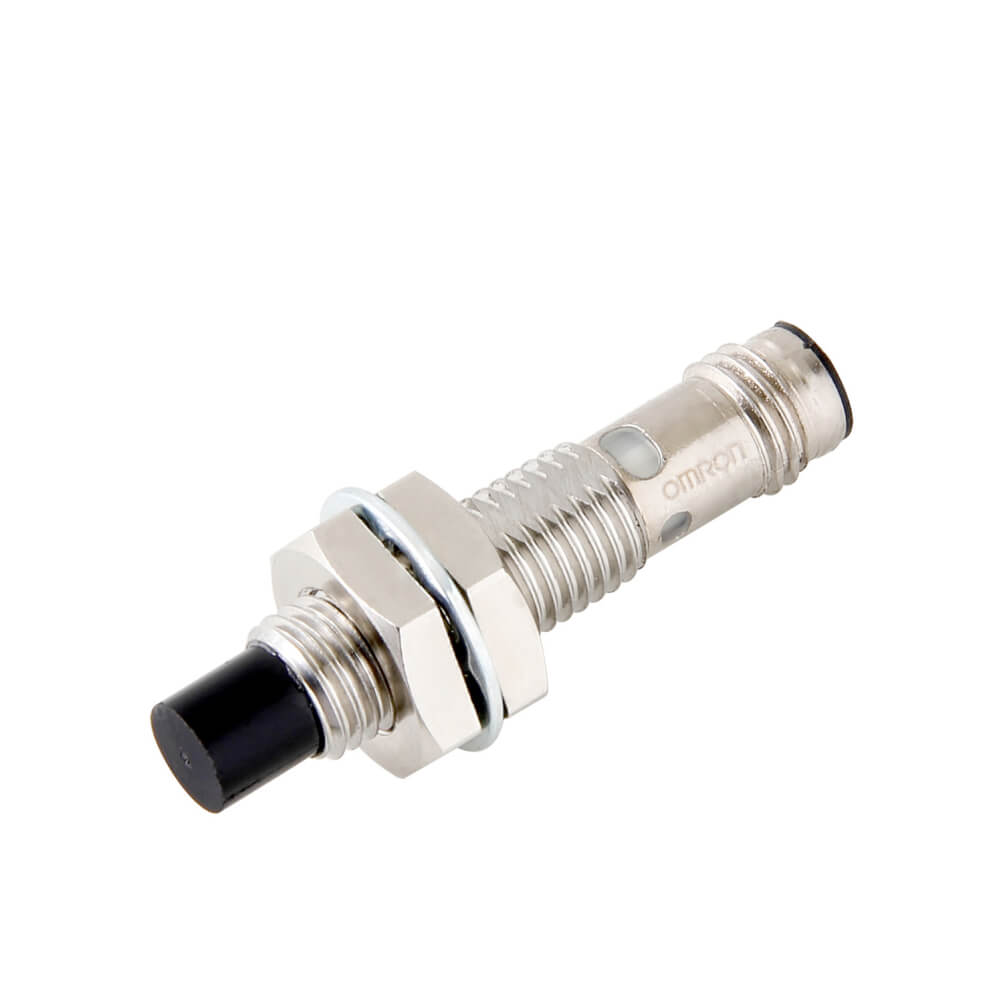
Omron E2E-X2MC18-M3 Inductive Proximity Sensor
| Feature | Value |
|---|---|
| Manufacturer | Omron |
| Series | E2E NEXT |
| Sensor Type | Inductive Proximity Sensor |
| Sensing Distance | 2 mm |
| Housing Size | M8 Threaded |
| Mounting Type | Non-flush (Unshielded) |
| Output Type | NPN Normally Open (NO) |
| Supply Voltage | 10 to 30 VDC |
| Connection Type | M8 Connector |
| Connector Orientation | Straight |
| Housing Material | Stainless Steel |
| Response Frequency | 1 kHz |
| Operating Temperature | -40°C to +85°C |
| Protection Rating | IP67 / IP67G / IP69K |
| Overall Length | 43 mm |
Equipment designers often seek sensing devices that combine compact dimensions with connector-based installation methods. The Omron E2E-X2MC18-M3 Inductive Proximity Sensor addresses these requirements through its compact M8 cylindrical design and integrated connector interface, supporting streamlined integration into industrial automation systems.
Developed within the E2E NEXT product family, this sensor is intended for reliable metallic object detection in machinery operating under demanding environmental conditions. Its rugged construction and non-contact detection principle help maintain stable sensing performance throughout continuous production processes.
Technical Description
The Omron E2E-X2MC18-M3 Inductive Proximity Sensor is designed to detect metallic targets at a rated sensing distance of 2 mm. The sensor utilizes an unshielded sensing configuration and is housed within a stainless-steel threaded body suitable for industrial installations.
The device operates using a 10 to 30 VDC supply and provides an NPN normally open switching output. An integrated M8 connector allows rapid installation and simplified replacement procedures while reducing wiring complexity in modular machine architectures.
The sensor’s environmental protection ratings support operation in production environments exposed to moisture, cleaning agents, oils, and airborne contaminants.
Omron E2E-X2MC18-M3 Operating Principle
The Omron E2E-X2MC18-M3 Inductive Proximity Sensor generates an electromagnetic field from its sensing surface using an internal oscillator circuit. When a metallic object enters the sensing zone, eddy currents are induced within the target material.
These eddy currents absorb energy from the oscillating field. Once the change exceeds the internal switching threshold, the output circuit changes state and transmits a signal to the connected automation controller.
Because the sensing process occurs without physical contact, the sensor can provide reliable long-term operation without mechanical wear on the detection surface.
Advantages of the Sensor
- Compact threaded M8 housing.
- M8 connector supports quick installation.
- Durable stainless-steel construction.
- Suitable for harsh industrial environments.
- High protection ratings up to IP69K.
- Reliable metallic object detection.
- Fast response characteristics.
- Supports modular machine design strategies.
Applications in Automation Systems
The Omron E2E-X2MC18-M3 Inductive Proximity Sensor can be integrated into a wide range of automation and machinery applications requiring dependable metal detection.
- Automated assembly equipment
- Industrial robotics
- Conveyor systems
- Packaging machinery
- Automated inspection stations
- Semiconductor handling equipment
- Production transfer mechanisms
- Material handling systems
Omron E2E-X2MC18-M3 Industrial Application Examples
Robotic End-of-Arm Tooling
Compact sensors are frequently installed on robotic tooling to verify fixture positions and confirm the presence of metallic workpieces before processing operations begin.
Transfer System Monitoring
Production transfer units often require accurate position verification of carriers and indexing mechanisms to maintain process synchronization.
Automated Inspection Equipment
Inspection systems can utilize proximity sensors to detect the arrival of metallic components before initiating testing or quality verification routines.
Electronics Manufacturing
Production lines handling metallic pallets, fixtures, and carrier plates can use inductive sensors to monitor equipment movement and workpiece flow.
Important Selection Considerations
When specifying the Omron E2E-X2MC18-M3 Inductive Proximity Sensor, engineers should evaluate the installation environment, connector requirements, available mounting space, and electrical interface compatibility.
The M8 connector version may be particularly beneficial in compact machinery where cable management and quick serviceability are important operational considerations.
For broader automation projects and related sensing technologies, users may review Omron sensor solutions to compare additional models and configurations.
Omron E2E-X2MC18-M3 Sector-Based Use Cases
- Detecting metallic fixtures in electronics assembly.
- Monitoring pallet movement in automated production cells.
- Verifying actuator positions in packaging systems.
- Confirming carrier locations in robotic transfer stations.
- Monitoring indexing mechanisms in assembly machinery.
- Detecting machine component movement in industrial equipment.
Frequently Asked Questions
What connector type does this sensor use?
The sensor is equipped with a straight M8 connector.
What is the sensing distance?
The rated sensing distance is 2 mm.
What output configuration is available?
The sensor provides an NPN normally open output.
What voltage range is supported?
The operating voltage range is 10 to 30 VDC.
Can the Omron E2E-X2MC18-M3 Inductive Proximity Sensor be used in washdown environments?
Its IP67, IP67G, and IP69K protection ratings make it suitable for demanding industrial environments.
What materials can be detected?
The sensor is designed for metallic and conductive materials.
Is the Omron E2E-X2MC18-M3 Inductive Proximity Sensor suitable for compact machines?
Yes. Its M8 housing and connector design support installation where available space is limited.
What industries commonly use this sensor?
Typical sectors include robotics, electronics manufacturing, packaging, machine building, material handling, and industrial automation.