
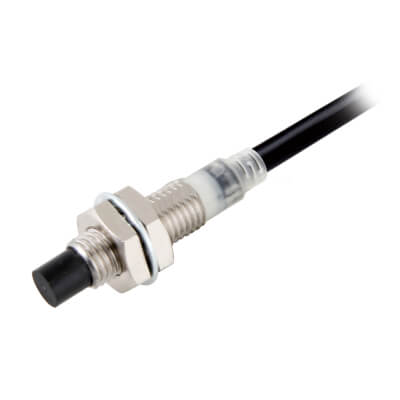
Omron E2E-X2MB1T8-R 2M Inductive Proximity Sensor
| Feature | Value |
|---|---|
| Sensor Type | Inductive Proximity Sensor |
| Series | Omron E2E NEXT |
| Sensing Distance | 2 mm |
| Housing Size | M8 |
| Mounting Type | Non-flush (Unshielded) |
| Output Type | PNP NO |
| Connection Method | 2 m Robotic Cable |
| Supply Voltage | 10 to 30 VDC |
| Communication | IO-Link COM3 (230.4 kbps) |
| Response Frequency | 1 kHz |
| Housing Material | Stainless Steel |
| Protection Rating | IP67 / IP67G / IP69K |
| Operating Temperature | -40°C to +85°C |
| Overall Length | 37.8 mm |
| Thread Length | 20 mm |
The Omron E2E-X2MB1T8-R 2M Inductive Proximity Sensor is designed for reliable non-contact detection of metallic targets in industrial automation systems. As part of the E2E NEXT family, this sensor combines compact dimensions, stainless-steel construction, IO-Link communication capability, and a robotic cable suitable for repetitive movement applications. The sensor is intended for machine builders and system integrators requiring dependable object detection in demanding environments.
Technical Description
The Omron E2E-X2MB1T8-R 2M Inductive Proximity Sensor features an M8 cylindrical housing with a 2 mm sensing distance. Its non-flush design allows an extended sensing field compared to shielded alternatives of similar size. The sensor uses a PNP normally open output and supports IO-Link COM3 communication, enabling access to device parameters and diagnostic information through compatible control systems.
The housing is manufactured from stainless steel, providing mechanical durability and resistance to industrial contaminants. The integrated 2-meter robotic cable is designed for applications involving repetitive movement and cable flexing.
Operating Principle
Like other inductive proximity sensors, the Omron E2E-X2MB1T8-R 2M Inductive Proximity Sensor generates an electromagnetic field at its sensing face. When a metallic object enters this field, eddy currents are induced in the target material. These currents alter the oscillation characteristics within the sensor circuit.
The internal electronics continuously monitor these changes. Once the target reaches the specified sensing range, the output state switches and transmits a signal to the PLC, motion controller, or automation device. Through IO-Link communication, additional information such as device status and parameter settings can also be exchanged.
Key Advantages
- Compact M8 housing suitable for confined installation spaces.
- IO-Link COM3 support for advanced diagnostics and parameterization.
- Robotic cable designed for dynamic machine movements.
- Stainless-steel body for improved mechanical durability.
- IP67, IP67G, and IP69K protection ratings for harsh environments.
- Wide operating temperature range from -40°C to +85°C.
- 1 kHz response frequency for fast detection tasks.
- Reliable non-contact sensing without mechanical wear.
Typical Application Areas
The Omron E2E-X2MB1T8-R 2M Inductive Proximity Sensor can be integrated into a wide range of automation systems where metallic targets must be detected accurately.
- Automated assembly equipment
- Packaging machinery
- Material handling systems
- Robotic end-of-arm tooling
- Conveyor monitoring systems
- Machine tool positioning applications
- Automated inspection stations
- Industrial transfer mechanisms
Engineers frequently use this sensor for position confirmation of moving machine components where contact-based switches may experience excessive wear.
Industrial Applications
Automotive Manufacturing
Production lines use inductive sensors to verify the presence and position of metallic fixtures, carriers, and mechanical assemblies. The flexible robotic cable makes this model suitable for moving automation equipment.
Packaging Industry
Packaging machinery often requires high-speed detection of metallic machine parts and transfer mechanisms. The 1 kHz response frequency helps support rapid machine cycles.
Food and Beverage Equipment
Equipment exposed to washdown procedures benefits from the sensor’s IP69K protection rating and stainless-steel housing.
Logistics and Material Handling
Conveyor systems and automated storage solutions use proximity sensors for positioning and object detection functions within transport mechanisms.
Considerations When Selecting This Sensor
Several factors should be reviewed before integrating this sensor into a machine design.
- Confirm that the target material is metallic.
- Verify that a 2 mm sensing distance is sufficient for the application.
- Consider the mounting arrangement because the sensor uses a non-flush design.
- Ensure compatibility with PNP input circuits.
- Evaluate whether IO-Link communication is required.
- Review environmental exposure conditions and cleaning procedures.
- Check cable routing requirements in dynamic applications.
For additional industrial sensing technologies and related product families, explore Omron sensor series.
Engineering Integration Scenarios
In robotic welding cells, the Omron E2E-X2MB1T8-R 2M Inductive Proximity Sensor can verify fixture positioning before welding sequences begin. The robotic cable construction helps maintain signal integrity despite repeated movement cycles.
In automated assembly systems, the Omron E2E-X2MB1T8-R 2M Inductive Proximity Sensor may be used to confirm component carrier alignment before precision assembly operations are executed.
Machine builders also use IO-Link functionality to simplify maintenance procedures by enabling parameter storage and device replacement through compatible control architectures.
Frequently Asked Questions
What type of objects can this sensor detect?
The sensor is designed for detecting metallic targets using inductive sensing technology.
What is the sensing distance?
The nominal sensing distance is 2 mm.
Does the sensor support IO-Link communication?
Yes. It supports IO-Link COM3 communication with a baud rate of 230.4 kbps.
What output configuration is provided?
The device uses a PNP normally open (NO) output configuration.
Can it be installed in washdown environments?
Its IP67, IP67G, and IP69K protection ratings make it suitable for demanding industrial environments where washdown resistance is required.
What is the operating voltage range?
The sensor operates from 10 to 30 VDC.
Why is a robotic cable used?
The robotic cable is intended for applications involving repetitive motion, bending, and dynamic machine operation.
What is the maximum response frequency?
The specified response frequency is 1 kHz.
What housing material is used?
The housing is manufactured from stainless steel.
Where is this sensor commonly applied?
Typical applications include robotics, packaging systems, automotive manufacturing equipment, conveyor systems, and industrial assembly machinery.