
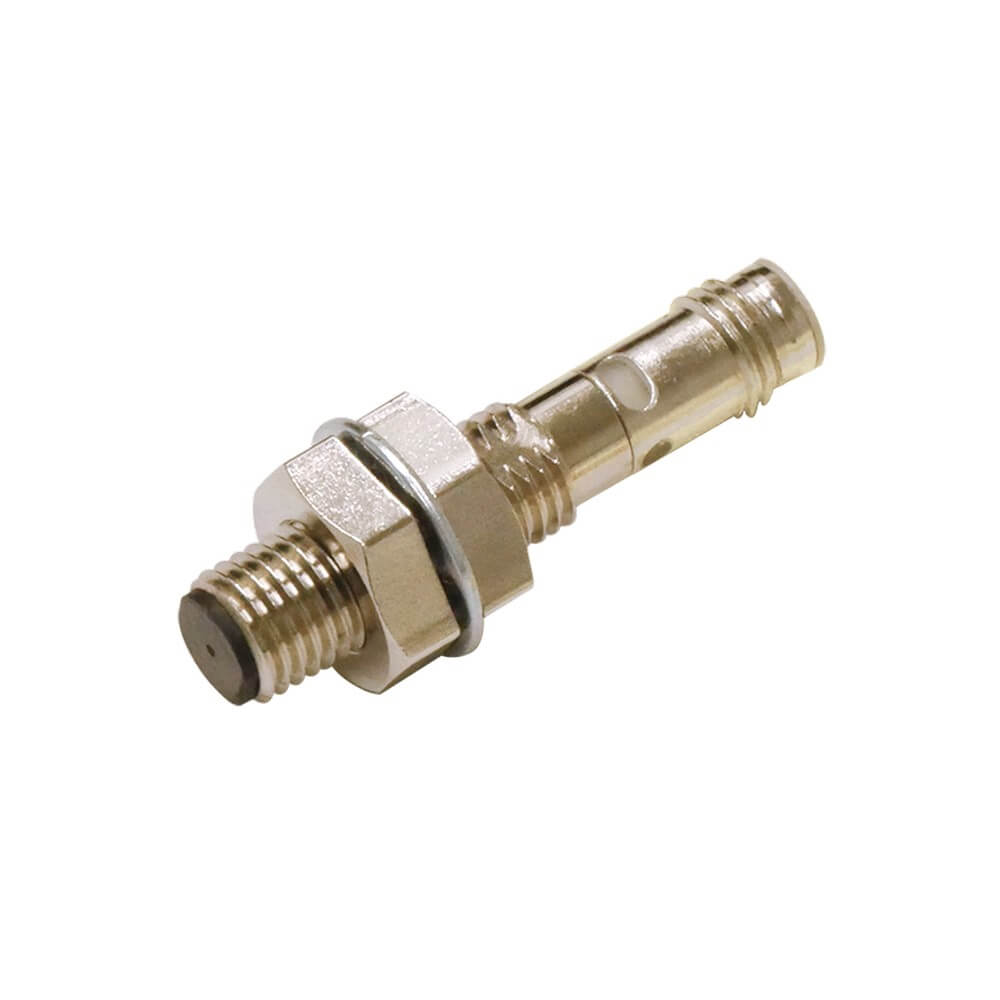
Omron E2E-X2C18-M3 Inductive Proximity Sensor
| Feature | Value |
|---|---|
| Sensor Type | Inductive Proximity Sensor |
| Series | E2E NEXT |
| Sensing Distance | 2 mm |
| Mounting Type | Flush Shielded |
| Housing Size | M8 Threaded |
| Output Type | NPN Open Collector |
| Output Configuration | Normally Open (NO) |
| Supply Voltage | 10 to 30 VDC |
| Response Frequency | 1500 Hz |
| Current Consumption | ≤16 mA |
| Connection Method | M8 4-Pin Connector |
| Operating Temperature | -40°C to +85°C |
| Protection Rating | IP67 / IP69K |
| Housing Material | Stainless Steel (SUS303) |
| Overall Length | 39 mm |
The Omron E2E-X2C18-M3 Inductive Proximity Sensor is a compact cylindrical sensing device designed for reliable detection of ferrous metal targets in industrial automation systems. Built within the E2E NEXT sensor family, this model combines a shielded sensing structure, stainless steel housing, and high environmental protection ratings for use in demanding operating conditions.
Technical Description
The Omron E2E-X2C18-M3 Inductive Proximity Sensor utilizes electromagnetic induction to detect metallic objects without physical contact. The sensor features an M8 threaded stainless steel body and a flush mounting design, allowing installation in space-constrained machinery and equipment.
The sensing distance is specified at 2 mm for standard ferrous targets. The NPN normally open output is compatible with a wide range of PLCs, machine controllers, and industrial I/O systems. The sensor incorporates multiple protection functions including power polarity protection, output reverse connection protection, short-circuit protection, and surge suppression.
The Omron E2E-X2C18-M3 Inductive Proximity Sensor is engineered to maintain stable operation across a broad temperature range from -40°C to +85°C, making it suitable for both indoor and outdoor industrial environments.
Operating Principle
The sensor generates a high-frequency electromagnetic field from its sensing face. When a conductive metal object enters this field, eddy currents are induced within the target material. These currents absorb energy from the oscillator circuit, causing a measurable change in oscillation amplitude.
The internal detection circuitry continuously monitors this variation and activates the NPN output when the target reaches the specified sensing range. Because detection occurs without mechanical contact, wear-related failures are minimized and long-term operational stability is improved.
Applications and Installation Areas
This sensor is commonly integrated into automated systems where precise metal object detection is required. Its compact dimensions allow installation in locations where larger sensors cannot be accommodated.
- Position detection in assembly equipment
- Metal component presence verification
- Conveyor system monitoring
- Machine tool positioning systems
- Automated packaging machinery
- Transfer and indexing mechanisms
- Robotic handling stations
- Industrial sorting equipment
Engineers frequently select the Omron E2E-X2C18-M3 Inductive Proximity Sensor when designing compact automation cells requiring high switching frequencies and reliable sensing performance.
Industrial Applications
Automotive Manufacturing
Used for detecting stamped metal parts, fixture positioning, and monitoring component transfer systems on automated production lines.
Packaging Industry
Installed in packaging equipment to verify metallic machine elements and monitor actuator positions during high-speed operations.
Material Handling Systems
Supports conveyor automation by confirming the position of metallic carriers, pallets, and transfer mechanisms.
Machine Building
Integrated into custom machinery for limit detection, indexing verification, and process sequencing.
Advantages
- Compact M8 threaded housing
- Flush shielded sensing design
- High switching frequency of 1500 Hz
- Wide operating temperature range
- IP67 and IP69K environmental protection
- Stainless steel housing construction
- Integrated electrical protection functions
- Non-contact detection principle
Industry-Specific Usage Examples
In automotive assembly facilities, the sensor can verify the presence of steel brackets before robotic fastening operations begin.
Within automated warehousing systems, it may be used to detect metallic carrier positions during transfer between conveyor zones.
For CNC machine manufacturers, the sensor can monitor moving mechanical components and provide position feedback to machine controllers.
Food processing equipment builders often use protected inductive sensors such as the Omron E2E-X2C18-M3 Inductive Proximity Sensor because the IP69K rating supports washdown environments.
Factors to Consider When Selecting This Sensor
- Target material should be ferrous metal for rated sensing performance.
- The maximum sensing distance is 2 mm.
- Control systems must support NPN input configurations.
- Connector compatibility should be verified during installation.
- Required switching frequency should be evaluated against application speed.
- Available mounting space should accommodate the M8 threaded body.
Additional information about Omron sensor products can be useful when comparing sensor technologies for different automation projects.
Omron E2E-X2C18-M3 Frequently Asked Questions
What type of sensor is the Omron E2E-X2C18-M3 Inductive Proximity Sensor?
It is a shielded inductive proximity sensor designed for non-contact detection of metallic objects.
What is the sensing distance?
The rated sensing distance is 2 mm for standard ferrous targets.
Which output configuration does it use?
The sensor provides an NPN open collector, normally open output.
What supply voltage is required?
The operating voltage range is 10 to 30 VDC.
Can it operate in harsh industrial environments?
Yes. The device carries IP67 and IP69K protection ratings and uses a stainless steel housing.
What materials can be detected?
Ferrous metals are detected at the rated distance. Non-ferrous metals may be detected at reduced distances.
What is the response frequency?
The maximum response frequency is 1500 Hz, making it suitable for fast-moving automation processes.
Where is this sensor commonly used?
Typical applications include assembly machinery, packaging systems, conveyors, robotics, and machine-building projects.