
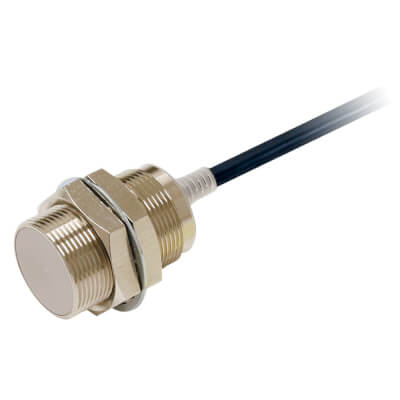
| Feature | Value |
|---|---|
| Sensor Type | Inductive Proximity Sensor |
| Series | E2E NEXT |
| Housing Size | M30 |
| Mounting Type | Quasi-Flush |
| Sensing Distance | 15 mm |
| Output Type | NPN |
| Operation Mode | Normally Open |
| Connection Method | 2 m Cable |
| Supply Voltage | 10 to 30 VDC |
| Response Frequency | 250 Hz |
| Housing Material | Nickel-Plated Brass |
| Protection Rating | IP67, IP67G, IP69K |
| Operating Temperature | -40°C to +85°C |
| Overall Length | 82.3 mm |
Omron E2E-X15B3D30 2M Inductive Proximity Sensor
Technical Description
The Omron E2E-X15B3D30 2M Inductive Proximity Sensor is designed for reliable non-contact detection of metallic objects in industrial automation systems. As part of the E2E NEXT family, this sensor combines a 15 mm sensing distance with a robust M30 cylindrical housing, making it suitable for machinery that requires stable position monitoring and object detection.
This version features an NPN normally open output and is supplied with a 2-meter oil-resistant cable. The sensor housing is manufactured from nickel-plated brass, providing mechanical durability for installation in manufacturing equipment, transport systems and processing machinery. The Omron E2E-X15B3D30 2M Inductive Proximity Sensor is engineered to maintain dependable operation even in environments exposed to dust, moisture and industrial cleaning procedures.
Operating Principle
The sensor generates an electromagnetic field from the active sensing surface. When a metallic object enters the sensing zone, eddy currents are induced within the target material. These currents influence the oscillation characteristics of the sensor’s internal circuit.
The electronic circuitry continuously evaluates these changes and activates the output when the sensing threshold is reached. Because there is no physical contact between the sensor and the detected object, the sensing process minimizes mechanical wear and supports long-term operational stability.
In a normally open configuration, the output changes state when a valid target enters the detection range.
Main Features
- 15 mm sensing distance
- M30 cylindrical threaded housing
- NPN normally open output
- 2 m oil-resistant cable connection
- Quasi-flush mounting structure
- Nickel-plated brass housing
- Wide operating temperature range
- IP67, IP67G and IP69K environmental protection
- Suitable for industrial automation systems
Usage Areas
The sensor can be integrated into numerous industrial applications that require reliable metallic object detection and position feedback.
- Automated assembly equipment
- Conveyor systems
- Packaging machinery
- Transfer stations
- Industrial handling equipment
- Machine tool systems
- Pallet positioning applications
- Metal component detection processes
The sensing capability allows equipment controllers to verify the presence or location of metallic machine elements before initiating process movements or machine cycles.
Industrial Applications
In automotive manufacturing facilities, the sensor may be used to detect fixture locations, workpiece carriers and metallic positioning elements. In packaging equipment, it can monitor machine positions during indexing, feeding and transfer operations.
Metal processing facilities often use sensors of this type to verify workpiece positioning, machine movements and transfer sequences. In logistics systems, the sensor can provide position feedback for conveyor stops, lift mechanisms and transport structures.
The Omron E2E-X15B3D30 2M Inductive Proximity Sensor is also suitable for machine builders seeking a compact and durable solution for metallic object detection in demanding operating environments.
Advantages
- Non-contact sensing reduces wear-related failures
- Stable metallic target detection
- Durable industrial housing construction
- Suitable for harsh operating environments
- Resistance to dust, water and washdown conditions
- Oil-resistant cable design
- Reliable operation across a broad temperature range
- Compatible with many industrial control systems using NPN inputs
Sector-Specific Use Examples
Automotive Industry
Used to monitor metallic fixtures and confirm part positioning before robotic assembly operations begin.
Packaging Equipment
Supports machine synchronization by detecting metal indexing components and moving assemblies.
Material Handling Systems
Provides position confirmation for pallet transport systems, conveyors and transfer devices.
Metal Fabrication Facilities
Helps verify workpiece locations and supports automated movement sequences within production equipment.
Selection Considerations
Before selecting an inductive sensor, engineers should verify the target material, sensing distance requirements, available installation space and electrical interface compatibility. This model uses an NPN normally open output, which should match the input requirements of the connected controller.
Environmental conditions should also be considered. Exposure to coolant, moisture, cleaning chemicals and vibration can influence installation requirements. Proper cable routing and mounting practices help maximize sensor performance.
For additional sensing solutions and related product families, engineers may review Omron sensor products when comparing alternative sensing distances, outputs and housing configurations.
The Omron E2E-X15B3D30 2M Inductive Proximity Sensor offers a practical solution for metallic target detection where robust construction and stable operation are required.
Frequently Asked Questions
What type of targets can this sensor detect?
The sensor is designed for detecting metallic objects using inductive sensing technology.
What is the rated sensing distance?
The rated sensing distance is 15 mm.
What output configuration does this model use?
This model uses an NPN normally open output.
What supply voltage is required?
The sensor operates from 10 to 30 VDC.
Is the sensor suitable for washdown environments?
Yes. It carries IP67, IP67G and IP69K protection ratings when installed correctly.
What cable length is supplied?
The sensor includes a 2-meter oil-resistant cable.
What housing material is used?
The housing is constructed from nickel-plated brass.
Which industries commonly use this sensor?
Automotive, packaging, logistics, machine building and metal processing industries commonly use this type of sensor.
Does the sensor require contact with the target?
No. Detection occurs through an electromagnetic field without physical contact.
What should be checked before installation?
Target material, mounting clearances, electrical compatibility and environmental conditions should all be verified before installation.