
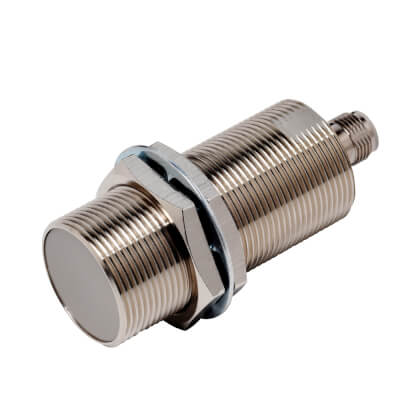
| Feature | Value |
|---|---|
| Sensor Type | Inductive Proximity Sensor |
| Series | E2E NEXT |
| Housing Size | M30 |
| Mounting Type | Quasi-Flush |
| Sensing Distance | 15 mm |
| Output Type | PNP |
| Operation Mode | Normally Closed |
| Connection Type | M12 Connector |
| Supply Voltage | 10 to 30 VDC |
| Response Frequency | 250 Hz |
| Housing Material | Nickel-Plated Brass |
| Protection Rating | IP67, IP67G, IP69K |
| Operating Temperature | -40°C to +85°C |
| Overall Length | 77 mm |
Omron E2E-X15B2L30-M1 Inductive Proximity Sensor
Technical Description
The Omron E2E-X15B2L30-M1 Inductive Proximity Sensor is a cylindrical M30 sensor designed for non-contact detection of metallic objects in industrial automation systems. As part of the E2E NEXT product family, this model combines a 15 mm sensing range with a connector-based wiring approach, making it suitable for installations where quick replacement and simplified maintenance are important considerations.
Unlike permanently wired cable models, this version uses an M12 connector interface, allowing the sensor to be integrated into modular machine architectures. The robust nickel-plated brass housing provides mechanical protection, while the environmental sealing supports operation in demanding production environments.
The Omron E2E-X15B2L30-M1 Inductive Proximity Sensor is commonly used for monitoring metallic machine elements, transfer mechanisms, fixtures and positioning components in automated manufacturing equipment.
Operating Principle
The sensor generates an electromagnetic field at the active sensing face. When a conductive metallic target enters the sensing zone, induced eddy currents modify the characteristics of the oscillating field. The internal electronic circuitry detects this change and switches the output state accordingly.
This detection method eliminates mechanical contact between the sensor and the target. As a result, wear-related failures associated with physical switches can be minimized, helping maintain stable operation over extended periods.
The normally closed output configuration provides a predefined output state during standard operation and changes state when the target is detected.
Main Features
- 15 mm sensing distance
- M30 threaded housing
- PNP normally closed output
- M12 connector connection
- Quasi-flush mounting design
- Nickel-plated brass housing construction
- Wide operating temperature range
- IP67, IP67G and IP69K environmental protection
- Suitable for industrial automation applications
Usage Areas
The sensor is suitable for industrial environments where reliable metal detection and easy maintenance are required. The connectorized design can reduce downtime during replacement procedures because the wiring does not need to be reinstalled.
- Automated assembly lines
- Conveyor transport systems
- Packaging equipment
- Machine tool automation
- Transfer units
- Pallet handling systems
- Metal processing machinery
- Position monitoring applications
Industrial Applications
In automated assembly systems, the sensor can verify whether a metallic fixture has reached the correct position before the next process step begins. In transfer equipment, it may be used to detect carrier movement and confirm positioning accuracy.
Machine builders frequently use connectorized sensors when maintenance accessibility is a priority. The M12 connection simplifies replacement procedures and supports standardized wiring concepts throughout the machine.
The Omron E2E-X15B2L30-M1 Inductive Proximity Sensor can also be integrated into modular production systems where sensors may need periodic replacement without interrupting large sections of the installation.
Advantages
- Non-contact operation reduces mechanical wear
- M12 connector supports faster sensor replacement
- Stable detection of metallic targets
- High resistance to industrial contaminants
- Suitable for harsh environmental conditions
- Strong mechanical construction
- Compatible with many industrial control architectures
- Reliable operation across a wide temperature range
Sector-Specific Use Examples
Automotive Production
Used for monitoring welding fixtures, tooling positions and transport carriers throughout automated production cells.
Packaging Machinery
Provides position feedback for metallic machine components used in indexing, feeding and transfer mechanisms.
Metal Fabrication
Supports workpiece positioning and machine sequence verification during fabrication processes.
Logistics Automation
Used in conveyor-based systems to monitor the position of metallic stops, lift mechanisms and transport structures.
Omron E2E-X15B2L30-M1 Important Selection Considerations
When selecting an inductive proximity sensor, engineers should evaluate target material properties, available mounting space, required sensing distance and environmental exposure. The M30 housing requires sufficient installation space, while the quasi-flush mounting configuration should be considered during mechanical design.
The M12 connector interface can simplify installation and maintenance, particularly in machines where sensor replacement may occur during scheduled service intervals.
Additional information about Omron sensor products may assist engineers when comparing sensing ranges, output configurations and housing sizes within the Omron portfolio.
Omron E2E-X15B2L30-M1 Frequently Asked Questions
What type of sensor is the E2E-X15B2L30-M1?
It is an inductive proximity sensor designed for non-contact detection of metallic objects.
What is the rated sensing distance?
The sensor provides a rated sensing distance of 15 mm.
What output configuration does it use?
It features a PNP normally closed output.
What connection method is used?
The sensor uses an M12 connector rather than a permanently attached cable.
Why choose a connector version?
Connectorized sensors can simplify installation, maintenance and replacement procedures.
Can it operate in washdown environments?
The sensor carries IP67, IP67G and IP69K ratings, supporting operation in demanding industrial environments when installed correctly.
What housing material is used?
The housing is manufactured from nickel-plated brass for mechanical durability.
Which industries commonly use this sensor?
Automotive, packaging, logistics, machine building and metal processing industries commonly use this type of sensor.
Does the sensor require contact with the target?
No. Detection is performed through electromagnetic field interaction.
What should be verified before installation?
Engineers should confirm mounting clearances, target material suitability, electrical compatibility and environmental requirements.