
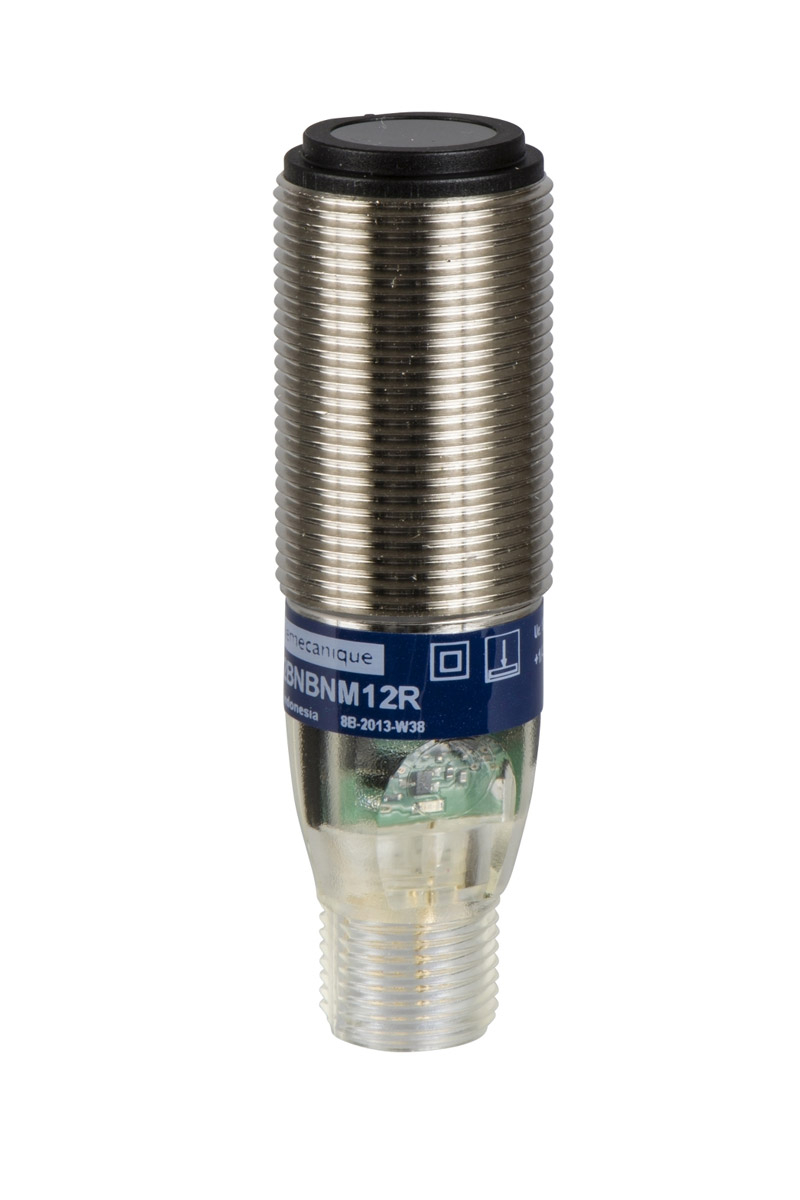
Telemecanique XUB2BKSNM12T Photoelectric Sensor: Technical Overview
The Telemecanique XUB2BKSNM12T photoelectric sensor is an M18 cylindrical photoelectric transmitter developed for thru-beam detection applications. It belongs to the Telemecanique XU sensor family and is intended for industrial automation systems that require accurate object detection across a defined optical path.
General Product Description
This model operates as a transmitter in a thru-beam photoelectric sensing pair. The transmitter sends a beam toward a separate receiver. When an object interrupts the beam, the receiver detects the change. This sensing principle is widely used because it offers dependable performance even when the target object has a difficult surface, irregular shape, dark color, or inconsistent reflectivity.
The XUB2BKSNM12T is built in a cylindrical M18 format, which is one of the most common sensor body styles in industrial automation. Its M12 connector is a major advantage for maintenance teams because it supports faster replacement and cleaner wiring compared with permanent cable-only installations.
Technical Features
The Telemecanique XUB2BKSNM12T is associated with thru-beam optical technology, cylindrical barrel construction, DC operation, and M12 connector wiring. The sensor is suitable for environments where a compact transmitter must be mounted securely on a machine frame or conveyor structure. Its operating temperature range is commonly listed from -25°C to +55°C, making it suitable for many indoor industrial environments.
The M12 connection format also reduces wiring complexity. In many automation systems, M12 connectors are preferred because they support modular maintenance. If a sensor needs replacement, technicians can disconnect and reconnect the unit without rewiring the control panel.
Application Areas
The Telemecanique XUB2BKSNM12T photoelectric sensor is suitable for object detection, passage confirmation, product flow monitoring, counting, and process triggering. It can be used in packaging lines, conveyor systems, sorting equipment, assembly machines, and automated handling systems.
Because it is a transmitter, it should be paired with a compatible receiver. Together, the sensing pair creates a beam path across the monitored zone. This makes the model especially useful in applications where the object may pass quickly or where detection must remain consistent across different product types.
Practical Installation Guidance
During installation, the transmitter and receiver must be aligned accurately. Poor alignment may reduce detection reliability, especially across longer distances. The mounting structure should be stable and resistant to vibration. It is also recommended to keep the lens area clean and free from dust, oil, condensation, or packaging residue.
The sensor should be wired according to the official connection diagram and used within its specified electrical limits. In control systems with electrical noise, proper cable routing and separation from high-power wiring can help preserve signal reliability.
For related product references, visit Telemecanique.
Telemecanique XUB2BKSNM12T Frequently Asked Questions
What is the Telemecanique XUB2BKSNM12T used for?
It is used as a photoelectric transmitter in thru-beam sensing systems for industrial object detection, counting, positioning, and process monitoring.
Does the XUB2BKSNM12T work alone?
No. As a transmitter, it requires a compatible receiver to create a complete thru-beam detection system.
Why is the M12 connector useful?
The M12 connector makes installation and replacement easier. It allows technicians to disconnect the sensor quickly without cutting or rewiring cables.
What type of housing does this sensor use?
It uses a cylindrical M18 barrel design, a common industrial format that fits standard brackets and compact machine layouts.
Is thru-beam detection reliable for dark or shiny objects?
Yes. Since thru-beam sensing detects interruption of a light beam rather than reflection from the object, it can be more reliable for difficult surfaces than diffuse sensing methods.