
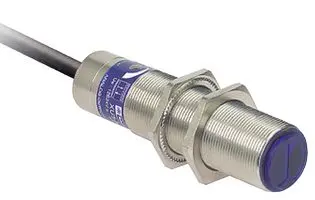
Telemecanique XU8M18MB230 Photoelectric Sensor: Technical Overview and FAQ
The Telemecanique XU8M18MB230 photoelectric sensor is a compact M18 industrial sensor designed for accurate short-range detection in automation environments. It belongs to the Telemecanique XU photoelectric sensor series and is intended for applications where reliable object detection is needed close to a machine surface, conveyor structure, or fixed background.
This sensor uses background suppression detection. Unlike a basic diffuse sensor, a background suppression sensor is designed to detect an object within a specified sensing distance while reducing the chance of responding to surfaces behind it. This makes the XU8M18MB230 useful in machines where the background cannot easily be removed or covered.
Technical Profile
The XU8M18MB230 features a cylindrical M18 metal housing, a nominal sensing distance of 0.12 m, and an AC/DC supply range of 24 to 240 V. It uses a 2-wire electrical connection and provides a 1 NC discrete output function.
The normally closed output can be useful in control architectures where the system expects circuit continuity during the default condition. The metal M18 body supports stable mechanical mounting, while the cable format helps simplify permanent machine installation.
Best-Fit Applications
The Telemecanique XU8M18MB230 photoelectric sensor is commonly selected for short-range part detection, package presence monitoring, object positioning, and machine sequence confirmation. It is especially useful where the target passes in front of a wall, guide rail, metal frame, or conveyor structure.
Common applications include packaging lines, indexing tables, compact conveyors, automated assembly systems, feeder equipment, and production cells where unwanted background reflection could disturb the detection signal.
How Background Suppression Helps
Background suppression can improve sensing consistency when the environment includes fixed objects behind the detection point. For example, a sensor may need to identify a product passing 80 mm away while ignoring a reflective bracket located farther back. A BGS sensor is designed for this type of separation.
This does not mean installation can be ignored. Proper aiming, target testing, and distance setup are still important. The best results are achieved when the sensor is positioned so the target enters the active sensing zone clearly and repeatedly.
Installation Recommendations
The sensor should be mounted firmly using a suitable M18 bracket or threaded hole. Avoid placing it where vibration can shift alignment. Keep the sensing lens clean, especially in dusty, oily, or high-particulate environments. During commissioning, test the actual target object under normal machine lighting and operating conditions.
Electrical wiring should follow the official 2-wire AC/DC connection scheme. The load must be suitable for the sensor output, and circuit protection should be checked before operation.
Engineering Value
The XU8M18MB230 is a practical choice when a compact M18 background suppression sensor with normally closed output is required. Its 120 mm sensing distance, wide AC/DC supply range, and industrial housing make it suitable for precise close-range detection where a simple sensor layout is preferred.
Telemecanique XU8M18MB230 For additional product context, visit Telemecanique sensor information.
Telemecanique XU8M18MB230 FAQ
What is the Telemecanique XU8M18MB230?
It is an M18 cylindrical photoelectric sensor with background suppression detection for close-range industrial sensing.
What is the sensing distance?
The nominal sensing distance is 0.12 m, or 120 mm.
What output function does it have?
The sensor provides a 1 NC discrete output function.
What does normally closed mean?
Normally closed means the output is designed around closed-circuit logic in its default switching condition, depending on the detection state and wiring configuration.
Does it require a reflector?
No. It is a background suppression photoelectric sensor and does not require a separate reflector.
When should this model be used instead of a diffuse sensor?
It should be considered when the detection point has a nearby background that could cause false triggering with a standard diffuse sensor.
Can it detect every material equally?
No sensor detects all materials exactly the same way. Color, gloss, surface angle, and object size can influence sensing behavior.
Is it suitable for compact machines?
Yes. The M18 cylindrical design and short sensing distance make it suitable for compact automation equipment and localized detection points.