
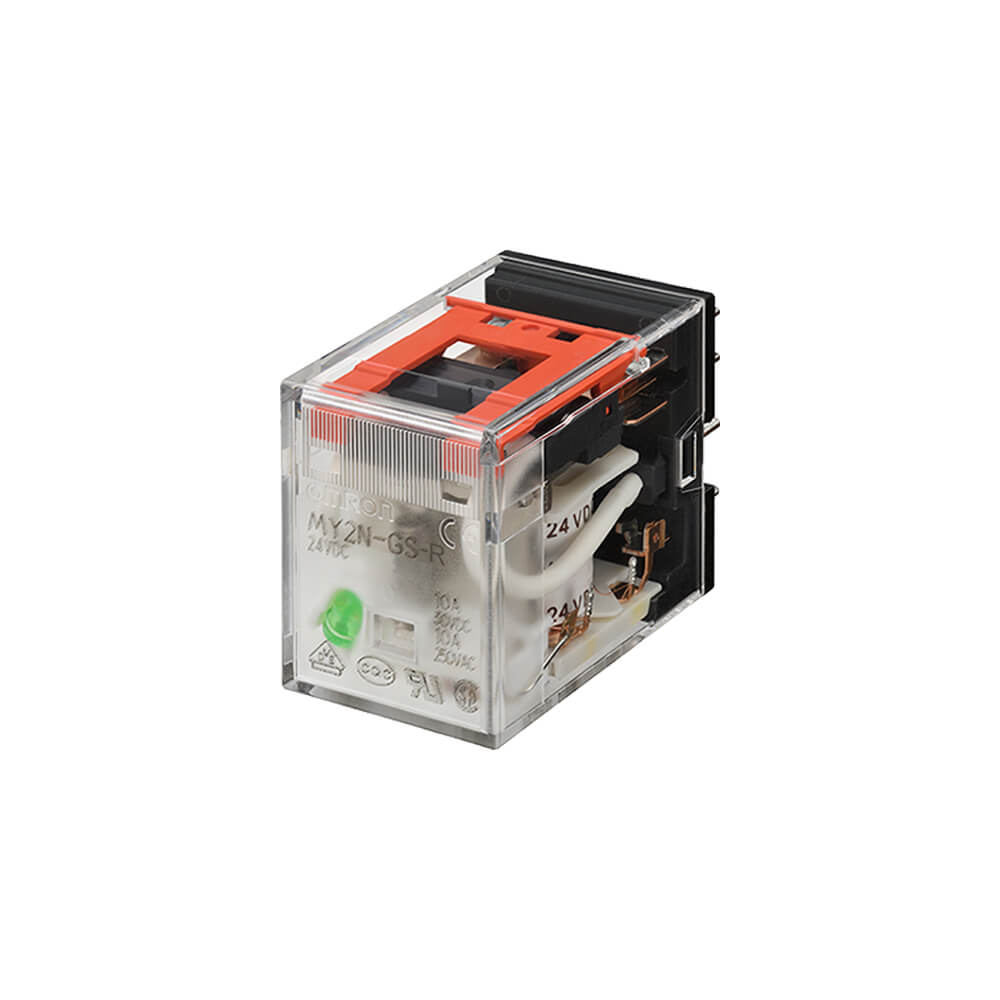
Omron MY2N 100/110VDC Plug-in Relay Technical Guide
The Omron MY2N 100/110VDC Plug-in Relay is a miniature power relay from Omron’s MY series, designed for industrial control panels, sequence control, power switching, and automation applications. It is used when a higher DC coil voltage is required and where dependable DPDT switching is needed in a socket-mounted format.
Omron identifies the MY2N DC100/110 as a miniature power relay with a 2-pole single contact structure, plug-in terminals, an operation indicator, and a 100/110VDC coil. Its contact form is DPDT, the contact method is single contact, the contact material is silver, and performance data includes 50 milliohms maximum contact resistance, 20 ms maximum operating time, and 20 ms maximum reset time. :contentReference[oaicite:2]{index=2}
For more information about Omron products, visit Omron industrial automation solutions.
Key Technical Specifications
- Manufacturer: Omron
- Model: MY2N 100/110VDC (S)
- Product Type: Plug-in Relay
- Relay Series: MY
- Coil Voltage: 100/110VDC
- Contact Form: DPDT
- Contact Method: Single contact
- Contact Material: Silver
- Terminal Structure: Plug-in terminal
- Operation Indicator: Included
- Contact Resistance: 50 milliohms maximum
- Operating Time: 20 ms maximum
- Reset Time: 20 ms maximum
- Mounting Style: Socket mount
Application Areas
The Omron MY2N 100/110VDC Plug-in Relay is often used in industrial systems where 100VDC or 110VDC control power is already available. Such systems may include power distribution panels, control cabinets, railway-related auxiliary circuits, industrial process equipment, older automation installations, and plant modernization projects.
Because it uses a plug-in terminal structure, the relay is practical for systems that require regular inspection, replacement, or panel-level troubleshooting. Maintenance teams can remove and replace the relay without rebuilding the wiring circuit.
DPDT Switching Function
The DPDT contact arrangement gives this relay two independent changeover contacts. That structure is useful in control logic where one coil action must switch two circuits at the same time. For example, one contact may drive an output signal while the other provides feedback, alarm logic, or an auxiliary interlock.
This flexibility makes the relay suitable for sequence control, signal routing, status conversion, and load isolation in industrial panels.
Why Use a 100/110VDC Relay?
Higher DC control voltages are commonly found in certain industrial, energy, transport, and legacy automation environments. A 100/110VDC relay allows direct integration into these systems without adding unnecessary voltage conversion stages.
This can simplify cabinet design and improve long-term maintainability, especially where the facility already standardizes on 100VDC or 110VDC control supply architecture.
Operation Indicator and Maintenance Value
The built-in operation indicator improves visibility inside control cabinets. When a fault occurs, technicians can quickly determine whether the relay coil is being energized. This reduces diagnostic time and helps separate input-side problems from contact-side or load-side problems.
The relay’s socket-mounted design also supports spare part replacement strategies. Facilities can keep compatible units available and restore operation quickly during service windows.
Omron MY2N 100/110VDC Electrical and Environmental Considerations
Before installation, engineers should verify the coil voltage, contact rating, socket type, load category, and wiring arrangement. DC switching requires careful attention because arcs may behave differently than in AC circuits. Inductive loads such as solenoids, brake coils, contactors, and DC motors may require suitable suppression devices.
The relay should be installed in an enclosure that protects it from moisture, conductive contamination, chemical vapors, and mechanical shock. Proper spacing, clean wiring, and secure socket retention all support reliable long-term operation.
Frequently Asked Questions
What is the Omron MY2N 100/110VDC Plug-in Relay used for?
It is used for industrial switching, sequence control, signal isolation, auxiliary control logic, and power switching tasks in systems using 100VDC or 110VDC control power.
Does this relay have DPDT contacts?
Yes. The relay has a DPDT contact form, allowing two independent changeover circuits to be switched by one coil.
Is the relay suitable for socket mounting?
Yes. The plug-in terminal structure is designed for compatible relay sockets, making installation and replacement easier in control panels.
What is the benefit of the operation indicator?
The operation indicator helps technicians confirm coil energization visually. This is valuable during commissioning, preventive maintenance, and troubleshooting.
Can this relay be used in older industrial systems?
Yes. Many industrial and legacy control systems use 100VDC or 110VDC control supplies, making this relay relevant for maintenance and modernization projects.
Omron MY2N 100/110VDC What does 20 ms operating time mean?
It means the relay is designed to operate within a maximum of 20 milliseconds after rated operating power is applied, excluding contact bounce conditions.
What should be checked before installation?
Engineers should verify coil voltage, socket compatibility, contact current rating, switching voltage, load type, wiring layout, and enclosure conditions before installation.
Can it switch inductive loads?
It can be used with inductive loads within the rated limits, but additional suppression may be required to reduce arcing, noise, and contact stress.
Why is contact material important?
Silver contact material supports dependable conductivity and switching performance in many industrial relay applications.
Conclusion
The Omron MY2N 100/110VDC Plug-in Relay is a dependable miniature power relay for control systems requiring higher DC coil voltage, DPDT switching, operation indication, and socket-based maintenance. Its practical construction and proven MY series platform make it suitable for automation panels, sequence control, and industrial service applications.