
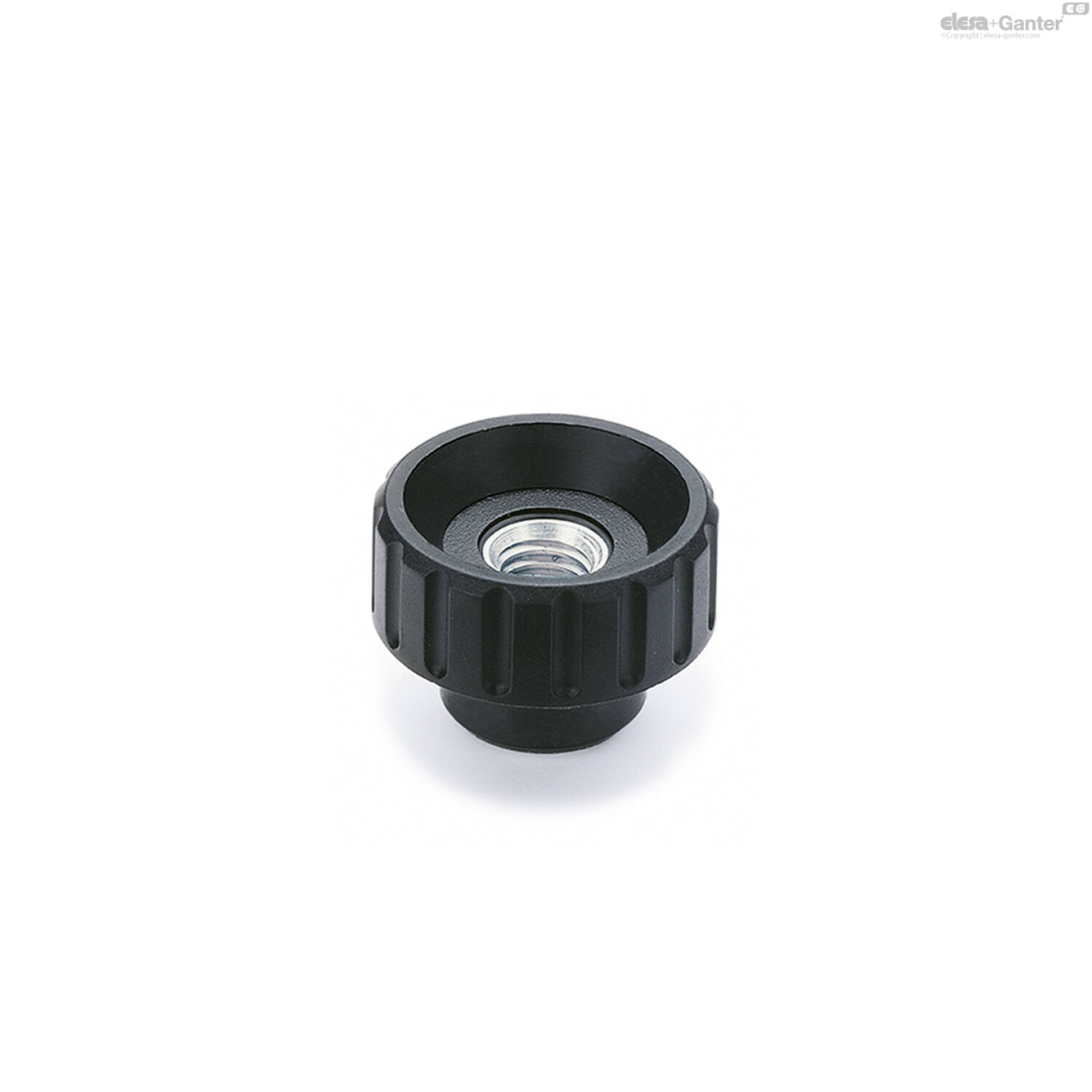
Elesa+Ganter BT.25-SST-FP-M6 Fluted Knob Overview
The Elesa+Ganter BT.25-SST-FP-M6 fluted knob is a manually operated industrial knob designed with a stainless steel pass-through threaded boss. This construction makes it especially useful where a through-thread configuration supports mounting flexibility, repeatable adjustment, or assembly layouts that need full thread passage rather than a blind connection.
What Defines the BT.25-SST-FP-M6
Within the BT product family, BT-SST-FP identifies the stainless steel pass-through threaded execution. The official BT series documentation specifies a black polyamide-based technopolymer body with matte finish and an AISI 303 stainless steel threaded pass-through hole. For this exact code, the catalog lists a 26 mm knob diameter, M6 thread, 19 mm overall height, 16 mm upper diameter, 15 mm lower diameter, 7 mm dimensional value, 8 mm reference, 14 mm depth figure, and 9 mm final value in the table row.
Elesa+Ganter BT.25-SST-FP-M6 Key Technical Characteristics
- Brand: Elesa+Ganter
- Code: BT.25-SST-FP-M6
- Product type: Fluted knob with pass-through threaded hole
- Knob diameter: 26 mm
- Thread: M6 pass-through
- Body material: PA-based technopolymer
- Boss material: AISI 303 stainless steel
- Finish: Black matte
- Series temperature reference: -30°C to +130°C
Why a Pass-Through Thread Can Be Valuable
The Elesa+Ganter BT.25-SST-FP-M6 fluted knob is useful in designs where the threaded element must travel through the knob insert instead of stopping at a blind base. This can support longer screw engagement, variable assembly thickness, or mounting concepts where a continuous threaded path gives the engineer more freedom in selecting mating hardware.
Compared with a blind threaded knob, the pass-through structure can be advantageous in adjustable brackets, modular frames, inspection lids, machine guards, or fixture systems where the screw length may vary between installations. It also supports easier adaptation during servicing or redesign work because the same knob can work with different fastening depths.
Typical Use Cases in Equipment Design
This model fits well in industrial enclosures, machine access panels, modular tooling, OEM structures, and process equipment where repeated manual loosening and retightening are part of routine operation. The 26 mm fluted body provides a stable hand feel, while the stainless insert helps maintain durability in environments where moisture or regular cleaning affects component selection.
Elesa+Ganter BT.25-SST-FP-M6 For more information about Elesa+Ganter, reviewing related operating elements can help standardize manual hardware across the full machine platform.
Elesa+Ganter BT.25-SST-FP-M6 FAQ
What does the FP designation mean in this knob?
In the BT series, FP identifies a pass-through threaded hole. That means the threaded opening runs through the insert instead of stopping as a blind thread. This can be very useful when the mating screw length is not fixed or when the assembly needs continuous threaded passage.
How is this different from BT.25-SST-M6?
BT.25-SST-M6 has a blind threaded stainless boss, while BT.25-SST-FP-M6 has a pass-through threaded stainless boss. The choice depends on how the mating screw or threaded shaft is intended to interact with the knob inside the final assembly.
Why is AISI 303 stainless steel used here?
AISI 303 is commonly selected for machined industrial inserts because it provides practical corrosion resistance and dependable performance in many machine-building environments. In this knob, it supports durability in the threaded region where wear and environmental exposure matter most.
Is this a compact or large manual knob?
It is generally considered compact to mid-size. With a 26 mm diameter, it offers more grip than a very small knob while still fitting comfortably into dense machine layouts and equipment panels.
Where is a pass-through threaded knob especially helpful?
It is especially helpful in adjustable systems, maintenance-access points, modular assemblies, and projects where screw length or stack thickness can vary. The through-thread format adds flexibility that many engineers value during both original design and later field service.