
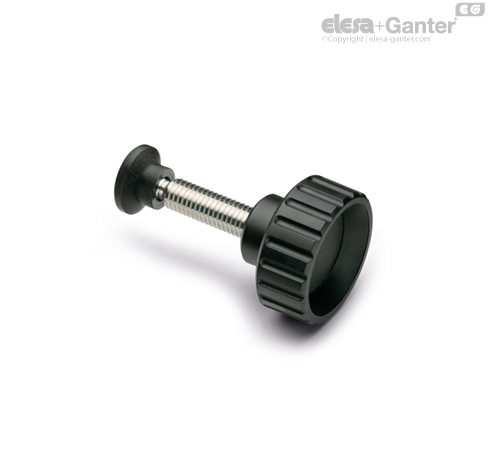
Elsa+Ganter BT.25-SST-P-M6X25-SV15 Fluted Knob Explained
The Elesa+Ganter BT.25-SST-P-M6X25-SV15 fluted knob is built for manual locking tasks where surface protection is just as important as fastening performance. Unlike a basic stud knob, this version includes a locking thrust pad that helps prevent direct contact between the threaded stud and the clamped surface. That detail makes it especially useful in applications where finish quality, repeated adjustment, or sensitive contact points matter.
Product Type and Function
This model is a fluted knob with locking thrust pad. The fluted outer profile provides grip during manual tightening, while the thrust pad distributes contact more carefully at the clamping point. In practical terms, that means it can help reduce marking, indentation, or concentrated stress on the surface being secured.
Elesa+Ganter BT.25-SST-P-M6X25-SV15 Verified Technical Features
The knob body is made from polyamide-based technopolymer in a matte black finish. The threaded stud is AISI 303 stainless steel with a spherical end, and the thrust pad is made from POM-based technopolymer. For this exact version, the knob diameter is 26 mm, the thread is M6, the stud length is 25 mm, and the thrust pad size is SV15. These dimensions make it a compact choice for controlled manual locking in tighter spaces.
Elesa+Ganter BT.25-SST-P-M6X25-SV15 Why the Locking Thrust Pad Matters
In many machines, fixtures, and covers, direct metal-to-surface contact is not ideal. A thrust pad can improve contact behaviour by creating a more forgiving interface. That makes the Elsa+Ganter BT.25-SST-P-M6X25-SV15 fluted knob relevant for assemblies that involve painted panels, light machine frames, adjustable stops, sliding guides, or parts that are repositioned regularly.
Elesa+Ganter BT.25-SST-P-M6X25-SV15 Typical Application Areas
This kind of fluted knob is commonly selected for positioning systems, enclosures, jigs, inspection setups, and compact machine modules. It also suits situations where an operator needs a small hand knob that feels secure without being oversized. Because the threaded element is stainless steel, the part also supports use in environments where corrosion resistance is a planning priority.
Elesa+Ganter BT.25-SST-P-M6X25-SV15 Design Advantages for Daily Operation
The balance of compact diameter and functional grip is one of the more useful aspects of this model. The fluted form supports confident finger control, while the stud-and-pad configuration helps maintain a cleaner contact point. For equipment builders, this can simplify component selection when a standard hand knob must do more than simply tighten.
Elesa+Ganter BT.25-SST-P-M6X25-SV15 Learn More About the Product Family
When selecting standard components, it helps to compare stud length, thread size, and pad diameter together rather than looking at only one value. For more information about Elesa+Ganter, you can review the broader range of machine elements and clamping components built for industrial use.
Elesa+Ganter BT.25-SST-P-M6X25-SV15 FAQ
What is the benefit of a locking thrust pad?
The locking thrust pad reduces the chance of the threaded stud pressing directly into the contact surface. This can help protect the clamped part, improve force distribution, and support cleaner repeated adjustment.
What does SV15 mean in this code?
SV15 identifies the thrust pad size used on this version. It is an important part of the specification because it affects how the knob interfaces with the surface being locked.
Is the BT.25-SST-P-M6X25-SV15 suitable for corrosion-sensitive environments?
Yes, the AISI 303 stainless steel stud is intended for applications where corrosion resistance is required. That makes the product more suitable for demanding industrial settings than a standard plated alternative in many cases.
What kind of equipment uses this fluted knob?
It is often used on compact machinery, access panels, adjustment mechanisms, light fixture systems, protective covers, and machine subassemblies that need hand-operated tightening.
Why choose a fluted knob instead of a wing knob?
A fluted knob can be easier to integrate where space is limited and a more compact round profile is preferred. It also offers a different grip feel that many designers favour for controlled manual fastening.