
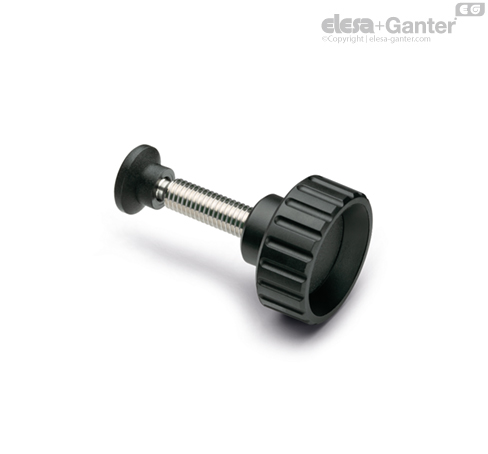
Elsa+Ganter BT.32-SST-P-M8X30-SV32 Fluted Knob Technical Guide
The Elesa+Ganter BT.32-SST-P-M8X30-SV32 fluted knob is a manual clamping component intended for applications where surface-friendly tightening and corrosion-conscious material selection are both important. Like the rest of the BT-SST-p-SV series, it features a black PA technopolymer knob body, an AISI 303 stainless steel threaded stud with spherical end, and a black POM technopolymer thrust pad supplied separately. What sets this model apart is the SV32 pad configuration combined with a 30 mm M8 stud, giving it a different contact geometry from the SV25 alternatives in the same size group.
Confirmed Technical Dimensions
The manufacturer lists this version under code 108731. The dimensional data states D = 32 mm, thread = M8, L = 22 mm, d1 = 17 mm, d2 = 21 mm, d3 = 32 mm, d4 = 6 mm, l1 = 30 mm, l2 = 9 mm, l3 = 6 mm, l4 = 11 mm, and l5 = 6 mm. Compared with the SV25 version, the key difference is the larger d3 dimension of 32 mm, which reflects the larger thrust pad arrangement. This makes the Elesa+Ganter BT.32-SST-P-M8X30-SV32 fluted knob particularly relevant where a broader contact profile is preferred.
Why the SV32 Variant Can Be Useful
In some assemblies, a wider thrust pad arrangement can improve contact behavior by distributing pressure over a broader area. That may be helpful when the clamped surface is more sensitive, when localized force should be reduced, or when design engineers want a more forgiving interface at the tightening point. Because this is still the 30 mm stud version, it remains a compact option for installations with limited depth.
Material and Practical Benefits
The black matte technopolymer body is designed for frequent manual handling, while the stainless steel stud contributes to durability and improved resistance in demanding industrial settings. The POM thrust pad supports smoother and less aggressive contact at the clamping point. These features make the product suitable for adjustable machine elements, fixture hardware, cover positioning, and operator-accessible locking points. Elesa+Ganter BT.32-SST-P-M8X30-SV32 For more information, visit Elesa+Ganter.
Typical Engineering Scenarios
This model can be a good fit for machine frames, panel systems, service-access assemblies, modular supports, and equipment that requires frequent repositioning without damaging the underlying surface. The fluted shape makes manual use straightforward, especially in maintenance and changeover routines.
Elesa+Ganter BT.32-SST-P-M8X30-SV32 FAQ
What is the main difference between SV25 and SV32 in this series?
The most important difference is the thrust pad geometry and associated dimensions. In the official table, the SV32 version shows a larger d3 value than the SV25 version. This can translate into a broader contact profile, which may be useful for applications that benefit from more distributed surface contact.
Why would an engineer prefer the M8x30 stud length here?
The 30 mm stud length is helpful when the clamping point does not require deep reach. It can keep the assembly compact, reduce unnecessary projection, and make the manual adjustment point easier to integrate into tight spaces.
Elesa+Ganter BT.32-SST-P-M8X30-SV32 Does the stainless steel stud affect application range?
Yes, it broadens the range of environments where the product may be considered. AISI 303 stainless steel is often selected where corrosion resistance is a design concern, though exact suitability still depends on exposure conditions and maintenance practices.
Elesa+Ganter BT.32-SST-P-M8X30-SV32 Can this fluted knob help reduce cosmetic damage on equipment?
It can help. The thrust pad is designed to avoid direct stud contact with the locked surface, which may reduce scratching, pressure marks, and local wear compared with a simple metal-to-surface clamping point.
Is this more about adjustment or structural fastening?
This style of component is generally used for manual adjustment, positioning, and clamping rather than for permanent structural fastening. It is ideal where components need to be tightened, released, and repositioned as part of normal operation or maintenance.