
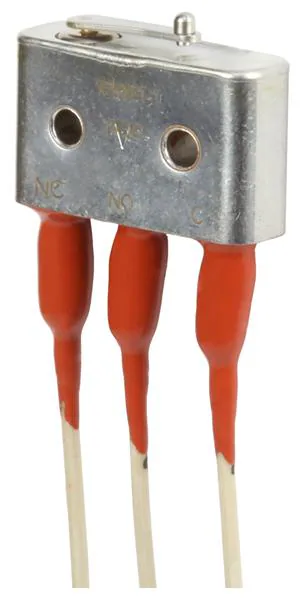
Honeywell 16HM1-1 Sealed Switch Technical Overview
The Honeywell 16HM1-1 sealed switch is a hermetically sealed miniature basic switch developed for environments where contamination resistance, dependable switching, and temperature durability are essential. As part of the Honeywell HM Series, this model is widely associated with harsh-duty applications where dust, moisture, corrosive gases, and wide temperature swings can affect conventional switch performance. For technical buyers and design engineers, the Honeywell 16HM1-1 sealed switch is a specialized option rather than a general-purpose snap-action switch.
What Defines the Honeywell 16HM1-1 Sealed Switch?
The Honeywell 16HM1-1 industrial sealed switch uses hermetic sealing to protect the internal contact chamber while still transmitting motion through a metal diaphragm system. That construction helps support stable electrical switching in environments where sealing performance is critical. This Honeywell product code is configured with SPDT circuitry and wire lead termination, making it practical for compact installations where robust environmental protection is required.
Technical Features of the Honeywell 16HM1-1 Industrial Switch
The Honeywell 16HM1-1 switch belongs to a series built with a stainless steel housing and a miniature package size. Across the HM platform, Honeywell specifies a hermetic sealed design, SPDT circuitry, and operating capability across an extremely broad temperature range. For the 16HM1-1 variant, the product listing identifies a temperature range from -65°C to 260°C, with performance down to -184°C under non-flexing wire conditions. The model is supplied with three 305 mm wire leads, which can simplify routing in compact assemblies.
This combination makes the Honeywell 16HM1-1 sealed switch relevant in aerospace-adjacent systems, harsh industrial machinery, and specialized control assemblies where dependable actuation is more important than commodity-grade switching. Because it is part of a hermetically sealed family, it is especially useful where long-term exposure to environmental contaminants would be a concern.
Application Value of the Honeywell 16HM1-1 Sealed Switch
In practical terms, the Honeywell 16HM1-1 industrial switch is selected when designers need repeatable switching in environments that challenge open-frame or lightly sealed products. It may be considered for aerospace support systems, industrial equipment, marine-adjacent hardware, power systems, and precision position sensing assemblies. The Honeywell 16HM1-1 product is not just about switching current; it is about preserving switch reliability when environmental conditions are aggressive.
For more information, visit Honeywell.
FAQ About the 16HM1-1 Sealed Switch
What type of switch is the Honeywell 16HM1-1?
The Honeywell 16HM1-1 is a hermetically sealed miniature basic switch in the HM Series. It uses SPDT circuitry and is intended for demanding environments where contaminants and temperature extremes must be considered.
Why is hermetic sealing important in the 16HM1-1?
Hermetic sealing helps isolate the contacts from dust, water, corrosive gases, and other environmental factors. That improves consistency and makes the switch more suitable for critical applications than many standard sealed switches.
What temperature range does the 16HM1-1 support?
This model is listed for -65°C to 260°C, with lower-temperature capability down to -184°C when the wire leads are non-flexing. That wide range is a major reason it is used in harsh-duty applications.
Does the 16HM1-1 use terminals or wire leads?
The 16HM1-1 version is supplied with wire leads. This can be helpful in installations where direct lead routing is preferred over board-style or post-style terminations.
Who typically searches for the 16HM1-1 sealed switch?
Engineers, MRO teams, aerospace component specifiers, and industrial procurement professionals frequently search for the Honeywell 16HM1-1 sealed switch when they need a compact hermetic switch with code-specific documentation and dependable environmental performance.