
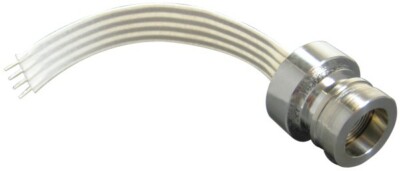
Honeywell 13C2000PA1K Pressure Sensor: Understanding a 2000 psi Absolute Sensor
The Honeywell 13C2000PA1K pressure sensor is a specialized option within Honeywell’s 13 mm Series for applications that require absolute pressure measurement rather than gauge sensing. That distinction is important. An absolute sensor references pressure against a vacuum baseline, which makes the Honeywell 13C2000PA1K packaged pressure sensor useful in systems where atmospheric variation would otherwise distort measurements.
Key Technical Profile
This model is configured for a 2000 psi operating range and delivers a Wheatstone bridge output in the 98 mV to 102 mV window. It is temperature compensated and designed for demanding pressure environments. Unlike threaded package variants, the Honeywell 13C2000PA1K pressure sensor is listed with no port, which makes it relevant for OEM package integration, custom manifold designs, or assemblies where the final pressure interface is built around the sensing element.
That no-port configuration is one of the reasons this model is often more interesting to engineering teams than to casual buyers. It is not a generic drop-in field transmitter. Instead, it is a pressure sensing solution for product developers who need control over packaging, mechanical fit, and final fluid path design.
Why Absolute Pressure Matters
In many process and instrumentation applications, absolute pressure is the correct choice because it creates a fixed and consistent reference. Vacuum systems, closed tanks, process control modules, and certain compensation algorithms rely on absolute pressure data rather than pressure relative to atmosphere. In those cases, the Honeywell 13C2000PA1K absolute pressure sensor offers a practical balance of compact size, industrial durability, and OEM-friendly integration.
The broader Honeywell 13 mm platform also reinforces confidence in the design. The series is built around a media-isolated 316L stainless steel construction intended for harsh environments, with long service life and resistance to the types of demanding media often found in industrial systems.
Where This Sensor Fits Best
The Honeywell 13C2000PA1K pressure transducer makes sense in industrial controls, custom pressure modules, hydraulic instrumentation, and pressure monitoring equipment that requires a 2000 psi absolute reference. Because it uses a low-level bridge output, it works best in systems that include custom electronics, instrumentation amplifiers, or dedicated control boards.
For more information about Honeywell, comparing this part with sealed gauge variants in the same 13 mm family is often the fastest way to determine whether absolute or gauge pressure is the better fit for your design.
FAQ
What is the difference between the Honeywell 13C2000PA1K and a gauge pressure sensor?
The main difference is the pressure reference. The Honeywell 13C2000PA1K is an absolute pressure sensor, which means it measures pressure relative to a vacuum reference rather than to ambient atmospheric pressure.
What pressure range does the Honeywell 13C2000PA1K support?
This model is rated for 2000 psi operating pressure. That makes it suitable for higher-pressure industrial systems where absolute pressure data is necessary for process accuracy or control logic.
Does the Honeywell 13C2000PA1K include a pressure port?
No. This part is listed as a no-port design. That usually means it is intended for OEM integration into a larger assembly where the final package, manifold, or interface is engineered around the sensing element.
What kind of output signal does the Honeywell 13C2000PA1K provide?
It uses a Wheatstone bridge output with a nominal range of 98 mV to 102 mV. This is commonly used in custom electronics designs where amplification and signal conditioning are handled elsewhere in the system.
Is the Honeywell 13C2000PA1K suitable for harsh industrial media?
Yes. It belongs to Honeywell’s 13 mm Series, which is based on a media-isolated stainless steel construction intended for demanding environments and challenging industrial applications.
Who is this sensor best suited for?
This model is best suited for OEM developers, control engineers, and equipment manufacturers building custom pressure assemblies rather than users looking for a simple, field-ready transmitter with a standard amplified output.