
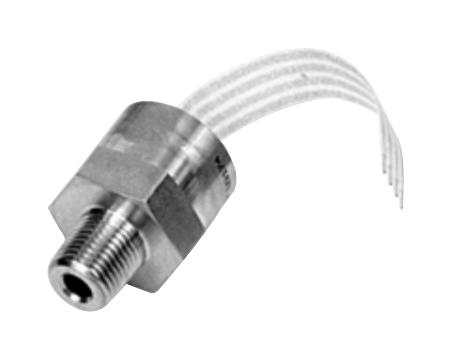
Honeywell 13C1000PS6K Pressure Sensor: A Practical Guide for High-Pressure Monitoring
The Honeywell 13C1000PS6K pressure sensor is built for engineers and technical buyers who need a rugged, media-isolated sensing solution for demanding pressure measurement tasks. As part of the Honeywell 13 mm Series, this Honeywell 13C1000PS6K packaged pressure sensor combines a stainless steel construction with a compact threaded form factor, making it a strong fit for industrial pressure monitoring, hydraulic systems, and process equipment where stability matters over time.
What Makes the Honeywell 13C1000PS6K Different?
This model is configured as a sealed gauge pressure sensor with a 1000 psi operating range. In practical terms, that means it is designed to measure pressure relative to ambient atmospheric pressure while still maintaining a sealed reference structure suitable for industrial environments. The output is a low-level bridge signal in the 98 mV to 102 mV range, which is useful in systems that already include signal conditioning, amplification, or dedicated control electronics.
The mechanical design is equally important. The Honeywell 13C1000PS6K pressure transducer uses a male 7/16 UNF threaded connection and a flex cable termination style. That combination supports compact integration in equipment where board-level electronics and pressure interfaces need to stay separated. Because the unit belongs to Honeywell’s heavy-duty 13 mm Series, it also benefits from a 316L stainless steel, media-isolated architecture intended for harsh media and demanding operating conditions.
Typical Use Cases
The Honeywell 13C1000PS6K pressure sensor is well suited to hydraulic controls, tank pressure systems, industrial controls, and pressure transmitter assemblies. It is especially relevant in projects where designers want a durable sensing core instead of a fully amplified transmitter. The 1000 psi range is a practical match for medium-to-high pressure circuits that need dependable response without moving to oversized transducer platforms.
Its operating temperature capability also helps in real-world installations. Many industrial environments see large temperature swings during startup, shutdown, or outdoor operation. In those settings, a sensor that has been temperature compensated and designed for long service life is usually the safer engineering choice.
Why Engineers Still Choose This Style of Sensor
One reason the Honeywell 13C1000PS6K packaged pressure sensor continues to attract attention is integration flexibility. A bridge-output sensor gives system designers freedom to pair the sensor with custom electronics, control boards, or calibration routines. That can be useful in OEM development where signal conditioning is already built into the main control architecture.
For more information about Honeywell, it helps to review the wider 13 mm Series family and compare package styles, pressure references, and pressure ranges before final specification.
FAQ
What type of sensor is the Honeywell 13C1000PS6K?
It is a media-isolated, temperature-compensated, sealed gauge pressure sensor from Honeywell’s 13 mm Series. It is intended for high-pressure applications where hostile media and harsh operating conditions are part of normal use.
What pressure range does the Honeywell 13C1000PS6K support?
This model is designed for a 1000 psi operating range. That makes it suitable for many hydraulic, tank monitoring, and industrial pressure control applications where mid-range high-pressure sensing is required.
Is the Honeywell 13C1000PS6K a complete transmitter?
No. This product is better understood as a pressure sensor or sensing element package with bridge output rather than a fully amplified industrial transmitter. It is often integrated into OEM systems that already have electronics for signal processing.
What kind of output does the Honeywell 13C1000PS6K provide?
It provides a low-level analog bridge output around 98 mV to 102 mV. That style of output is common in engineered systems where amplification and calibration are handled at the system level.
Where is the Honeywell 13C1000PS6K commonly used?
It is commonly considered for hydraulic controls, industrial machinery, pressure transmitter assemblies, and other equipment that needs reliable pressure feedback in a compact threaded package.
Why does the threaded connection matter?
The threaded male 7/16 UNF pressure connection supports mechanical stability and practical installation in equipment where sealing, alignment, and repeatable mounting are important. In industrial design, connection style often matters as much as the pressure range itself.