
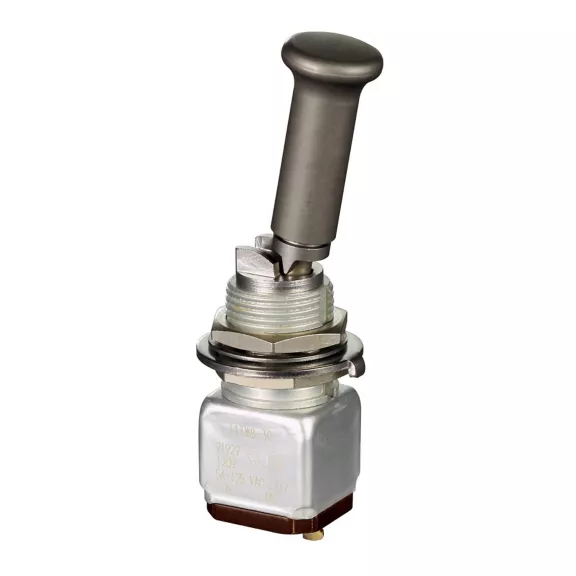
Honeywell 13AT25-T Toggle Switch Overview
The Honeywell 13AT25-T toggle switch is part of the proven MICRO SWITCH AT Series, a product family widely recognized in industrial controls, panel equipment, and demanding switching environments. When engineers search for a dependable Honeywell 13AT25-T toggle switch, they are usually looking for a compact operator control that combines stable switching action, durable mechanical construction, and predictable electrical performance.
Based on available product references, the Honeywell 13AT25-T toggle switch is built as a 2-pole, 2-position switch with solder T-type terminals and a standard lever. That makes it a practical choice for equipment designers who need a straightforward on-on switching arrangement in control panels, machinery interfaces, and instrument enclosures. In real applications, a Honeywell 13AT25-T operator control switch is often preferred when long service life and a familiar manual actuation feel matter more than unnecessary complexity.
Key Technical Characteristics of the Honeywell 13AT25-T Toggle Switch
One of the reasons the Honeywell 13AT25-T industrial toggle switch remains relevant is the broader AT Series design philosophy. The family is known for metal toggle levers, metal bushings, and metal housings that support durability in frequent-use applications. The AT Series also supports panel mounting and is associated with a compact behind-panel profile, which helps in space-conscious layouts.
For engineers comparing operator controls, the Honeywell 13AT25-T switch is valuable because a 2-pole, 2-position format can simplify circuit separation while still giving dependable manual control. This matters in electrical cabinets, maintenance panels, control stations, and specialized industrial assemblies where operators need a tactile, direct mechanical interface.
Where the Honeywell 13AT25-T Operator Control Fits Best
A Honeywell 13AT25-T toggle switch can be suitable for panel controls, equipment selection functions, machine interfaces, and legacy system replacements. It is especially useful where technicians want a recognizable lever-operated control instead of membrane or touch-based input. The direct mechanical action makes troubleshooting easier and supports maintenance workflows in industrial environments.
Another practical advantage is integration flexibility. Solder terminals are still highly valued in certain control assemblies because they allow robust point-to-point wiring or tailored harness connections. For many OEM and retrofit applications, that is a real design advantage rather than an outdated detail.
For more information about Honeywell, product families and control solutions can be reviewed in broader system context.
FAQ About the 13AT25-T Toggle Switch
What type of switch is the Honeywell 13AT25-T?
The Honeywell 13AT25-T is a toggle switch in the Honeywell MICRO SWITCH AT Series. Available product data identifies it as a 2-pole, 2-position configuration with solder T-type terminals and a standard lever.
Is the 13AT25-T suitable for industrial panels?
Yes. The Honeywell 13AT25-T toggle switch is well aligned with industrial panel and operator control use because the AT Series is known for durable metal construction, dependable switching action, and panel-mount integration.
Why do engineers choose a 2-pole, 2-position toggle switch?
A 2-pole, 2-position format is useful when two independent circuits need to change state together. This can help simplify wiring logic and support cleaner operator control layouts.
Are solder terminals still useful on the Honeywell 13AT25-T?
Absolutely. Solder terminals remain valuable in custom assemblies, serviceable controls, and low-volume specialized equipment where precise wiring and secure electrical joints are important.
What makes the 13AT25-T different from generic toggle switches?
The biggest difference is the platform behind it. The Honeywell AT Series has a long-standing reputation in demanding control applications, and that heritage matters when consistency, durability, and field reliability are part of the selection criteria.