
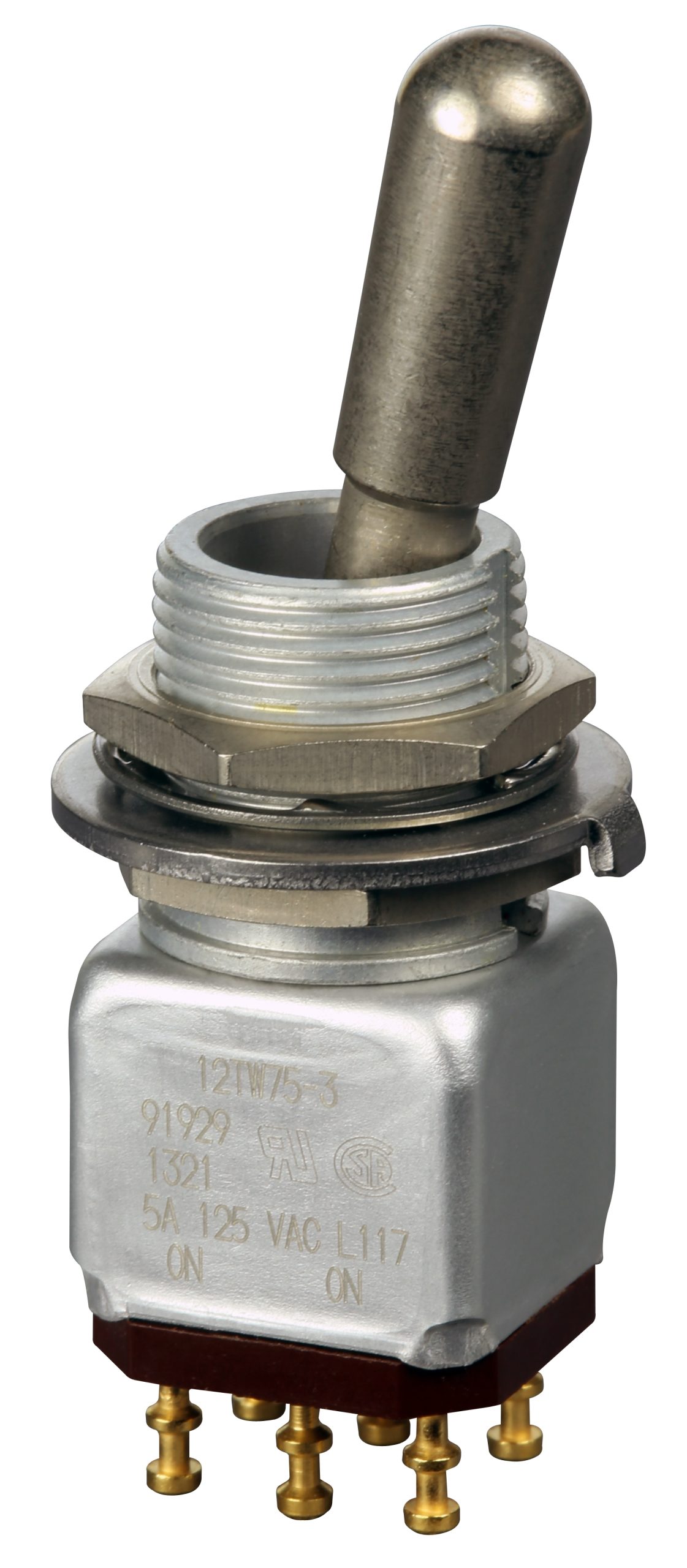
Honeywell 12TW75-3 Operator Controls Accessory: Technical Details and Practical Use
The Honeywell 12TW75-3 operator controls accessory is part of the MICRO SWITCH TW Series, a family known for compact, sealed, and application-focused toggle switch designs. This model is frequently referenced by engineers and maintenance teams looking for a dependable manual control component that supports stable switching performance in demanding environments. Although compact in size, the Honeywell 12TW75-3 toggle switch is not a lightweight solution in engineering terms. It is usually selected because the design requirements are very specific.
Understanding the 12TW75-3 Configuration
The Honeywell 12TW75-3 operator controls accessory is typically listed as a 2-pole, 2-position switch with Solder T2 type terminals and a standard lever. That sounds simple at first, but those details make a major difference in panel design. A two-pole configuration allows one switching action to manage more than one circuit path, while the two-position layout supports straightforward control logic where a defined change of state is required.
Because of this structure, the component is often considered for systems that benefit from clear operator feedback and reliable toggling without unnecessary complexity. It fits applications where manual actuation remains the preferred interface because of safety procedures, field serviceability, or straightforward human-machine interaction.
Why the TW Series Still Matters
The broader Honeywell TW platform remains relevant because it combines compact size with environmental and mechanical resilience. In control panels, reliability is often about more than current and voltage numbers. The switch also has to withstand repetitive use, installation constraints, vibration, and in some cases exposure to dust or moisture. That is why the Honeywell 12TW75-3 operator controls accessory continues to be searched by part number rather than replaced casually with a generic alternative.
Another useful point is the standardized identity of the product. When documentation, maintenance records, and replacement planning all reference the exact same part, service teams can work with fewer compatibility surprises. That is especially valuable in long-life equipment platforms.
Typical Applications for Honeywell 12TW75-3
The Honeywell 12TW75-3 operator controls accessory can fit industrial panels, instrumentation interfaces, transportation systems, and specialized machinery where a durable, manually actuated switch is needed. It is also relevant in retrofit work, especially when the original equipment specification calls for a TW Series form factor and matching lever style.
For more information about Honeywell, reviewing the wider family of switching and control components can help clarify compatibility across related installations.
FAQ
What is the main technical identity of the Honeywell 12TW75-3?
It is generally identified as a TW Series 2-pole, 2-position toggle switch with Solder T2 terminals and a standard lever. Those features help define its installation method and switching behavior.
Why do people search for Honeywell 12TW75-3 operator controls accessory by exact code?
Because exact codes matter in technical sourcing. Circuit layout, terminal type, lever style, mounting compatibility, and environmental expectations must often match the original design with little or no deviation.
Is the Honeywell 12TW75-3 meant for demanding applications?
The TW Series is widely associated with sealed and military-qualified design options, so it is commonly discussed for environments where durability, mechanical stability, and long-term reliability are important.
What does the two-position format mean in practical use?
It means the switch moves between two defined operating states. In real systems, that usually supports direct and clear control logic, which is valuable when operators need predictable switching behavior.
Can the Honeywell 12TW75-3 operator controls accessory be useful for maintenance and replacement planning?
Yes. Exact part-number continuity helps maintenance teams preserve the intended control feel, electrical behavior, and panel fit of the original equipment design.