
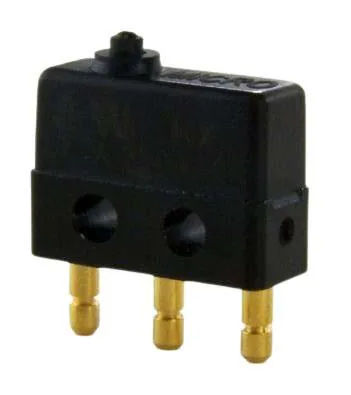
Honeywell 12SX15-T Basic Switch: Technical Context and Use Cases
The Honeywell 12SX15-T basic switch is a subminiature snap-action component created for dependable switching in compact electromechanical systems. Even though this model is listed as obsolete in current distributor data, the Honeywell 12SX15-T basic switch still matters for maintenance, replacement planning, documentation work, and legacy equipment support.
Understanding the Honeywell 12SX15-T Basic Switch
The Honeywell 12SX15-T switch uses an SPDT arrangement with a round pin plunger actuator, chassis mounting, and solder turret termination. That combination reflects a classic design approach for systems where switching accuracy, stable mounting, and compact dimensions are all important. In practical terms, this is the type of switch engineers often encounter when maintaining established assemblies rather than designing from scratch.
Technical Characteristics
According to current product data, the Honeywell 12SX15-T electromechanical switch is rated at 1 A DC with a 28 V DC rating. It uses a round pin plunger actuator and solder turret termination in a chassis-mount format. Operating force is 141 gf, release force is 28 gf, pretravel is 0.020 in (0.5 mm), differential travel is 0.003 in (0.075 mm), and overtravel is 0.003 in (0.076 mm). The switch is also associated with a mechanical life of 10,000,000 cycles and an operating range of -55°C to 125°C.
Why This Part Still Matters
Obsolete components do not disappear from the field overnight. The Honeywell 12SX15-T basic switch may remain installed in instrumentation, industrial mechanisms, or specialized control assemblies for years. That makes reliable part identification especially important. Knowing the actuator style, rating, force values, and travel characteristics helps technicians and engineers assess compatibility when servicing older hardware.
Practical Evaluation Considerations
When reviewing the Honeywell 12SX15-T basic switch, it is smart to focus on matching the actuation profile and switching behavior rather than only the headline rating. In many legacy systems, even small changes in force or travel can alter performance. For more information about Honeywell, broader portfolio review can support cross-reference and replacement research.
FAQ
Is the Honeywell 12SX15-T still active?
Current distributor listings identify the Honeywell 12SX15-T basic switch as obsolete. That means it is primarily relevant for replacement planning, service work, and legacy equipment documentation.
What type of switch is the Honeywell 12SX15-T?
It is an SPDT snap-action basic switch with a round pin plunger actuator. It is designed for compact electromechanical switching tasks.
Why is obsolete status important for engineers?
Obsolete status affects maintenance strategy, sourcing risk, and redesign planning. It also makes accurate technical comparison more important when evaluating substitute parts.
What mounting and termination style does it use?
The switch uses chassis mounting and solder turret termination. This matters when matching wiring layout and physical installation requirements in an existing assembly.
Can the Honeywell 12SX15-T still be relevant in modern documentation?
Yes. Even if a component is no longer manufactured, it may still appear in fielded systems, BOM reviews, maintenance records, and retrofit discussions.
What should be checked before choosing a replacement?
Engineers should check current and voltage ratings, actuator type, mounting method, termination style, operating force, travel values, temperature range, and expected lifecycle before selecting a replacement path.