
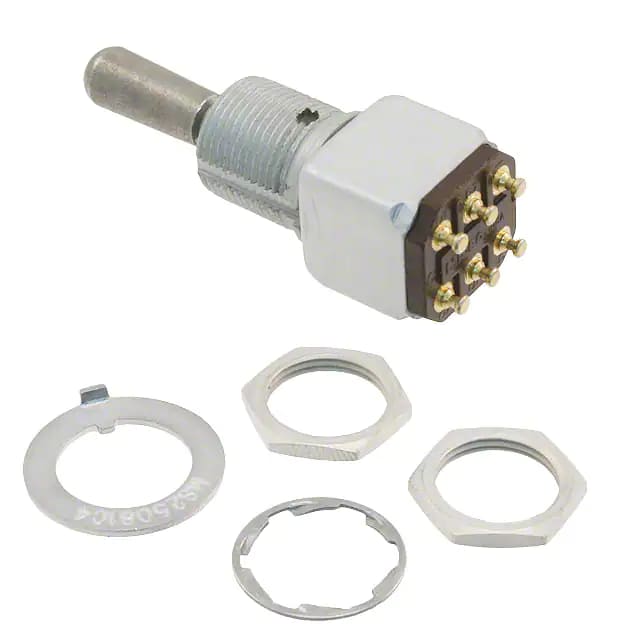
Honeywell 12TW1-56 Toggle Switch Guide
The Honeywell 12TW1-56 toggle switch is a compact manual control component from the Honeywell TW Series, developed for reliable operation in demanding environments. Unlike locking variants in the same family, the Honeywell 12TW1-56 operator control accessory is known for its standard lever configuration, which can make it more appropriate for applications where quick, direct lever movement is preferred.
From a technical perspective, the Honeywell 12TW1-56 DPDT toggle switch is a 2-pole, 3-position switch with solder terminals and a 15/32 inch bushing. It is generally referenced as a TW Series unit with a standard lever rather than a mushroom-style locking lever. That makes it useful in systems where ruggedness and compact size are still required, but lever locking is not part of the design intent.
How the 12TW1-56 Fits into the TW Series
The Honeywell TW Series is widely recognized for miniature military-grade toggle construction and for use in environments where shock, vibration, dust, splashing water, and temperature extremes can affect component reliability. The Honeywell 12TW1-56 toggle switch benefits from that broader series reputation while offering a more straightforward operating feel.
This matters because some applications need clear, repeatable switching without the extra step of unlocking the lever. In operator consoles, industrial panels, instrumentation assemblies, and service-access controls, a standard lever can improve speed and ease of use when accidental actuation risk is already managed by panel design.
Main Technical Features
- Honeywell TW Series miniature toggle switch
- DPDT, 3-position switch layout
- Solder terminal connection style
- 15/32 inch bushing for panel mounting
- Standard lever configuration
- Compact design for limited behind-the-panel space
- Suitable for rugged and technical control environments
Typical Engineering Value
The Honeywell 12TW1-56 accessory switch offers a balance between robust construction and straightforward manual operation. For engineering teams, that can simplify user interaction while maintaining confidence in the mechanical quality of the switch platform. It is often a sensible direction when the panel requires a durable DPDT 3-position switch but does not call for a lever lock.
That distinction is important because part-number suffixes in the TW family are not cosmetic; they define how the switch behaves in service. A standard lever version like the Honeywell 12TW1-56 toggle switch may be the better fit for systems prioritizing immediate operator response.
FAQ
What is the main advantage of the Honeywell 12TW1-56 toggle switch?
Its main advantage is combining the rugged TW Series platform with a standard lever format. That gives engineers a dependable miniature 3-position DPDT switch without introducing locking behavior where it is not needed.
Is the Honeywell 12TW1-56 a locking toggle switch?
No. This version is generally identified with a standard lever rather than a mushroom-style locking lever. That is one of the key reasons it is selected over other TW suffix variants.
Where is the 12TW1-56 commonly relevant?
It can be relevant in industrial control panels, instrumentation systems, transportation equipment, and specialized machinery where compact size, rugged construction, and direct manual switching are all priorities.
Why is suffix-level selection important in the TW Series?
Because the suffix often changes the practical behavior of the switch. Two parts may share the same family and base architecture while differing in lever design, locking arrangement, or actuation logic. That directly affects operator experience and system safety.
For more information about Honeywell, review the wider catalog of control and switching technologies.