
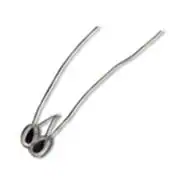
Honeywell 126-104XYW-B03 Temperature Sensor: Glass Bead Thermistor for Precise Sensing
Honeywell 126-104XYW-B03 temperature sensor solutions are associated with precision thermal measurement where dependable response matters. Publicly visible product listings identify this model as an NTC thermistor in a glass bead or probe-style format. That makes it especially relevant to applications that value compact sensing geometry, consistent thermal behavior, and the ability to support accurate temperature-related control decisions.
Understanding the Honeywell 126-104XYW-B03 Temperature Sensor
The Honeywell 126-104XYW-B03 temperature sensor belongs to the broader Honeywell 126 Series thermistor family. This series is known for precision sensing use, curve-matched interchangeability, and a design approach intended for accurate temperature control and indication. When an application requires a thermistor that behaves consistently from unit to unit, this product family becomes highly relevant.
The B03 variation is commonly listed as a glass bead or probe thermistor configuration. That form factor can be useful when integration space is limited or when the sensing point must be positioned carefully within an assembly. In temperature-sensitive equipment, the mechanical presentation of the sensing element can be just as important as its electrical performance.
Why Engineers Use Glass Bead Thermistors
A Honeywell 126-104XYW-B03 temperature sensor offers value because glass bead thermistor designs are often selected for precision, responsiveness, and compact implementation. In many systems, the sensor must react quickly enough to reflect real thermal changes without taking up excessive space. That combination makes this type of Honeywell temperature sensor appealing for technical applications where stable data matters.
It is also relevant for projects where repeatability is more important than low-cost approximation. A reliable thermistor can improve temperature compensation, reduce measurement drift concerns, and support tighter control logic across the full system.
Application Areas
The Honeywell 126-104XYW-B03 temperature sensor may be considered for industrial electronics, thermal monitoring circuits, instrumentation, HVAC assemblies, and other equipment that depends on precise temperature feedback. In these environments, selecting a proven Honeywell temperature sensor can help maintain consistent product behavior and system confidence.
Selection Considerations
When evaluating a Honeywell 126-104XYW-B03 temperature sensor, decision-makers should look at resistance characteristics, expected operating temperatures, packaging needs, mounting approach, electrical interface design, and the response behavior required by the application. Precision thermal components deliver the best results when the full measurement chain is designed correctly.
For more information about Honeywell, reviewing adjacent thermistor models can help identify the right fit for the intended control or monitoring environment.
FAQ
What kind of sensor is the Honeywell 126-104XYW-B03?
It is an NTC thermistor used for temperature sensing. Public listings identify it as a glass bead or probe-style thermal sensing component, which points to precision-focused temperature measurement applications.
Why is the glass bead design important?
Glass bead thermistor designs are valued for compact size, stable sensing behavior, and suitability for precise measurement tasks. This can make them especially useful when the temperature sensing point needs to be placed carefully within a system.
Where can the Honeywell 126-104XYW-B03 temperature sensor be used?
It can be relevant in instrumentation, industrial electronics, thermal management systems, HVAC-related assemblies, and other control environments where consistent temperature feedback is needed for system performance.
What makes the Honeywell 126 Series attractive for precision sensing?
The 126 Series is associated with curve-matched interchangeability and accurate temperature indication. That means it is designed for applications where predictable thermal behavior and better unit-to-unit consistency are important.
How should this Honeywell temperature sensor be chosen for a design?
The selection process should include resistance requirements, operating temperature range, mechanical fit, wiring or probe format, and overall circuit compatibility. A strong selection process focuses on application behavior, not only the part number.