
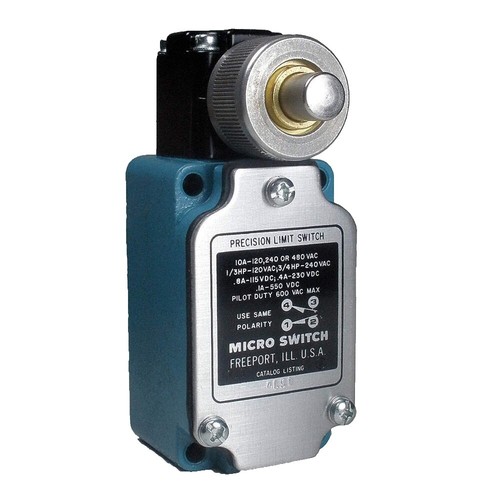
Honeywell 12CX2 Hazardous Location Limit Switch Explained
The Honeywell 12CX2 limit switch is a defined member of the Honeywell CX Series and is especially relevant for applications that need momentary switching in hazardous or environmentally demanding settings. Honeywell’s official order guide identifies the Honeywell 12CX2 hazardous location limit switch as an epoxy-coated aluminum short-housing model with momentary action, two BA SPDT basic switches, and the CX family’s 20 A electrical rating. That technical profile makes it useful wherever rotating movement or mechanical travel must trigger a reliable electrical response.
Technical Profile of the Honeywell 12CX2
According to the official CX datasheet, the Honeywell 12CX2 industrial limit switch uses BA basic switch construction with two SPDT circuits and momentary operation. The same order guide shows a short housing format and a typical operating torque value listed for this configuration. At the family level, CX switches offer NEMA 1, 3, 4, 4X, 6, 6P, and 13 sealing, IP66 protection, and operating temperatures from -25°C to 85°C. These specifications support use in demanding industrial systems where sealing and enclosure strength are essential.
Momentary Action and Why It Matters
The biggest operational difference in the Honeywell 12CX2 limit switch is its momentary switching behavior. In practical use, that means the contact state changes while the actuator is engaged and then returns when the actuation force is removed. This is valuable in sequencing, indexing, and travel-detection tasks where a temporary but highly reliable signal is needed. For control engineers, a Honeywell 12CX2 momentary limit switch can be a very efficient solution for event-based machine logic.
Best-Fit Applications
The Honeywell 12CX2 hazardous location limit switch can be used in rotary equipment monitoring, valve position feedback, material handling systems, conveyor stop points, and machine travel detection. Because it belongs to the hazardous-duty CX platform, it also aligns well with oil and gas operations, chemical plants, outdoor handling systems, and other industrial areas where exposure conditions are severe.
Mechanical and Environmental Value
What makes the Honeywell 12CX2 industrial limit switch practical is the balance between compact housing and rugged design. The short-housing format can help in tighter installations, while the enclosure family is designed to maintain performance in weather, dust, and hazardous-area service. That combination is often exactly what industrial maintenance teams look for when uptime and reliability are business-critical.
For more information about Honeywell, it is worth exploring how the CX Series compares with other heavy-duty limit switch families used in motion feedback applications.
FAQ
What type of product is the Honeywell 12CX2?
The Honeywell 12CX2 is a Honeywell hazardous location limit switch in the CX Series. Honeywell’s order guide identifies it as a short-housing, momentary-action unit with two SPDT BA basic switches.
What is the electrical rating of the Honeywell 12CX2?
Within Honeywell’s CX Series order guide, the Honeywell 12CX2 limit switch is tied to the family’s 20 A rating code for BA basic switches. Final application suitability should still be checked against the full datasheet and system requirements.
What is the difference between the Honeywell 12CX2 and 12CX15-D01?
The key difference is switching behavior and shaft configuration. The Honeywell 12CX2 is a momentary-action model, while the Honeywell 12CX15-D01 is a maintained-action version with a flat shaft for direct coupling.
Is the 12CX2 good for outdoor industrial use?
Yes. The CX platform is designed for outdoor and hazardous environments, with sealing and protection characteristics that support use in exposed industrial settings.
Why do engineers choose a momentary limit switch like the 12CX2?
Because it delivers a clear temporary signal during mechanical actuation. That makes it useful for event-triggered logic, indexing, position confirmation, and machine sequencing where a maintained signal is not required.