
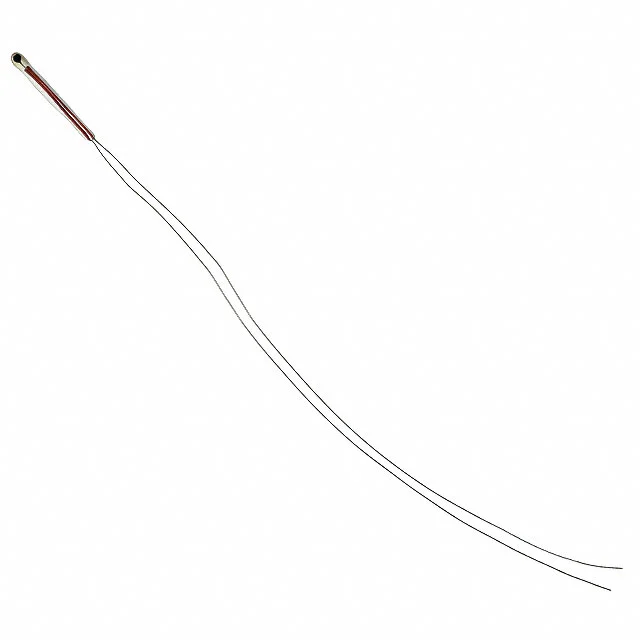
Honeywell 120-202EAD-Q02 Temperature Sensor Technical Guide
The Honeywell 120-202EAD-Q02 temperature sensor belongs to Honeywell’s 120 Series of packaged NTC thermistor probes. In practical engineering terms, this means it is designed for temperature sensing tasks where stable response, compact construction, and dependable performance matter more than marketing language. Because the device uses an NTC thermistor element, its resistance decreases as temperature rises, making it suitable for measurement, monitoring, compensation, and protection functions across many electronic and industrial systems.
What Makes the Honeywell 120-202EAD-Q02 Relevant?
The Honeywell 120-202EAD-Q02 NTC thermistor probe is often researched by engineers looking for a sensor that combines a compact cylindrical glass probe format with a wide operating temperature capability. That combination is useful in designs where space is limited but temperature data still needs to remain consistent and repeatable. The glass probe construction also matters because it supports durability in demanding environments and helps preserve measurement integrity over time.
When teams search for a Honeywell 120-202EAD-Q02 glass probe temperature sensor, they are usually not looking for a general-purpose consumer part. They are evaluating a component that can support thermal feedback loops, control boards, instrumentation, laboratory devices, and specialty equipment where predictable electrical behavior is essential. A 2 kOhm nominal resistance at 25°C is often a familiar reference point in these applications, especially when the broader system has already been designed around a known resistance-temperature curve.
Technical Characteristics That Matter in Real Use
For specification-driven projects, the core value of the Honeywell 120-202EAD-Q02 temperature sensor is not only its resistance class, but also how that resistance behaves across a broad thermal range. Engineers typically assess probe geometry, thermistor curve behavior, lead length, installation style, and material stability together. In that context, this model fits applications where free-hanging installation and direct thermal exposure are preferred over heavy mechanical packaging.
The cylindrical glass body also makes the part easier to place in compact assemblies, test fixtures, and embedded thermal zones. In addition, the sensor’s profile supports integration into designs where fast thermal tracking is more valuable than a large mechanical housing. That is why the Honeywell 120-202EAD-Q02 temperature sensor is frequently associated with precision-oriented thermal monitoring rather than simple ambient sensing alone.
Typical Application Context
This part may be considered for industrial controls, electronics cooling supervision, test and measurement equipment, thermal compensation networks, and custom monitoring assemblies. In those environments, the goal is usually not just to detect heat, but to interpret temperature change reliably enough for a circuit or controller to respond in a meaningful way.
For more information about Honeywell, review the broader product range and technical context around related sensing components.
FAQ
What type of sensor is the Honeywell 120-202EAD-Q02?
It is an NTC thermistor probe. That means the resistance drops as the temperature rises, which allows the part to be used in temperature measurement and control circuits.
Why is the glass probe construction important?
Glass packaging is valuable because it supports stability, repeatability, and environmental resilience. In technical applications, that can improve long-term confidence in the sensing element compared with less robust constructions.
Where is the Honeywell 120-202EAD-Q02 temperature sensor commonly evaluated?
It is commonly reviewed for industrial electronics, embedded monitoring systems, instrumentation, and equipment that needs dependable thermal feedback in a relatively compact package.
Is the Honeywell 120-202EAD-Q02 only for high-temperature systems?
No. Its wide operating range makes it versatile. It can be relevant in both low-temperature and high-temperature environments as long as the electrical curve and mechanical format match the design requirements.
Why do engineers search specifically for Honeywell 120-202EAD-Q02 NTC thermistor probe information?
They usually need to validate fit, response behavior, curve compatibility, and environmental suitability before choosing a part for a design, repair, or replacement workflow.
What should be checked before final design approval?
The most important checks are the resistance-temperature curve, tolerance expectations, physical installation method, and how the probe interacts with the surrounding thermal mass. Those factors determine whether the sensor will behave as expected inside the final assembly.