
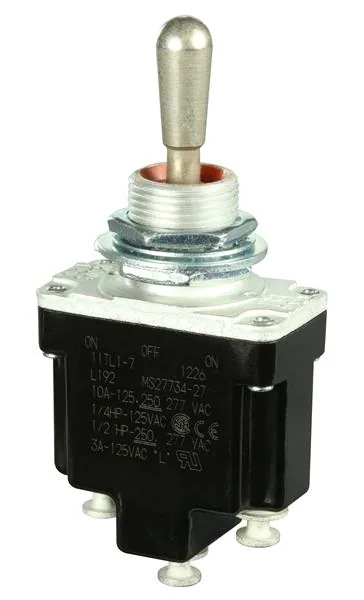
Honeywell 11TL1-7 Toggle Switch: Technical Overview and Practical Use
The Honeywell 11TL1-7 toggle switch is part of Honeywell’s TL Series, a family widely known in industrial controls, transport equipment, and demanding panel applications. When engineers look for a Honeywell 11TL1-7 toggle switch or a dependable Honeywell 11TL1-7 operator control switch, they are usually trying to solve a simple problem: how to get repeatable manual control in environments where reliability matters more than appearance. This model is built for panel mounting and is often considered when a sealed switch is preferred over a basic open-frame alternative.
From a technical standpoint, the Honeywell 11TL1-7 is an SPDT panel mount toggle switch with a momentary-off-momentary switching function. It is rated at 10 A at 125 V AC, uses a solder turret termination, and includes environmental sealing. The actuator is a standard round lever with a length of 17.27 mm, while the typical panel cutout is 12.40 mm with a 15/32-32 bushing thread. Its operating temperature range, stretching from -65°C to 71°C, makes it relevant for installations where cold starts, outdoor exposure, or fluctuating temperatures are part of normal service conditions.
In practical terms, the Honeywell 11TL1-7 toggle switch is a strong fit for control panels, heavy-duty machinery interfaces, specialty vehicles, aviation support systems, and industrial enclosures where dust, splashing, or environmental stress can shorten the life of standard switches. Because the TL Series is designed around tougher service conditions, engineers often compare this part with general-purpose switches and choose it when sealing, mechanical integrity, and operating consistency are more important than low initial cost. That makes the Honeywell 11TL1-7 toggle switch especially relevant in maintenance-heavy sectors where replacing a failed operator control can cost far more than the switch itself.
Why the Honeywell 11TL1-7 Matters in Operator Control Systems
What sets this model apart is not just the electrical rating. It is the balance between compact panel integration, sealed construction, and a familiar toggle format that technicians already understand. In the field, that matters. A well-known switch format reduces training friction, simplifies inspection, and helps maintenance teams identify the intended switching action quickly. For documentation-heavy environments, using a clearly specified Honeywell 11TL1-7 operator control switch can also make spare-part planning easier.
For more information about Honeywell operator controls, it helps to compare series-level differences before selecting a replacement or writing a maintenance specification.
FAQ
What type of switch is the Honeywell 11TL1-7?
It is a sealed SPDT panel mount toggle switch in Honeywell’s TL Series. It uses a momentary-off-momentary function, which is useful when the lever should return after actuation rather than stay latched in every position.
Where is the Honeywell 11TL1-7 commonly used?
This model is commonly discussed for industrial panels, transport equipment, rugged operator stations, and applications where environmental sealing is important. It is especially relevant when vibration, dirt, moisture, or temperature swings may affect switch life.
Is the Honeywell 11TL1-7 suitable for harsh environments?
It is better suited to demanding environments than a basic unsealed toggle switch because the TL Series includes environmental sealing and a broad operating temperature range. Even so, exact suitability should always be checked against the enclosure design and application standards.
What should be checked before specifying a Honeywell 11TL1-7 toggle switch?
Review the switching function, current and voltage rating, termination style, panel cutout size, actuator length, and operating environment. Those details determine whether the part is a true functional match or only a visual match.
Can the Honeywell 11TL1-7 be used as a replacement part?
Yes, but only after confirming the circuit logic, mounting dimensions, sealing requirements, and termination style. In legacy systems, the switching action is often the most overlooked detail, so it should be verified carefully before installation.