
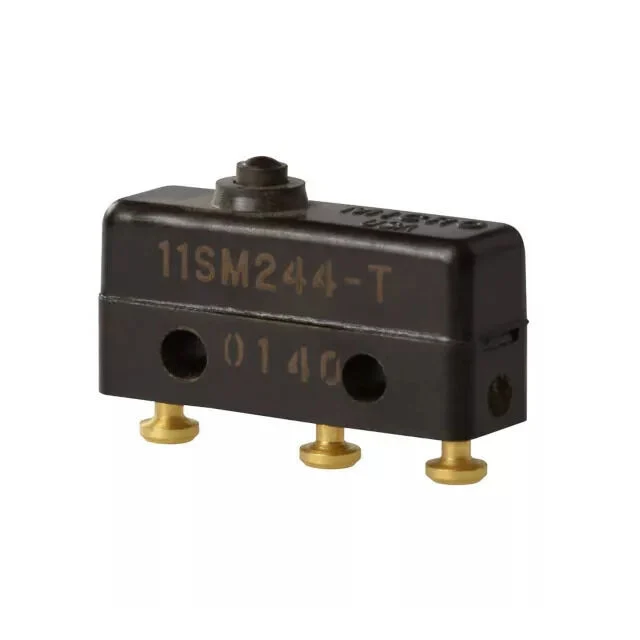
Honeywell 11SM723-T Basic Switch Technical Guide for Precision Switching
The 11SM723-T basic switch is a compact electromechanical switching solution intended for precise low-current control tasks. As part of the Honeywell SM Series, this model is especially relevant when design requirements call for a small switch body, stable snap-action behavior, and dependable response over a long mechanical service life.
What Makes the Honeywell 11SM723-T Different?
The 11SM723-T basic switch uses an SPDT circuit and a pin plunger actuator, but it is typically associated with lower electrical ratings than some other SM Series variants. That makes it useful for lighter-duty switching, control logic, and signal-level mechanical detection tasks where compactness and precision matter more than high current capacity.
Core Technical Specifications
This Honeywell electromechanical switch is generally listed at 1 A for AC/DC operation, with rated voltages up to 125 V AC and 30 V DC. It uses a chassis-mount construction and solder turret termination. Typical operating force is 56 gf, release force is 14 gf, and operating position is around 8.4 mm. Pretravel is approximately 0.5 mm, differential travel about 0.05 mm, and overtravel around 0.13 mm. Mechanical life reaches up to 10,000,000 cycles. The operating temperature range is usually given as -55°C to 125°C.
Best-Fit Applications for the Honeywell 11SM723-T Basic Switch
Because of its current rating and form factor, the Honeywell 11SM723-T basic switch can be a strong match for instrumentation, compact device controls, small mechanism position sensing, and assemblies where repeatable actuation is more important than switching large loads. It is also relevant in designs that require the flexibility of SPDT contacts while maintaining a very compact layout.
Advantages in Real Engineering Use
The practical strength of the 11SM723-T electromechanical switch is not simply that it is small. It is that the switch offers predictable travel characteristics and long mechanical life within that small package. For control designers, this can help reduce uncertainty in mechanism behavior. For maintenance teams, it supports consistent replacement planning within systems built around SM Series dimensions.
In many low-current control environments, overly large switch hardware adds cost and complexity. The Honeywell 11SM723-T basic switch avoids that issue by staying focused on compact, precise, reliable operation.
FAQ
What kind of application is the 11SM723-T best suited for?
It is best suited for low-current, precision-oriented switching tasks such as control logic input, compact mechanism sensing, and instrumentation-related electromechanical signaling.
What is the current rating of the 11SM723-T basic switch?
This model is typically associated with a 1 A rating for AC/DC applications, making it more appropriate for lighter-duty switching than higher-current SM Series versions.
Does the Honeywell 11SM723-T use screw, solder, or quick-connect terminals?
The 11SM723-T is commonly listed with solder turret termination, which supports a secure wired connection in compact assemblies.
How long can the Honeywell 11SM723-T electromechanical switch last?
Its mechanical life is generally stated up to 10 million cycles. Actual field life depends on environmental conditions, loading, mounting accuracy, and system design.
Why would an engineer choose the Honeywell 11SM723-T basic switch instead of a higher-rated switch?
Because not every design benefits from higher current capacity. In many cases, a low-current switch with compact size, precise travel, and predictable actuation is the better engineering choice.
For more information about Honeywell, review the broader switch range for related configurations.