
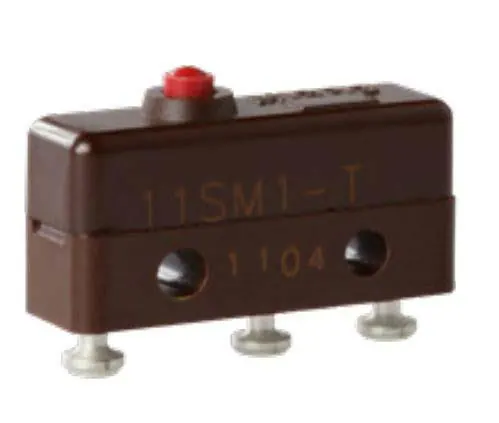
Honeywell 11SM423-H2 Basic Switch Technical Overview for Compact PCB Designs
What Makes the Honeywell 11SM423-H2 Basic Switch Different?
The Honeywell 11SM423-H2 basic switch is designed for compact equipment that requires stable switching performance with board-level integration. As a 11SM423-H2 basic switch, this model is especially useful when designers want the proven behavior of a snap action switch but prefer through-hole mounting for cleaner PCB-based layouts. In many electronics and control applications, a Honeywell 11SM423-H2 microswitch is selected for its small size, dependable actuation, and flexible SPDT contact arrangement.
This model belongs to Honeywell’s SM Series and is configured as an SPDT switch with a round pin plunger actuator. Unlike chassis-mounted alternatives, the Honeywell 11SM423-H2 electromechanical switch uses through-hole mounting and PC pin termination. That makes it a practical fit for compact assemblies, embedded control boards, and equipment that benefits from direct board integration without additional harness complexity.
Honeywell 11SM423-H2 Basic Switch Technical Features
The 11SM423-H2 basic switch is rated for 1 A in AC/DC service, with voltage ratings up to 125 V AC and 30 V DC. It uses a snap action switching mechanism, which is valued for fast contact transition and reliable signal response. Its maximum operating force is 99 gf, with a release force of 28 gf. The operating position is 8.4 mm, pretravel is 0.5 mm, differential travel is 0.025 mm, and overtravel is 0.13 mm.
These motion values matter because they help design teams predict how the switch will behave inside compact mechanisms. When a Honeywell 11SM423-H2 pin plunger switch is used in a tightly engineered assembly, consistency in travel and actuation can improve repeatability and help reduce unintended switching behavior.
The switch also supports operation in temperatures from -55°C to 125°C and offers a mechanical life of up to 10,000,000 cycles. That combination makes it suitable for long-term use in control panels, instrumentation, compact industrial devices, and specialty equipment exposed to varying environmental conditions.
Typical Applications for the Honeywell 11SM423-H2 Microswitch
A 11SM423-H2 SPDT switch can be used for position sensing, board-mounted limit detection, device cover monitoring, trigger mechanisms, and compact safety logic. The through-hole format makes it especially attractive for original equipment manufacturers that want a board-mount Honeywell basic switch without sacrificing mechanical reliability.
For more information about Honeywell, you can explore additional switch and sensing solutions.
FAQ About the Honeywell 11SM423-H2 Basic Switch
What is the Honeywell 11SM423-H2 used for?
The Honeywell 11SM423-H2 is commonly used in compact control systems, PCB-based industrial devices, and applications that need reliable snap action switching with through-hole installation.
Is the 11SM423-H2 a PCB-mount switch?
Yes. This model uses through-hole mounting and PC pin termination, which makes it appropriate for printed circuit board integration.
What contact configuration does the 11SM423-H2 basic switch have?
It uses an SPDT configuration, allowing designers to work with both normally open and normally closed switching logic in one component.
How durable is the 11SM423-H2 microswitch?
The switch is designed for a mechanical life of up to 10 million cycles. That durability helps support long service life in repeated-actuation environments.
Can the 11SM423-H2 operate in hot or cold environments?
Yes. Its operating temperature range of -55°C to 125°C supports use in environments with significant temperature variation, including demanding industrial equipment.