
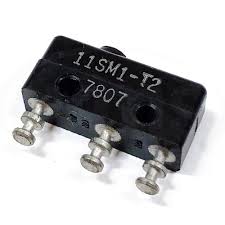
Honeywell 11SM1-T2 Basic Switch Overview
The Honeywell 11SM1-T2 basic switch is a compact SM Series electromechanical switch intended for applications that require precise snap-action response and dependable long-term operation. The Honeywell 11SM1-T2 basic switch is closely associated with engineering searches such as Honeywell 11SM1-T2 basic switch, Honeywell 11SM1-T2 micro switch, and Honeywell 11SM1-T2 SPDT switch, particularly in projects where exact configuration matching matters.
Technical Characteristics of the 11SM1-T2 Basic Switch
This switch uses an SPDT contact arrangement and a round pin plunger actuator. It is rated for 5 A at 250 V AC and 30 V DC, which makes it appropriate for many compact control and switching applications. The Honeywell 11SM1-T2 basic switch is listed with chassis mount installation and solder turret termination, supporting reliable integration into wired electromechanical systems.
Its operating characteristics include an operating force of 141 gf, a release force of 28 gf, pretravel of 0.020 in (0.5 mm), differential travel of 0.004 in (0.1 mm), overtravel of 0.005 in (0.13 mm), and an operating position of 0.330 in (8.4 mm). Those numbers help designers predict actuation timing and confirm whether the switch will align correctly with the motion profile of a mechanism.
Design Relevance of the 11SM1-T2 Basic Switch
The 11SM1-T2 micro switch is often considered in industrial equipment, compact enclosures, actuation mechanisms, monitoring systems, and instrumentation platforms where consistent switching performance is required. Its mechanical life of 10,000,000 cycles supports durability in repetitive-use applications, while the -55°C to 125°C operating temperature range gives the switch flexibility across a wide range of environmental conditions.
For many engineers, the value of the Honeywell 11SM1-T2 SPDT switch lies in its predictable Honeywell SM Series behavior combined with a specific terminal and mounting format. That can be especially important in maintenance work or when existing equipment must be matched as closely as possible.
For more information about Honeywell, reviewing the broader SM Series can help compare this model with other terminal and force variants.
FAQ
What is the difference between the Honeywell 11SM1-T2 basic switch and other SM variants?
The main difference is usually the exact configuration code tied to terminal style, packaging, or specific build variation. In practical sourcing and replacement work, those details matter because even closely related SM switches may differ in how they are mounted or connected.
Is the Honeywell 11SM1-T2 micro switch suitable for long-term use?
Yes. With a rated mechanical life of 10 million cycles, it is designed for repetitive actuation over extended service periods. That makes it useful in applications where reliability is a major requirement.
Why do buyers search for the Honeywell 11SM1-T2 SPDT switch specifically?
Because many applications require an exact part match. Buyers and engineers often need to preserve the original actuator feel, travel values, terminal geometry, and mounting format when replacing a switch in an installed system.
Can the Honeywell 11SM1-T2 basic switch operate in harsh temperatures?
Yes. Its temperature capability from -55°C to 125°C supports usage in many environments where thermal variation would challenge less robust switch designs.