
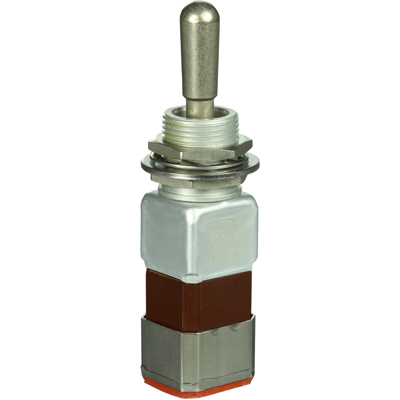
Honeywell 112TW1-5M Toggle Switch Technical Overview
The Honeywell 112TW1-5M toggle switch is a specialized operator control component within the TW Series, developed for applications that demand a compact sealed design and a defined locking behavior. This model is best understood as a Honeywell DPDT toggle switch configured around the functional pattern of a momentary ON – OFF – maintained ON switching sequence, combined with a pull-to-unlock style lever arrangement identified by the M locking configuration.
Technical Structure of the Honeywell 112TW1-5M Toggle Switch
At circuit level, the Honeywell 112TW1-5M toggle switch uses a double-pole double-throw (DPDT) design. The underlying three-position switching behavior makes it suitable for applications where one command should be temporary, the center should remain OFF, and the opposite command should stay engaged until manually changed. This makes it useful in operator interfaces where intentional actuation matters.
The broader TW Series specification supports 5 A ratings in both AC and DC use, with common ratings at 125 V AC and 28 V DC. TW Series switches are also known for their environment-sealed construction, panel-mount format, and operating temperature capability from -65°C to 71°C. These characteristics are valuable for compact industrial panels, equipment control stations, mobile systems, and installations where vibration, dust, or moisture exposure can be a concern.
What the M Locking Configuration Adds
A key detail of the Honeywell 112TW1-5M toggle switch is the M suffix, which corresponds to a defined locking configuration in the TW Series. This configuration is intended to control how the lever can be moved into or out of a specific extreme position, helping reduce accidental switching. In real-world control environments, that is more than a minor mechanical detail. It supports safer operator input, more deliberate switching, and better process discipline in equipment where unintended activation should be avoided.
Because of that mechanical behavior, the Honeywell 112TW1-5M operator control toggle switch is often relevant when designers want a manual control element that requires a more intentional action than a basic free-moving toggle. For more information about Honeywell, you can review additional product families and industrial control technologies.
Application Relevance
The Honeywell 112TW1-5M toggle switch can fit well in machinery interfaces, test equipment, aerospace-adjacent systems, process control panels, and ruggedized instrumentation. Professionals often search for this model when they need a sealed panel mount toggle switch, a locking lever toggle switch, or a Honeywell operator controls switch that combines tactile reliability with defined mechanical behavior.
FAQ: Honeywell 112TW1-5M Toggle Switch
What kind of switch is the Honeywell 112TW1-5M?
The Honeywell 112TW1-5M is a TW Series toggle switch used in demanding operator control applications. It is associated with a DPDT, three-position format and a locking lever configuration designed to support deliberate actuation.
What does the 5M configuration indicate?
In practical terms, the model is associated with a three-position switching structure derived from the -5 circuitry and an M locking arrangement. This means the switch behavior is not only electrical but also mechanical, which matters in applications where accidental operation should be limited.
Why is a locking toggle switch useful?
A locking toggle switch helps prevent unintended changes in state. In industrial and technical environments, that can improve operational consistency, support safer workflows, and reduce the risk of command errors caused by vibration, incidental contact, or hurried handling.
Is the Honeywell 112TW1-5M suitable for compact control panels?
Yes. TW Series switches are known for their miniature military-grade format, which makes them useful when panel space is limited but rugged performance is still required.
What makes the Honeywell 112TW1-5M relevant for engineers and buyers?
This model is relevant because it combines compact panel-mount integration, a sealed construction approach, defined switching behavior, and a controlled locking action. Those factors matter when a toggle switch must perform reliably in a professional environment rather than a light-duty consumer setting.