
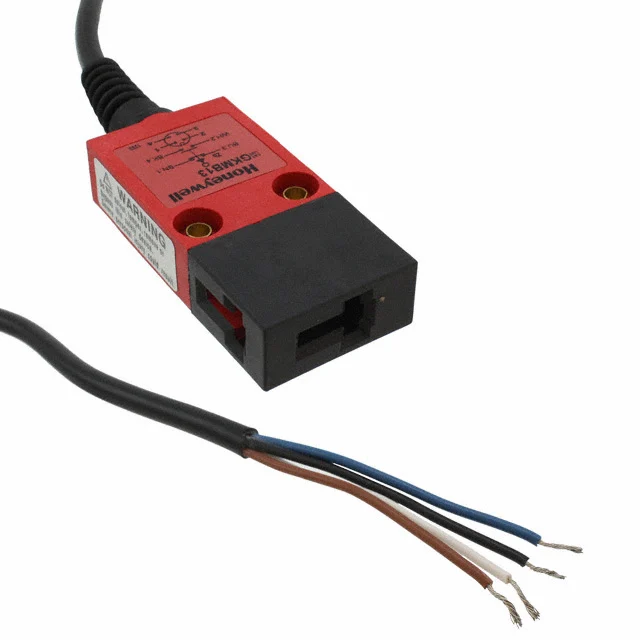
Honeywell GKMB13 Safety Interlock Switch: Key-Operated Protection for Machine Guarding
The Honeywell GKMB13 safety interlock switch is a key-operated safety interlock device designed for machine guarding and controlled access applications. Unlike a conventional limit switch that simply confirms position, a safety interlock switch is often part of the logic that helps prevent hazardous machine operation when a guard, gate, or cover is open. In that context, the Honeywell GKMB13 safety interlock switch is particularly valuable because it brings together a compact form, cable termination, environmental sealing, and a clear key-actuated operating concept.
What is Honeywell GKMB13?
Available technical summaries identify the Honeywell GKMB13 as a safety interlock switch in the GKM series. The product is described with N.O./N.C. DPST switching, a 10 A current rating, chassis or screw mounting, cable termination, UL/CSA/CE approvals, and a mechanical life of 5,000,000 cycles. It is also associated with IP67 and IP66 ratings, an operating temperature range of -25°C to 85°C, and a key-style disconnect actuator.
Why key-operated interlocks are important
The defining feature of the Honeywell GKMB13 Honeywell safety interlock switch is its key-operated design. In machine guarding, that means the switch changes state when the coded or matching actuator key is removed or inserted as the guard position changes. This approach helps create a more deliberate and secure relationship between physical access and machine control logic. It is especially relevant on doors, hatches, hinged covers, and guarded access panels where the machine should not run freely when protection is not in place.
Technical strengths of the GKMB13
The Honeywell GKMB13 safety interlock switch offers several characteristics that make it suitable for industrial use. A 10 A current rating allows integration into a wide range of control circuits. IP66 and IP67 protection support installation in environments where dust and water exposure may occur. The compact housing dimensions also help when space is limited around a guard or enclosure. At the same time, a mechanical life of 5 million cycles suggests the product is intended for long service in frequently accessed machinery.
Typical applications
The Honeywell GKMB13 key-operated safety interlock switch is well suited to packaging equipment, robotic cells, material handling systems, food and beverage machinery, and manufacturing lines with guarded doors. It can also be useful in access-controlled panels where the operating sequence depends on whether a protective barrier is properly engaged.
What makes this product especially practical is that it aligns with the way maintenance and safety teams think in the field. A visible key-actuated safety device gives a clear physical reference point. When diagnosing a system, technicians can inspect guard alignment, actuator entry, mounting stability, and cable integrity without guessing how the switching event is supposed to occur.
Installation and engineering considerations
As with any guarding component, the Honeywell GKMB13 safety interlock switch should be integrated into a properly engineered safety architecture. Mechanical alignment is essential. If the guard shifts over time, the key actuator may not engage consistently. Mounting rigidity, cable routing, and environmental exposure should all be considered at the design stage. Engineers should also verify that the product’s switching logic and approval profile align with the required machine safety approach in the target market.
The switch’s cable termination can simplify field installation because it avoids separate terminal wiring at the device body. That can be useful in compact guarded areas where wiring access is constrained. For more information about Honeywell, reviewing related machine-safety products can help determine whether a keyed interlock or another safeguarding method is the best operational fit.
Why the Honeywell GKMB13 remains relevant
The Honeywell GKMB13 safety interlock switch remains relevant because machine safeguarding still depends on components that are understandable, durable, and field-proven. In many industrial settings, that combination is more valuable than unnecessary complexity. A compact key-operated switch with strong sealing and a long mechanical life can still be the right answer when guarding strategy requires a physical interlock that technicians trust.
FAQ
What type of product is Honeywell GKMB13?
The Honeywell GKMB13 is a key-operated safety interlock switch in Honeywell’s GKM series, intended for machine guarding and controlled access applications.
What are the main specifications of the Honeywell GKMB13 safety interlock switch?
Published summaries list DPST switching, 10 A current rating, cable termination, chassis mounting, IP66/IP67 sealing, and a mechanical life of 5,000,000 cycles.
Where is Honeywell GKMB13 commonly used?
It is commonly used on machine guards, access doors, covers, panels, and enclosures where machine operation should be linked to the physical position of a protective barrier.
Why is IP67 important for a safety interlock switch?
IP67 helps protect the switch against dust ingress and water exposure, which supports dependable operation in harsher production environments where contamination can otherwise affect performance.
What temperature range is associated with Honeywell GKMB13?
Available product information shows an operating temperature range from -25°C to 85°C, covering many common industrial applications.
Does a safety interlock switch replace proper machine safety design?
No. A device like the Honeywell GKMB13 safety interlock switch must be part of a properly engineered safety system. Correct mounting, logic design, compliance review, and guard integrity all remain essential.