
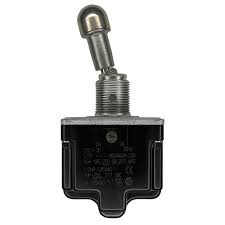
Honeywell 2TL1-3D Toggle Switch Technical Guide
What Is the Honeywell 2TL1-3D Toggle Switch?
The Honeywell 2TL1-3D toggle switch belongs to the well-known MICRO SWITCH TL Series, a family widely recognized in industrial, aerospace-adjacent, and rugged control applications where sealing, repeatability, and mechanical confidence matter. In practical terms, this is the kind of switch engineers choose when a standard panel switch is not enough and the environment may involve dust, vibration, temperature swings, or repeated operator use over a long service life.
The Honeywell 2TL1-3D toggle switch is commonly identified as a DPDT panel-mount toggle switch with screw termination and a sealed construction. That makes it relevant for applications where technicians want secure wire attachment, clear tactile actuation, and dependable switching behavior over time. In many specification listings, this model is associated with TL Series construction that is designed around a sealed lever-and-bushing architecture, which helps reduce the risk of contamination entering the switch body.
Core Technical Characteristics of the Honeywell 2TL1-3D DPDT Toggle Switch
From available product references, the Honeywell 2TL1-3D DPDT toggle switch is typically described with a double-pole, double-throw configuration, on-on switching function, and panel or bushing mount design. Listings also associate it with screw terminals, a sealed environment rating, and an operating temperature range that reaches from very low temperatures up to approximately 71°C. Several technical sources also identify it with 125 Vac and 250 Vdc switching references, while the broader TL Series is presented by Honeywell as a sealed series built to demanding performance expectations.
One reason this product remains relevant in technical searches such as “DPDT toggle switch,” “sealed toggle switch,” and “panel mount industrial toggle switch” is that it sits in a category where product quality has a direct effect on field reliability. The Honeywell 2TL1-3D toggle switch is not just a lever on a panel. It is a control interface component that influences operator confidence, maintenance intervals, and long-term electrical consistency.
Why the TL Series Construction Matters
Honeywell presents the TL Series as a line of sealed toggle switches with a bonded seal between the toggle lever and bushing, and also between the cover and case. That detail matters more than it may seem at first glance. In industrial enclosures, exposure to airborne contaminants, incidental fluid splash, and general environmental wear can gradually compromise unsealed hardware. A sealed toggle switch can help maintain switching integrity and reduce service interruptions in demanding installations.
This is why the search intent behind terms like Honeywell 2TL1-3D toggle switch, Honeywell TL series toggle switch, and Honeywell 2TL1-3D sealed toggle switch usually comes from engineers, maintenance teams, and procurement specialists who are looking for a part that fits an actual electrical or mechanical requirement, not simply a generic replacement.
Typical Applications for the Honeywell 2TL1-3D Toggle Switch
The Honeywell 2TL1-3D DPDT toggle switch is suitable for control panels, machine interface stations, power-routing functions, instrumentation panels, transport equipment, and other installations where a durable manual switching point is needed. Because the TL Series is associated with robust construction and established industrial use, it is often considered for systems where the switch may be actuated repeatedly and where downtime is expensive.
In real-world design work, a toggle switch like this is often chosen not because it is complex, but because it is predictable. That predictability matters in maintenance routines, retrofit planning, and spare-parts standardization.
Selection Considerations
When reviewing the Honeywell 2TL1-3D toggle switch, the most important checkpoints are the required circuit arrangement, mounting style, electrical load, termination preference, and environmental exposure. A DPDT switch gives design flexibility, but the surrounding application still needs to be validated carefully, especially for current, voltage, and panel layout requirements.
For more information about Honeywell products, it is useful to compare the broader switch family before finalizing an equivalent or a direct fit part.
FAQ
Is the Honeywell 2TL1-3D a sealed toggle switch?
Yes. The 2TL1-3D is associated with Honeywell’s TL Series sealed toggle switch construction. That sealing approach is one of the main reasons the part is frequently referenced for rugged environments.
What type of circuit does the Honeywell 2TL1-3D use?
Available technical listings describe the Honeywell 2TL1-3D toggle switch as a DPDT model. This gives it flexibility in applications where two circuits must be switched simultaneously.
What kind of terminals does the Honeywell 2TL1-3D have?
This model is commonly listed with screw terminals. That makes it a practical option in installations where technicians prefer mechanical wire fastening over quick-connect styles.
Why do engineers search for Honeywell 2TL1-3D toggle switch replacements?
Usually because they need a part with the same form factor, same switching logic, similar sealing performance, and proven durability. In many cases, mechanical fit and environmental performance are just as important as electrical rating.
Is the Honeywell 2TL1-3D suitable for industrial panels?
Yes. Its construction, sealed body, and DPDT format make it relevant for industrial control panels, instrumentation, and equipment interfaces where dependable manual switching is required.