
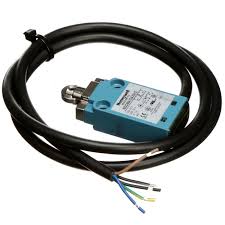
Honeywell NGCMA10AX01C Industrial Limit Switch Technical Guide
The Honeywell NGCMA10AX01C industrial limit switch is built for precise mechanical position detection in demanding factory environments. In many automation systems, limit switches are still the most dependable way to confirm whether a guard, actuator, machine arm, or moving assembly has reached a defined end position. That is exactly where the Honeywell NGCMA10AX01C limit switch stands out. It is known as a compact industrial switch with a roller plunger style actuator, a 1 m side-exit cable arrangement, and a 1NC/1NO contact layout that supports practical integration in control panels and machine logic.
What Type of Product Is Honeywell NGCMA10AX01C?
The Honeywell NGCMA10AX01C limit switch belongs to the industrial limit switch category and is used where repeatable position feedback matters. Unlike non-contact sensing methods that may be affected by distance, alignment, reflectivity, or electrical noise, a mechanical limit switch provides direct confirmation through physical actuation. For many engineers, that is still a preferred method in applications where deterministic switching behavior is more important than advanced electronics.
This model is generally identified with a roller plunger actuator, metal enclosure, and flying lead or side-exit 1 m cable configuration. That makes it suitable for machine builders who want a durable field device that can be mounted close to moving parts without adding separate plug assemblies.
Key Technical Characteristics
From a practical engineering perspective, the most relevant features of the Honeywell NGCMA10AX01C industrial limit switch are its actuator style, contact arrangement, and wiring format. The roller plunger helps reduce localized wear during repeated contact with cams or machine surfaces. The 1NC/1NO contact structure gives designers more flexibility in safety logic, interlocking, alarm output, or motion confirmation. The integrated side-exit cable also simplifies installation in equipment where connector clearance is limited.
In real-world maintenance work, these details matter more than marketing descriptions. A switch that is easy to align, easy to wire, and resistant to routine mechanical stress often reduces downtime over the long term.
Typical Applications
The Honeywell NGCMA10AX01C roller plunger limit switch is commonly relevant in packaging machinery, conveyor systems, transfer units, machine guards, and actuator travel confirmation points. It can be used to detect open/closed positions, end-of-stroke events, indexing points, or presence of a moving mechanism where physical contact is acceptable.
Because the actuator uses a roller plunger, it can perform well in applications where the moving target approaches from slightly varying angles. That can be useful in systems with cams, slides, and mechanical linkages. In machine design, this helps reduce sensitivity to small alignment changes over time.
Why Engineers Still Use Mechanical Limit Switches
There is a reason search demand remains strong for terms like industrial limit switch, roller plunger limit switch, and Honeywell limit switch. Mechanical switches remain highly relevant. They are easy to troubleshoot, familiar to maintenance technicians, and often simpler to validate in machine control systems. With the Honeywell NGCMA10AX01C industrial switch, the value lies in straightforward functionality: reliable position feedback, visible actuation, and practical wiring.
For more information about Honeywell, it helps to review broader product families and matching industrial switching solutions.
Installation Considerations
When installing the Honeywell NGCMA10AX01C industrial limit switch, the most important points are actuator alignment, cable routing, and mechanical overtravel control. The switch should be mounted so the roller plunger is contacted smoothly, without side loading that exceeds the intended motion path. Cable routing should also avoid pinch points, sharp bends, or direct abrasion near moving components.
Another best practice is to verify the switching point under real operating conditions. A machine may behave differently under vibration, thermal expansion, or full production speed than it does during initial setup. Good commissioning includes repeated cycling and confirmation of signal stability.
FAQ
What is the Honeywell NGCMA10AX01C used for?
It is used for mechanical end-position and presence detection in industrial machinery. Typical use cases include conveyor stops, guard door status, actuator travel limits, and moving assembly confirmation.
What actuator style does Honeywell NGCMA10AX01C use?
This model is commonly listed as a roller plunger limit switch. That actuator style is well suited to cam-driven and repeated-contact applications where smoother engagement is preferred.
Does Honeywell NGCMA10AX01C have both normally open and normally closed contacts?
Yes. It is commonly referenced with a 1NC/1NO contact arrangement, which gives flexibility for control logic, interlocks, and signal redundancy.
Why choose a cable exit limit switch instead of a connectorized version?
A fixed cable can simplify installation in compact machines, especially where connector clearance is limited. It can also reduce the number of field components required during assembly.
Is Honeywell NGCMA10AX01C suitable for high-cycle industrial use?
It is designed for industrial machine duty, but actual service life depends on alignment, load on the actuator, switching frequency, environment, and maintenance quality. Correct mounting has a major influence on longevity.
What should be checked during maintenance?
Maintenance teams should inspect actuator wear, switching consistency, mounting tightness, cable condition, and signs of contamination or mechanical damage. Preventive checks usually help avoid nuisance stops.