
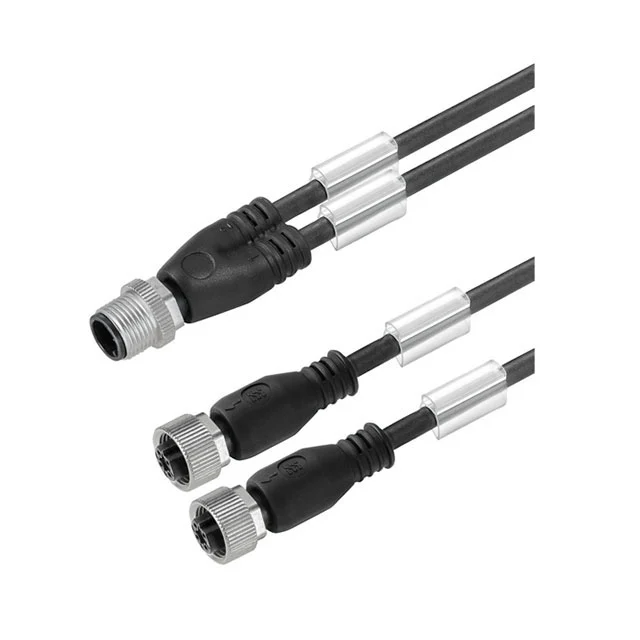
Weidmüller 1005460500 SAIL-ZW-M12BG-3-5.0U M12 Sensor-Actuator Adaptor Cable
The Weidmüller 1005460500 SAIL-ZW-M12BG-3-5.0U is a 5 m sensor-actuator adaptor cable designed for industrial M12 connectivity. It is a 3-pole, A-coded connecting line with twin cabling, one straight male connector, and two straight female connectors. For longer field-level routing in machinery, process lines, and modular equipment, this version stands out as a practical option where flexibility and industrial durability both matter.
Connector and Cable Architecture
This Weidmüller M12 cable is built according to IEC 61076-2-101 and uses M12 A-coded interfaces. The left connector is a straight male version and the right side consists of two straight female connectors. The product is unshielded and has no integrated LED, which keeps the construction straightforward for applications that prioritize mechanical reliability and standard field wiring over visual indication features.
The cable sheath is halogen-free black PUR, and the official product data identifies the configuration as suitable for sensor-actuator line applications. This construction is relevant in industrial systems where cabling may be exposed to movement, vibration, oils, and varying environmental conditions. The 5 m length also makes the product suitable for routing across larger machine sections or between a field device and a more distant connection point.
Detailed Technical Data
According to the official technical data, the Weidmüller 1005460500 uses a 0.34 mm² conductor cross-section and has a 3.8 mm ± 0.15 mm outer diameter. The cable is suitable for drag-chain use and is specified for 12 million bending cycles and more than 5 million torsion bending cycles. It also has a torsion resistance of 180°/m, a minimum bending radius of 10 x cable diameter when moving and 5 x cable diameter when fixed, and a tightening torque range of 0.8 to 1.2 Nm for the M12 connection.
Electrical data lists a rated current of 4 A and a rated voltage of 250 V. The contacts are gold-plated, and the cable insulation resistance is listed as 10^8 Ω. Environmental and mechanical resistance data also shows oil resistance, hydrolysis and microbe resistance, and flame-retardant behavior according to UL1581 UL/CUL FT2 and IEC 60332-2-2. The fixed temperature range is -50 to 80 °C, while the moving temperature range is -25 to 60 °C. Net weight is approximately 238.48 g.
Why the 5 m Version Is Often Chosen
A 5 m cable is often selected when routing distances are too long for short patch leads but still need to remain manageable within an industrial layout. In conveyor systems, machine modules, packaging lines, and remote sensor placements, a 5 m cable can bridge functional distances without forcing awkward intermediate joins. That improves installation simplicity and can support cleaner maintenance routines.
Search intent around this type of product is highly specific. Phrases such as Weidmüller 1005460500 M12 cable, SAIL-ZW-M12BG-3-5.0U adaptor cable, and Weidmüller 5 m sensor-actuator cable better reflect how technical users find exact products online than broad generic cable descriptions.
Weidmüller 1005460500 FAQ
What is Weidmüller 1005460500?
It is a ready-to-connect 3-pole M12 sensor-actuator adaptor cable with a 5 m length and a twin-cabling layout.
How long is SAIL-ZW-M12BG-3-5.0U?
The cable length is 5 m.
Weidmüller 1005460500 Is the cable suitable for drag-chain applications?
Yes. The technical data indicates that the cable is suitable for drag-chain use.
What are the rated current and voltage?
The cable is specified for 4 A rated current and 250 V rated voltage.
Is the cable resistant to oil and industrial stress?
Yes. The product data lists oil resistance, hydrolysis resistance, and microbe resistance, which are all relevant in industrial operating conditions.
Why would someone choose the 5 m version?
The 5 m length is useful when components are separated by a more substantial distance and a shorter cable would not provide enough routing flexibility.
For more information about Weidmüller, M12 connectivity, and field-level industrial cabling, reviewing related sensor-actuator products is a good next step.