
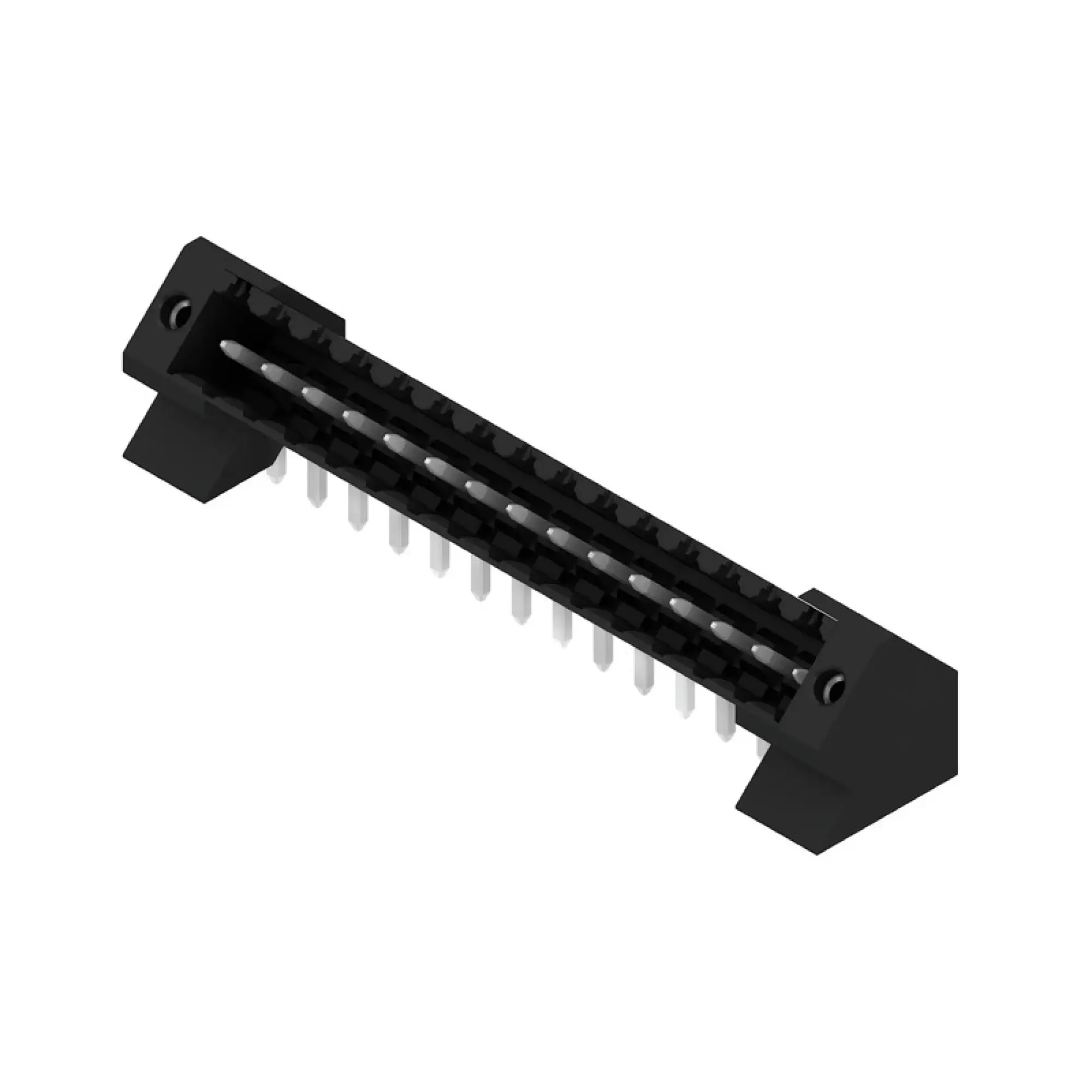
Weidmüller 1003650000 SL-SMT 3.50/15/135F 3.2SN BK BX Guide
The Weidmüller 1003650000 SL-SMT 3.50/15/135F 3.2SN BK BX is a 15-pole PCB male header created for pluggable board connection in compact but increasingly sophisticated electronic designs. As a Weidmüller 1003650000 PCB plug-in connector male header, it helps engineers keep higher connection counts under control while maintaining a structured and service-friendly interface strategy.
In modern industrial electronics, multi-pole compact connectors play a strategic role. They support efficient board design, reduce connector clutter, and help teams create a cleaner product architecture. The Weidmüller 1003650000 SL-SMT 3.50/15/135F 3.2SN BK BX male header is especially useful where product functionality has grown beyond small interface groups but still needs to remain within a compact 3.50 mm pitch system.
Product design and format
This connector is a flanged male header with THT/THR solder connection and a 135-degree layout. Those characteristics shape both mechanical and operational performance. The flange supports alignment and controlled positioning, while the THT/THR concept helps the connector stay firmly integrated with the PCB. That matters in devices expected to handle repeated mating, transport, service, or long operating life.
The angled format can also reduce integration friction in tight housings. Instead of forcing the cable or mating plug into an awkward path, the connector geometry can be used to guide the interface more naturally.
Technical characteristics
The Weidmüller SL-SMT 3.50/15/135F 3.2SN BK BX PCB connector uses a 3.50 mm pitch, 15 poles, and a 3.2 mm solder pin length. It is tinned, black, and packed in a box. The official electrical profile for this series is IEC 320 V / 15 A and UL 300 V / 10 A. Those values support its use in a wide range of professional board-level applications where compactness and interface quality both matter.
With 15 poles, the connector is well suited to grouped signal management, integrated low-voltage circuits, and controller interfaces that need more functionality per connector location. That can be a strong advantage when a PCB must remain efficient and organised.
Where a 15-pole header adds value
This version fits well in industrial control electronics, decentralised I/O products, smart building modules, advanced instrumentation, and communication hardware. In these applications, a multi-pole connector supports clearer grouping of functions and can make service tasks more straightforward.
Instead of scattering related lines across multiple small headers, one larger interface can create a more transparent electrical and mechanical structure. That is good for designers, assemblers, and technicians alike.
Engineering perspective
The Weidmüller 1003650000 product type is also valuable from a platform point of view. Product teams often want to keep a shared connector language across devices with slightly different feature sets. A family like this allows exactly that. The pitch, mating principle, and general design logic remain familiar even as pole count changes.
Weidmüller 1003650000 For more information about Weidmüller, it is useful to compare family members side by side during product platform planning.
Weidmüller 1003650000 FAQ
What is Weidmüller 1003650000?
It is a 15-pole PCB plug-in connector male header with flange, THT/THR solder connection, 3.50 mm pitch, and 135-degree orientation.
Why choose a 15-pole connector?
It allows broader grouped functionality through one organised interface, which can simplify layout and reduce connector fragmentation on the PCB.
Does this connector support compact designs?
Yes. Despite its higher pole count, it remains within a compact 3.50 mm pitch family that is well suited to space-conscious layouts.
What is the benefit of THT/THR soldering here?
It helps provide stronger mechanical anchoring, which is useful for stability and durability in technical devices.
Why is connector angle important?
The angle influences cable path, mating direction, and enclosure accessibility, which can all affect ease of integration.
What should be checked before finalising the part?
Engineers should confirm the counterpart, PCB layout, final application insulation requirements, and physical clearance inside the product housing.