
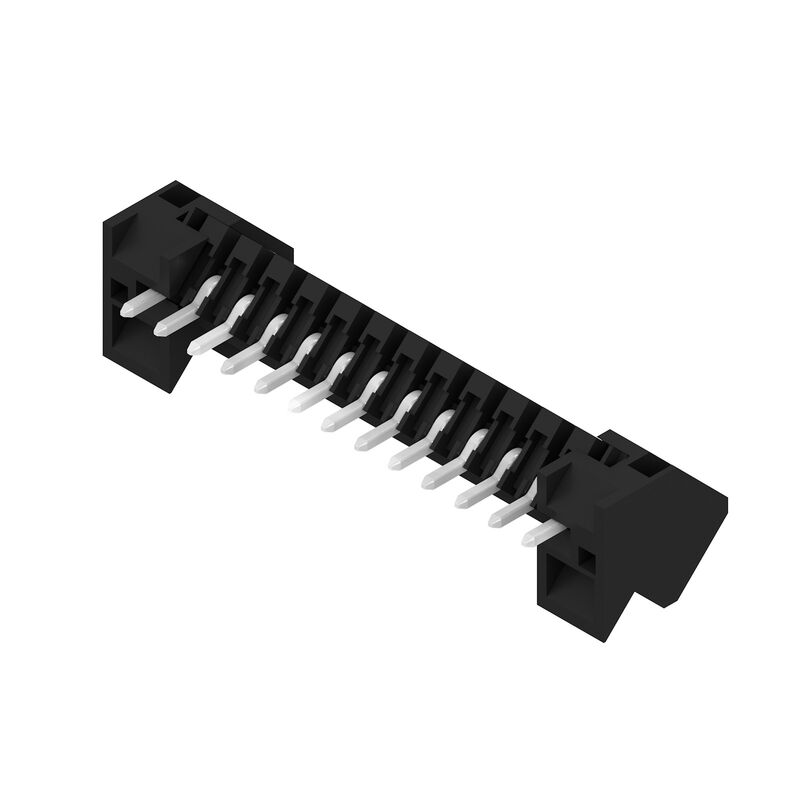
Weidmüller 1003630000 SL-SMT 3.50/13/135F 3.2SN BK BX Guide
The Weidmüller 1003630000 SL-SMT 3.50/13/135F 3.2SN BK BX is a 13-pole PCB male header designed for compact pluggable connection in industrial and professional board-level applications. As a Weidmüller 1003630000 PCB plug-in connector male header, it supports designers who need a denser interface while remaining within a manageable 3.50 mm pitch platform.
Once a product moves beyond basic compact signalling and begins to integrate broader control or interface functionality, pole count becomes a major layout factor. The Weidmüller 1003630000 SL-SMT 3.50/13/135F 3.2SN BK BX male header gives engineers a way to increase interface capacity without abandoning a consistent connection family or introducing unnecessary mechanical complexity.
Mechanical design and product identity
This connector is a flanged male header with THT/THR solder connection, which means it combines stable PCB anchoring with a structured pluggable interface. In practical engineering terms, that matters because the board connector is often exposed to insertion forces, service handling, and long-term mechanical stress. A dependable soldering concept helps support durability in the finished device.
The 135-degree orientation also has clear practical value. In dense control housings, cable direction and mating access can become difficult if connector angle is not carefully considered. This format gives product designers more control over how the connection sits relative to the board and enclosure.
Technical profile and ratings
The Weidmüller SL-SMT 3.50/13/135F 3.2SN BK BX PCB connector uses a 3.50 mm pitch, 13 poles, and a 3.2 mm solder pin length. It is tinned, finished in black, and supplied in box packaging. In this product family, official ratings are IEC 320 V / 15 A and UL 300 V / 10 A, which gives the connector a strong technical profile for compact industrial board applications.
A 13-pole configuration can be especially useful in devices where grouped signal, control, and reference connections need to remain on one organised interface. This supports cleaner product architecture and can simplify internal documentation and service instructions.
Where the 13-pole version works best
This product is well suited to industrial controller boards, decentralised automation electronics, compact measurement systems, embedded communication devices, and building control hardware. In all these areas, connection quality is measured not just by electrical values but also by integration logic, assembly efficiency, and service clarity.
Using a single multi-pole connector rather than multiple smaller headers can also reduce visual clutter and improve traceability during maintenance. That becomes increasingly valuable as product functionality expands.
Why this connector supports scalable design
The Weidmüller 1003630000 product type sits in a family that makes standardisation easier. Engineering teams can stay within one connector system as features evolve across different device versions. That helps with common footprints, familiar mating concepts, and a more coherent supply strategy.
Weidmüller 1003630000 For more information about Weidmüller, it is useful to evaluate nearby pole-count versions when planning a broader product portfolio based on the same connector philosophy.
Weidmüller 1003630000 FAQ
What is Weidmüller 1003630000?
It is a 13-pole PCB plug-in connector male header with flange, THT/THR solder connection, 3.50 mm pitch, and 135-degree orientation.
Why choose a 13-pole male header?
It can help keep a more complex board interface grouped into one clean connection point instead of splitting circuits across multiple smaller headers.
Does the 135-degree angle improve installation?
Yes. It can improve clearance, cable routing, and access depending on the enclosure and product layout.
What makes the connector mechanically reliable?
The THT/THR soldering concept and flanged construction both support stable PCB integration in demanding technical products.
Is this only for signal circuits?
No. It is suitable for a broader range of compact board-level interconnection tasks within its official ratings and application requirements.
What should engineers verify before adoption?
They should verify counterpart compatibility, footprint accuracy, insulation needs in the end device, and the physical impact of the angled connector format.