
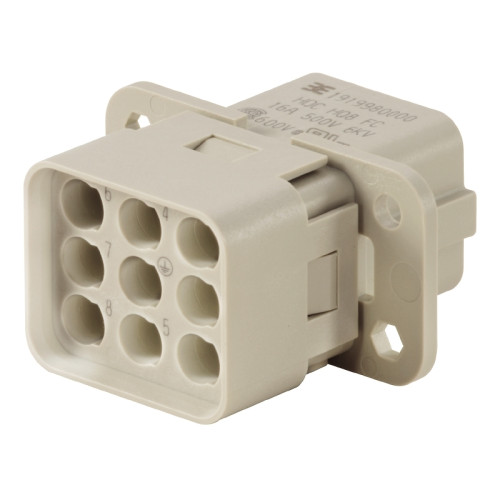
Weidmüller 1003080000 HDC HQM TOLU 1PG21 Technical Guide
The Weidmüller 1003080000 HDC HQM TOLU 1PG21 plug housing is a compact HQ-series hood for industrial connector applications that require top cable entry and a robust metal housing concept. In modern machine design, connector housings are selected not only for fit but also for mechanical behavior, installation logic, and environmental resilience. That is why product searches around PG21 plug housing, metal HQ housing, top entry industrial hood, and Weidmüller HDC HQM TOLU 1PG21 are common in specification work.
Weidmüller 1003080000 Housing Type and Technical Role
The Weidmüller HDC HQM TOLU 1PG21 is a plug housing with cable entry from the top. It is designed in HQ installation size and uses one PG21 external thread. This layout is useful where cables approach from above and where the selected gland size must accommodate larger cable diameters than PG16-based solutions. The housing is specified with a side-locking clamp on the lower side and IP65 protection in the plugged condition.
What Sets the HQM Version Apart
A notable technical point is that the Weidmüller 1003080000 HDC HQM TOLU 1PG21 belongs to the metal housing variant of the HQ series. Weidmüller states that the HQ metal housings include an internal plastic insert to ensure that the electrical conductor is not directly connected to the metal housing, meaning the housing is insulated. This is an important detail for engineers evaluating protective concepts and installation safety in demanding industrial environments.
Why PG21 Top Entry Matters
In many applications, the difference between PG16 and PG21 is more than a catalog detail. It affects cable selection, gland compatibility, strain relief planning, and overall routing strategy. The Weidmüller HDC HQM TOLU 1PG21 plug housing is therefore especially relevant in systems where cable outer diameter or protective sleeving requires a larger entry than smaller-format alternatives. That makes it a useful option in equipment with heavier cabling, industrial power distribution, or control systems with more demanding mechanical routing needs.
Weidmüller 1003080000 Industrial Use Perspective
Because it combines a top-entry design, metal housing construction, and HQ compactness, this model can fit well in transport systems, panel-based machine modules, production equipment, and process-related infrastructure. The side-locking system supports a secure mating concept, while the compact HQ form helps in installations where space is limited but housing quality cannot be compromised. In practice, that balance is one of the main reasons engineers stay within the HQ family for many heavy-duty connector tasks.
Selection Considerations
When choosing the Weidmüller 1003080000 HDC HQM TOLU 1PG21, the main specification questions are usually straightforward: is top entry the right routing direction, is PG21 the correct thread size, and does the project benefit from the metal HQM housing version? If the answer to those questions is yes, this model becomes a strong technical fit within a compact industrial connector architecture.
As always, the housing should be considered together with the mating base, insert type, and cable gland strategy. For More information about Weidmüller, reviewing the broader HQ housing ecosystem can support a cleaner and more future-ready design decision.
Weidmüller 1003080000 FAQ
What is Weidmüller 1003080000?
It is an HQ-series metal plug housing with top cable entry and one PG21 thread, designed for heavy-duty connector applications.
Why is the PG21 entry important?
PG21 allows a larger cable-entry size than PG16, which can be important for cable diameter, gland compatibility, and routing requirements in industrial equipment.
Is the metal housing electrically insulated?
Weidmüller states that the HQ metal housing includes an internal plastic insert so that the electrical conductor is not directly connected to the metal housing.
What ingress protection does it provide?
The product is rated IP65 in the plugged condition, supporting use in many industrial settings where environmental protection is required.
When is this housing preferred over a plastic alternative?
It is commonly preferred when the project prioritizes a metal housing concept, larger top-entry sizing, and durable mechanical performance in demanding industrial use.