
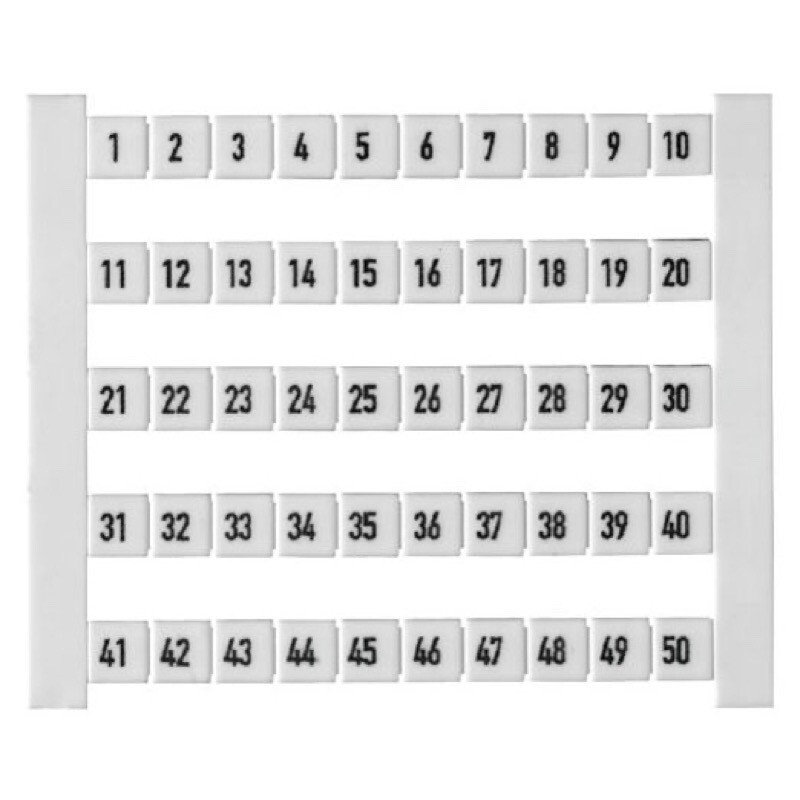
Weidmüller 0473460051 DEK 5 FW 51-100 Terminal Marker Guide
The Weidmüller 0473460051 DEK 5 FW 51-100 terminal marker is the numbered continuation of the DEK 5 FW marking family, providing terminal numbers from 51 to 100. Like the companion 1-50 version, it is intended for terminal labeling in a structured electrical installation. Manufacturer data identifies it as a marker for labeling terminals, with 5 mm width, 5 mm pitch, horizontal print orientation, and printed numeric characters.
Weidmüller 0473460051 What the Weidmüller DEK 5 FW 51-100 Is Designed For
The Weidmüller DEK 5 FW 51-100 terminal marker is used where a terminal strip extends beyond the first 50 positions or where numbering standards begin in a higher range. In real panel building, higher marker sequences are common in larger machines, marshalling cabinets, utility panels, and complex distribution assemblies. Using a matching continuation set preserves a consistent visual and documentation standard across the whole terminal row.
The product is described as suitable for printer or plotter workflows with the appropriate software, which reflects the broader Weidmüller marking logic. Even when using pre-numbered markers, compatibility with a standardized marking system is valuable because it simplifies ordering, storage, and panel documentation practices.
Technical Characteristics and Practical Value
The Weidmüller 0473460051 DEK 5 FW 51-100 numbered marker shares the same technical profile as the lower-numbered version: 5 mm width, 5 mm pitch, numeric printing, and horizontal orientation. It also carries the same industrial material references, including UL 94 V-2 and a minimum operating temperature of -40 °C. These details help confirm that the markers are intended for serious terminal identification in real electrical environments rather than temporary office-style labeling.
From a workflow perspective, higher-range number markers become especially useful when a project spans multiple terminal groups or when OEM standardization requires consistent numbering from one cabinet family to another. Instead of mixing handwritten numbers or inconsistent labels, a dedicated sequence keeps the strip readable and professional. {index=64}
Weidmüller 0473460051 Why Consistent Terminal Numbering Supports Better Maintenance
The Weidmüller DEK 5 FW 51-100 marker set supports traceability. When maintenance teams can identify terminal positions quickly and confidently, diagnostic work becomes faster and less error-prone. This is particularly important in larger systems where several rows of terminals may serve similar functions. A well-numbered strip reduces confusion and supports safer intervention.
It also improves drawing alignment. Electrical schematics and wire lists depend on stable terminal numbering conventions. If the physical terminal strip follows the same logic, the handover between design, installation, and service remains much smoother.
For more information about Weidmuller, it helps to review the complete marking family, especially when a project needs both pre-numbered and custom-print marker strategies.
Weidmüller 0473460051 FAQ
What is the difference between DEK 5 FW 1-50 and DEK 5 FW 51-100?
The difference is the printed numbering range. This version continues the sequence from 51 to 100, making it suitable for larger terminal strips or projects with extended numbering logic.
Why should larger terminal strips use dedicated numbered markers?
Because dedicated numbered markers improve readability, reduce manual marking effort, and help maintain consistent documentation across long or complex terminal rows.
Are the technical dimensions the same as the 1-50 version?
Yes. The manufacturer data shows the same 5 mm width and 5 mm pitch along with the same horizontal print orientation and numeric character style.
Is this product only useful in large industrial cabinets?
No. It is most obviously useful in larger cabinets, but any panel that needs numbering above 50 can benefit from using a consistent continuation marker set.