
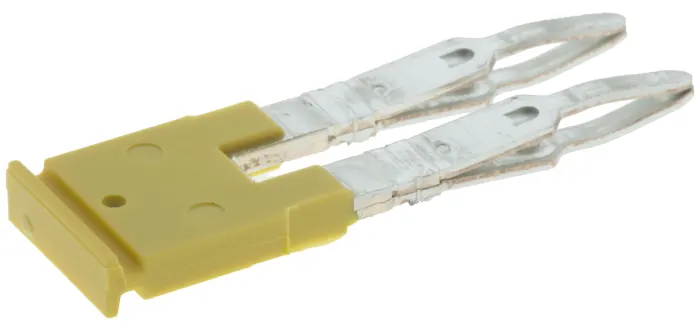
Weidmüller 1608940000 ZQV 2.5/10 Cross-Connector Technical Guide
The Weidmüller 1608940000 ZQV 2.5/10 cross-connector is an accessory for feed-through terminal blocks used for potential distribution and signal transmission. In terminal block engineering, cross-connectors are essential for efficient commoning. They allow multiple terminals to share a potential quickly and consistently, reducing wiring time and improving order inside the terminal strip.
What the Weidmüller ZQV 2.5/10 Does
The Weidmüller ZQV 2.5/10 terminal cross-connector is designed to bridge multiple feed-through terminal blocks. This supports common potential distribution without the need to jumper individual terminals with separate wires. In practice, that can make cabinet assembly cleaner, faster, and easier to understand during service work.
Datasheet information identifies the product as an accessory cross-connector rated at 24 A. This current rating is a key consideration because potential distribution accessories must match the electrical requirements of the terminal arrangement. The product is commonly associated with a 10-pole format, which is reflected in the product naming and common application logic.
Weidmüller 1608940000 Technical Characteristics That Influence Terminal Design
The Weidmüller 1608940000 ZQV 2.5/10 cross-connector is more than a convenience part. It affects how efficiently terminal potentials are distributed and how clearly those connections are documented. Manufacturer data also notes that the use of cross-connectors reduces the rated voltage to 400 V. In addition, when cut cross-connections with blank cut edges are used, the voltage is reduced to 25 V. Those details are highly important because accessory selection in terminal systems must always be aligned with the final voltage concept.
Dimensions reported in available datasheet material include approximately 27.6 mm depth and 49.3 mm height. While the exact mechanical relevance depends on the terminal family, these values help engineers understand the physical profile of the accessory within a denser terminal strip arrangement.
Weidmüller 1608940000 Why Cross-Connectors Matter in Control Panels
Without a structured cross-connector strategy, terminal strips can become crowded with unnecessary jumper wires. That increases assembly time and can make troubleshooting harder later. The Weidmüller ZQV 2.5/10 terminal accessory helps replace that clutter with a more standardized distribution method. In a well-organized panel, standardized potential distribution improves both installation quality and service clarity.
Cross-connectors are especially useful for 24 V DC distribution, common return potentials, and grouped signal routing where several adjacent terminals must share the same electrical reference. In those cases, a dedicated accessory is often more reliable and more readable than improvised jumper wiring.
Weidmüller 1608940000 Best-Fit Use Cases
The Weidmüller 1608940000 ZQV 2.5/10 cross-connector is suitable for control cabinets, machine terminal strips, building automation panels, and industrial marshalling sections where grouped potential distribution is needed. It supports a cleaner and more scalable terminal architecture, particularly in projects where multiple similar circuits are arranged side by side.
For more information about Weidmüller, it is useful to review the broader terminal block and accessory portfolio, since cross-connectors work best when selected as part of a coordinated terminal system.
Weidmüller 1608940000 FAQ
What is the main advantage of using the Weidmüller ZQV 2.5/10 instead of wire jumpers?
The main advantage is structured potential distribution. A cross-connector creates a cleaner, faster, and more standardized connection across adjacent terminal blocks. Compared with separate wire jumpers, it usually improves readability, reduces installation effort, and supports better maintenance visibility.
Weidmüller 1608940000 Why is the 24 A rating important?
The 24 A rating indicates the current capability associated with the accessory. Engineers need this information to make sure the cross-connector matches the intended electrical loading of the terminal group. Even in low-voltage control systems, correct current coordination is essential for safe and reliable design.
What does the voltage reduction note mean for practical applications?
It means the connector’s use changes the applicable rated voltage conditions of the terminal system. According to the product data, using cross-connectors reduces the rated voltage to 400 V, and cut versions with blank cut edges reduce it further to 25 V. This is an important design detail and should always be considered during terminal strip planning.
Where is a cross-connector most useful in an electrical cabinet?
It is most useful wherever several adjacent terminals need a shared potential, such as common 24 V DC distribution, common returns, or grouped signal references. In those layouts, the accessory improves order and makes the terminal strip more understandable for installation and service teams.