
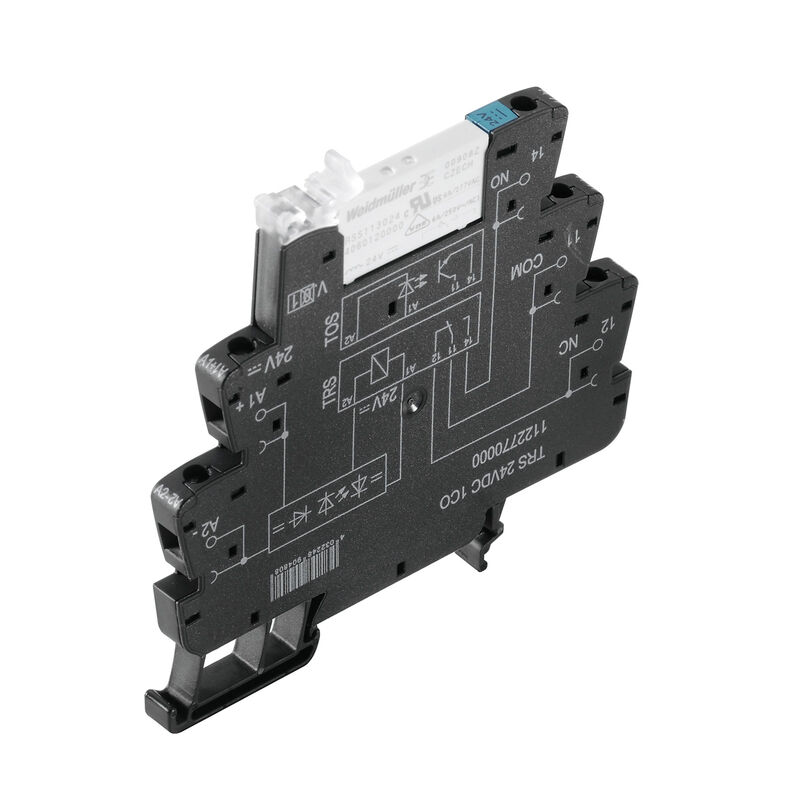
Weidmüller 2638320000 TRS 24VDC 1CO Guide
Relay modules continue to be one of the most practical ways to build clean and serviceable control circuits inside industrial cabinets. The Weidmüller 2638320000 TRS 24VDC 1CO relay module belongs to the TERMSERIES family and is described as an assembly of plug-in relay and plug-in socket. For professionals searching for a Weidmüller TRS 24VDC 1CO relay module, 24 V DC relay interface, or 1 CO relay module with screw connection, this product offers a structured solution for compact control applications.
Weidmüller 2638320000 What Is the TRS 24VDC 1CO?
The Weidmüller TRS 24VDC 1CO is a relay module that integrates a relay and socket concept in one coordinated format. It is specifically described as an assembly of plug-in relay and plug-in socket, and the product information also emphasizes that the control circuit and load circuit are electrically isolated. That kind of galvanic separation is one of the main reasons relay modules remain so relevant in automation engineering.
The module is aimed at situations where clear switching logic, safe separation, and straightforward panel integration are important. In many cases, it becomes the practical link between a PLC or controller output and a downstream switching task.
Technical Details That Support Real Installations
The Weidmüller 2638320000 relay module uses screw connection architecture and is associated with conductor information including finely stranded wires and two clampable wires. The product information references a maximum of 1 mm² for finely stranded conductors and indicates a blade size of PH0. These data points help engineers determine whether the module fits their preferred wiring approach and tool standard.
The 1 CO contact format is highly practical because it allows a single control action to direct either a normally open or normally closed path depending on circuit design. That flexibility makes the module suitable for alarm logic, signal handoff, output isolation, and auxiliary switching tasks.
Weidmüller 2638320000 Why Galvanic Isolation Still Matters
One of the strongest reasons to choose a relay module like the Weidmüller TRS 24VDC 1CO is electrical isolation between the control and load circuits. In real control cabinets, this separation can improve signal integrity, protect control electronics, and support more predictable troubleshooting. It also helps engineers build a clearer functional structure into the panel.
That matters even more in mixed systems where low-level control electronics interact with field-side loads and external circuits.
Typical Areas of Use
The Weidmüller 2638320000 TRS 24VDC 1CO relay module is suitable for machine control panels, building automation, signal interface cabinets, and general industrial control assemblies. It is particularly useful where 24 V DC control is standard and where maintenance teams value compact, replaceable relay solutions.
Because the module format is already structured, it can also help reduce design complexity during panel standardization. That is useful for OEMs and integrators working across repeated cabinet types.
Weidmüller 2638320000 FAQ
What is the Weidmüller 2638320000 TRS 24VDC 1CO?
It is a TERMSERIES relay module that combines a plug-in relay and a plug-in socket in one coordinated assembly for 24 V DC control applications.
What is the benefit of galvanic isolation in this module?
Galvanic isolation separates the control circuit from the load circuit, which helps protect control electronics and improves system clarity and troubleshooting.
What connection method does this module use?
It uses screw connection, which remains a familiar and reliable choice in many industrial panel-building environments.
What does 1CO mean here?
It means one changeover contact, giving the user flexibility to work with both normally open and normally closed circuit logic.
Where is the TRS 24VDC 1CO commonly used?
It is commonly used in PLC interfaces, control cabinets, building automation panels, and machine control systems that rely on 24 V DC signals.
Why do engineers choose relay modules instead of loose relays?
Because relay modules simplify installation, improve consistency, and make maintenance easier through a more integrated physical design.
For more information about Weidmüller, you can review related relay modules and interface technologies.