
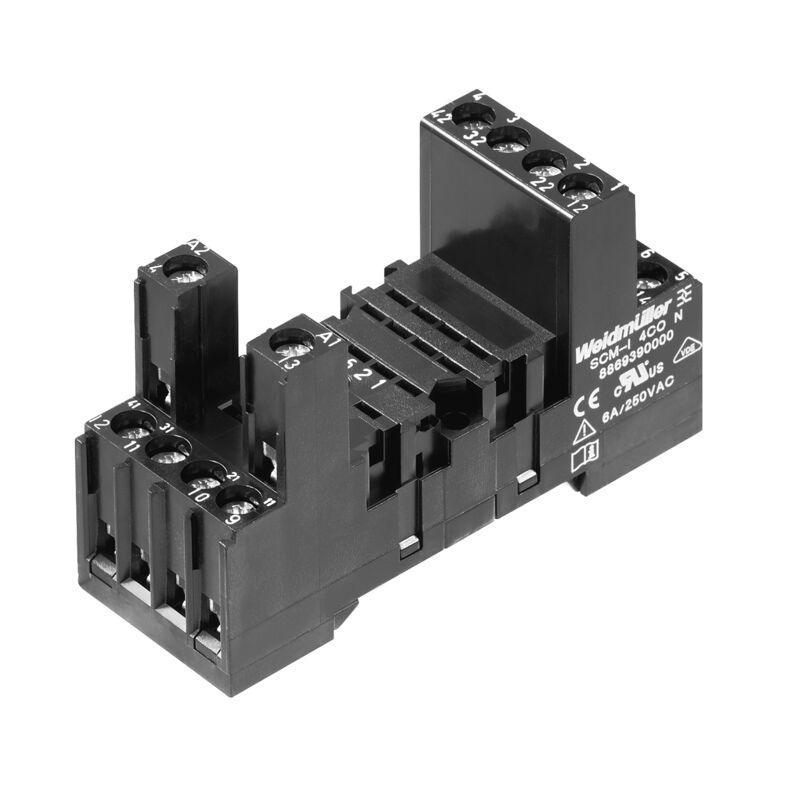
Weidmüller 8869390000 SCM-I 4CO N Relay Socket Explained
Relay sockets are a small but strategic part of panel architecture. The Weidmüller 8869390000 SCM-I 4CO N relay socket is designed to accept an industrial plug-in relay and support a structured relay interface inside industrial control systems. If your work involves relay logic, signal multiplication, or compact switching arrangements, the socket choice directly affects serviceability, panel order, and long-term maintainability.
What Is the Weidmüller SCM-I 4CO N?
The Weidmüller SCM-I 4CO N is a relay socket intended for use with an industrial plug-in relay with a four changeover contact arrangement. In simple terms, it provides the base through which the relay is mounted and connected into the wiring system. That makes it important in applications where a robust, repeatable, and organized relay installation method is required.
Compared with improvised or less structured relay mounting methods, a dedicated socket provides cleaner panel design. It separates fixed wiring from replaceable switching components, which is a major advantage during troubleshooting and replacement.
Important Technical Characteristics
The official product information identifies the Weidmüller 8869390000 relay socket as a socket for an industrial plug-in relay and notes connection details including clampable conductor information. It also highlights an important safety-related note: IP20 without connected conductor at complete opened clamping yoke connection. That is the kind of installation detail experienced control panel designers take seriously, because the degree of protection depends on how the product is actually wired and assembled.
The product data also references a blade size PZ1. In a practical sense, that helps electricians and technicians anticipate the required installation tooling and fastening approach. Small details like tool compatibility can have a real effect on assembly speed and consistency in series production environments.
Where a 4CO Relay Socket Fits Best
The value of a Weidmüller SCM-I 4CO N relay socket becomes clearer in control strategies where one relay needs to influence multiple circuits. Four changeover contacts allow a relay arrangement to manage more complex signaling or control distribution than simpler single-contact solutions. That is relevant in machine building, signaling logic, interlocking schemes, and conventional control cabinets where separate status paths or auxiliary switching paths are needed.
In many facilities, relay sockets like this sit at the intersection of reliability and maintainability. The relay can be exchanged while the socket remains wired in place, helping reduce downtime. For maintenance teams, that modularity often matters more than the component’s small physical size suggests.
Why It Supports Better Panel Engineering
Good panel engineering is not just about making a circuit work once. It is about making the system understandable and serviceable years later. The Weidmüller 8869390000 SCM-I 4CO N relay socket contributes to that goal by enabling a defined relay interface inside a DIN rail environment. It supports clearer component placement, more consistent maintenance procedures, and easier replacement planning.
It also aligns with the wider Weidmüller relay ecosystem, where sockets, relays, accessories, and marking concepts are organized as a system rather than isolated parts. That system thinking matters in scalable industrial design.
Weidmüller 8869390000 FAQ
What is the Weidmüller 8869390000 SCM-I 4CO N used for?
It is used as a relay socket for an industrial plug-in relay, creating the connection and mounting base inside control panels and automation assemblies.
Does this product include the relay itself?
No. It is a socket, not the switching relay. It is designed to accept a compatible industrial plug-in relay.
Why is a 4CO arrangement important?
A four changeover contact arrangement is useful where one relay must influence multiple switching paths, status circuits, or auxiliary control functions within the same logic structure.
What does the IP20 note mean here?
The official information indicates IP20 protection without connected conductor at a completely opened clamping yoke connection. This highlights that installation condition affects the resulting protection characteristics.
Why do engineers prefer relay sockets in service-heavy environments?
Because sockets support modular relay replacement. The field wiring remains in place, and the relay can be exchanged more efficiently, which helps reduce downtime and intervention risk.
Is this relevant for machine panels and conventional automation?
Yes. It fits machine control panels, signaling systems, industrial interfaces, and other relay-based control arrangements that benefit from organized wiring and quick service access.
For more information about Weidmüller, you can explore the wider relay and interface ecosystem.