
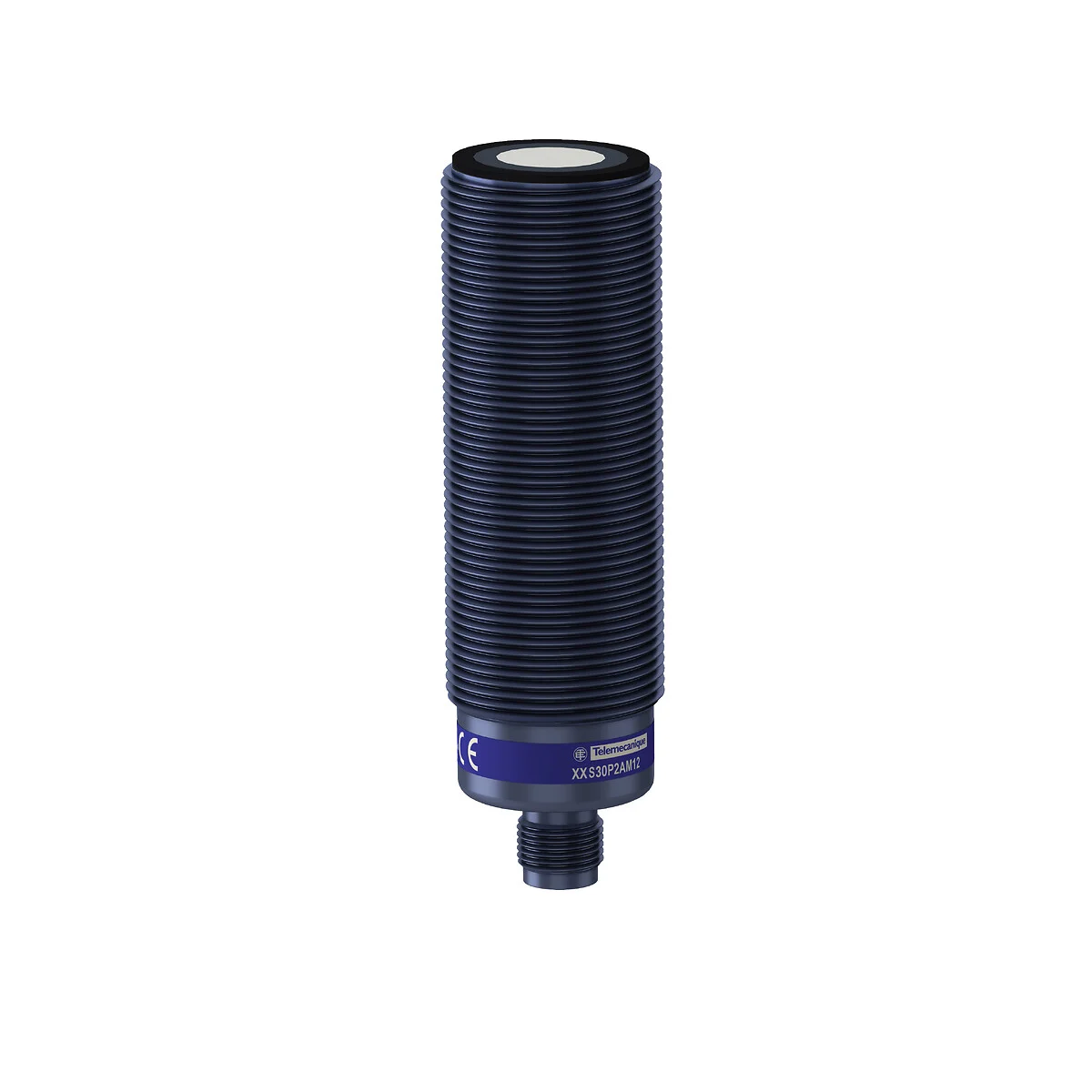
Telemecanique Sensors XX930A2A2M12 Ultrasonic Sensor: 2 m Adjustable Diffuse Detection with 4–20 mA Output
The Telemecanique Sensors XX930A2A2M12 ultrasonic sensor is a general-purpose ultrasonic solution designed for distance and presence detection in environments where optical sensors can struggle—such as dusty areas, variable colors, or low-contrast targets. Ultrasonic sensing is frequently selected when you need stable detection across different materials and surface finishes, because it does not rely on visible light reflectivity.
Verified Technical Snapshot (Datasheet Highlights)
The product datasheet describes XX930A2A2M12 as an ultrasonic sensor with a cylindrical M30 design and diffuse detection system. The nominal sensing distance is listed as 2 m, adjustable with teach push-button. It specifies an analogue output signal with 4…20 mA analogue output function, and a 4-wire wiring technique. The connection is noted as an M12 connector.
Telemecanique Sensors XX930A2A2M12 Why Ultrasonic Sensing Is Often Chosen Over Photoelectric
Ultrasonic sensors detect objects using sound waves rather than light. In practice, this can reduce sensitivity to:
- Color and print changes on packaging
- Dusty environments where optical lenses require frequent cleaning
- Low contrast targets that confuse diffuse photoelectric sensing
That does not mean ultrasonic is always “better.” The most reliable solution comes from matching the sensing principle to the application. For example, very soft materials, angled targets, or moving air turbulence can influence ultrasonic performance. The engineering goal is consistent detection margin across real production conditions.
2 m Adjustable Range: Practical Setpoint Governance
The datasheet confirms 2 m adjustable with a teach push-button. This is valuable in commissioning because it supports fine-tuning to your actual machine geometry. To reduce operational drift and maintenance variability:
- Document the setpoint: record the taught distance or process reference per station.
- Standardize the procedure: define who is authorized to re-teach and under which conditions.
- Verify under worst-case conditions: test at maximum line speed and with the most challenging target surface.
This governance approach reduces “mystery faults” where one shift teaches a slightly different threshold and downstream logic becomes unstable.
4–20 mA Analog Output: Better for Process Insight
The 4–20 mA analog output is often a strategic choice because it supports both control and diagnostics.
- implement thresholding in software (more flexible than fixed discrete switching),
- trend distance values to detect process drift,
- build predictive maintenance signals (e.g., gradual changes in measured distance).
In mature automation environments, analog data becomes a valuable operational asset—especially for quality assurance and downtime analysis.
Installation Best Practices: Mechanical and Electrical
- Mounting rigidity: avoid flexible brackets; vibration changes geometry and reduces measurement repeatability.
- Target validation: validate with the real product types and real approach angles.
- Signal integrity: route analog cabling with good practice to reduce noise; use proper grounding concepts as required by your control standards.
- Commissioning at speed: validate performance at production speed and under normal environmental airflow conditions.
Required internal link: Telemecanique sensor.
FAQ: Telemecanique Sensors XX930A2A2M12
What type of sensor is XX930A2A2M12?
It is an ultrasonic sensor with a cylindrical M30 design.
What is the sensing distance?
The datasheet lists a 2 m nominal sensing distance, adjustable with a teach push-button.
What output signal does it provide?
It provides an analogue 4–20 mA output.
How is it connected?
The datasheet indicates an M12 connector and 4-wire wiring technique.