
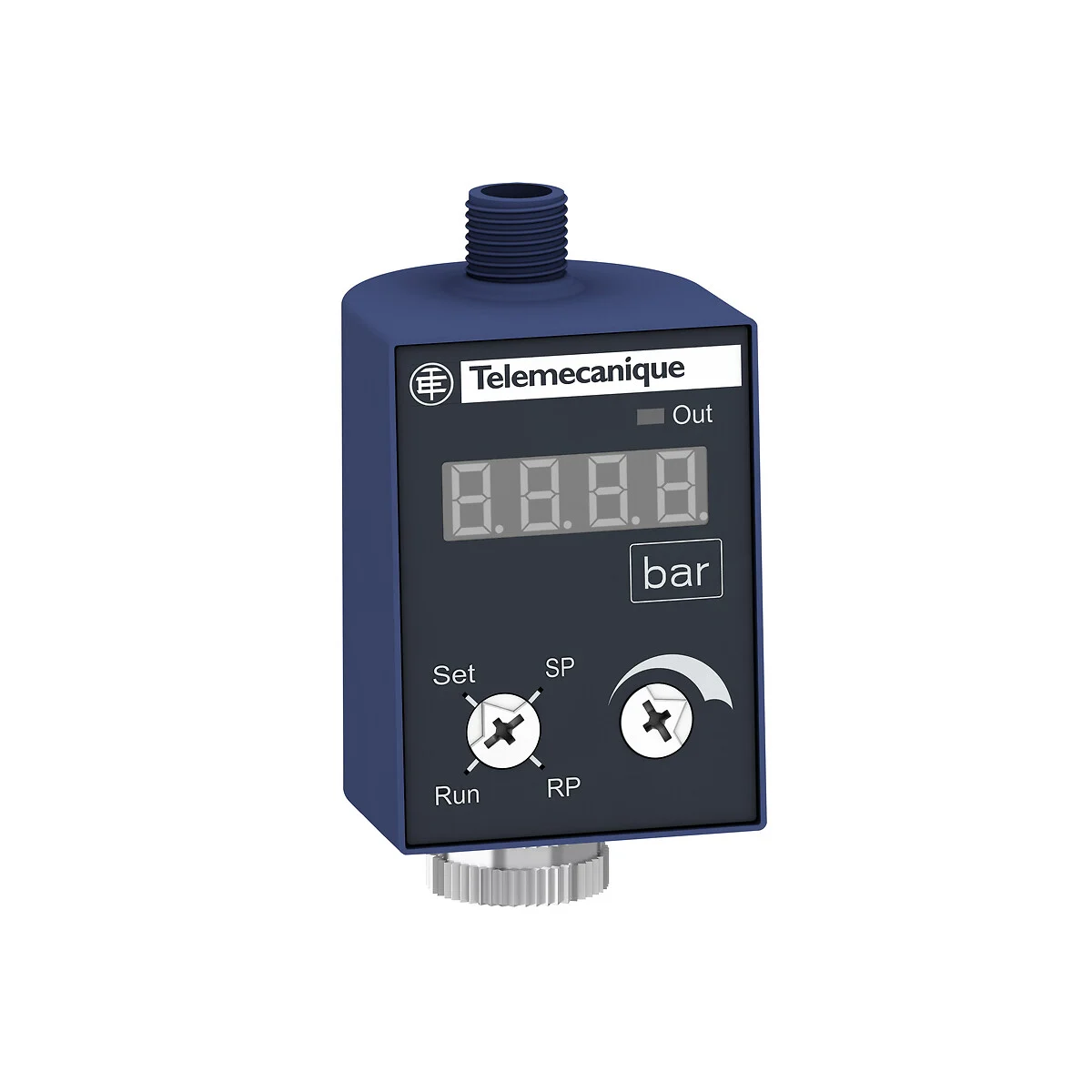
Telemecanique Sensors XMLP600BD72 Industrial Pressure Sensor Technical Overview
Telemecanique Sensors XMLP600BD72 industrial pressure sensor is engineered for high-pressure applications where measurement accuracy and mechanical durability must operate together. With a measuring range up to 600 bar, this device is positioned for demanding hydraulic and industrial fluid systems.
In technical documentation, the full expression “Telemecanique Sensors XMLP600BD72 industrial pressure sensor” is used to clearly distinguish this 600 bar model from other XMLP series variants. Accurate identification is essential in engineering specifications, spare parts planning, and system commissioning.
For complementary sensing technologies and connection accessories, refer to the complete Telemecanique sensor range.
Core Technical Specifications
- Pressure measurement range: 0–600 bar
- Analogue output: 0–10 V
- Electrical connection: M12 connector interface
- Process connection: G 1/4 threaded port
- Housing material: Stainless steel construction
- Ingress protection: IP65 and IP67 (family variants may list IP69K)
- Typical response time: Approximately 5 ms
Telemecanique Sensors XMLP600BD72 industrial pressure sensor provides a 0–10 V analogue output that integrates directly into PLC analogue input modules. The high-pressure tolerance of 600 bar allows it to operate in heavy-duty hydraulic presses, injection molding equipment, and energy sector machinery.
Mechanical and Electrical Architecture
The stainless steel housing of Telemecanique Sensors XMLP600BD72 industrial pressure sensor ensures structural stability under extreme mechanical stress. This design also enhances resistance to corrosion in industrial environments where oil, coolant, or moisture exposure is common.
The M12 electrical connector supports standardized industrial wiring practices. Proper connector tightening ensures sealing performance aligned with the declared IP rating. In high-pressure systems, maintaining both hydraulic and electrical integrity is critical.
Integration in High-Pressure Systems
When integrating Telemecanique Sensors XMLP600BD72 industrial pressure sensor, engineers should verify compatibility with the intended hydraulic circuit. The 0–10 V signal must be correctly scaled within the PLC or controller to ensure accurate data representation.
Due to its rapid response time, the sensor supports real-time pressure monitoring. This capability is particularly relevant in applications requiring immediate feedback loops, such as automated press control or hydraulic load balancing.
Operational Advantages
Telemecanique Sensors XMLP600BD72 industrial pressure sensor is widely applied in sectors such as heavy manufacturing, metal forming, and high-pressure fluid transport. Its design balances measurement precision with industrial ruggedness.
The 600 bar rating makes it suitable for systems where transient pressure peaks occur. Proper system design should account for these peaks to prevent mechanical overstress.
Maintenance and Diagnostics
Routine inspection of Telemecanique Sensors XMLP600BD72 industrial pressure sensor should include verifying thread sealing, checking connector stability, and confirming signal stability under operating load.
If measurement drift is suspected, technicians should first validate supply voltage consistency and confirm correct analogue scaling within the control system.
Application Examples
Common applications include hydraulic power units, industrial presses, offshore machinery, and heavy-duty manufacturing systems. In these contexts, continuous pressure monitoring is fundamental for operational safety and efficiency.
FAQ
1. What is the maximum pressure range?
The sensor measures pressure up to 600 bar.
2. What type of output does it provide?
It delivers a 0–10 V analogue output signal.
3. What connection type is used?
It uses a G 1/4 threaded process connection and an M12 electrical connector.
4. Is it suitable for harsh environments?
Yes, the stainless steel housing and IP-rated protection make it appropriate for demanding industrial conditions.
5. What industries typically use this sensor?
It is commonly used in hydraulic systems, heavy manufacturing, and high-pressure industrial applications.