
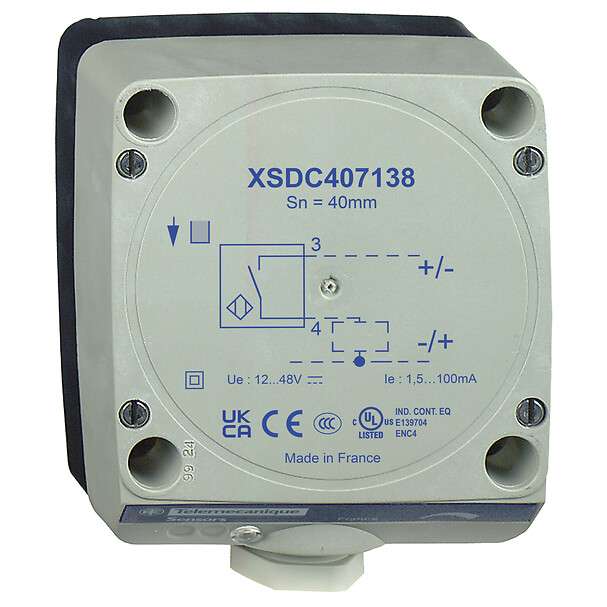
Telemecanique XSDC607139 Inductive Proximity Sensor: Practical Technical Guide
Inductive proximity sensing remains a cornerstone of industrial automation because it detects metal targets reliably without physical contact and with strong tolerance to dust, oil mist, and ambient light. The Telemecanique XSDC607139 inductive proximity sensor is specified with a 60 mm nominal sensing distance (Sn) and is designed for robust discrete detection tasks. It is a DC sensor with 12…48 V DC supply and a 2-wire wiring technique, supporting installations where simple wiring and dependable switching are priorities.
What the Telemecanique XSDC607139 Inductive Proximity Sensor Detects
As an inductive sensor, the Telemecanique XSDC607139 inductive proximity sensor detects metallic objects by sensing changes in an electromagnetic field near its detection face. This makes it suitable for confirming the presence of steel brackets, machine elements, pallets with metal components, tooling plates, or metal actuator flags. Unlike photoelectric sensors, performance is not influenced by target color or transparency, which is often valuable for heavy-duty industrial stations.
Key Datasheet Specifications
- Product type: Inductive proximity sensor (Telemecanique XS series, XSD family)
- Nominal sensing distance (Sn): 60 mm
- Output function: 1 NO (discrete)
- Supply voltage: 12…48 V DC
- Wiring: 2-wire
- Electrical connection: Screw-clamp terminals
- IP rating: IP67
- Switching frequency: ≤ 20 Hz
- Switching capacity: 1.5…100 mA
- Mounting: Non-flush mountable (as listed)
- Operating temperature: -25…70 °C
- Body material: Plastic
These values indicate that the Telemecanique XSDC607139 inductive proximity sensor is optimized for stable position sensing and presence confirmation rather than ultra-high-speed counting. The specified switching frequency (≤20 Hz) aligns with applications like end-stop confirmation, gate position checks, and slow-to-moderate mechanical movements.
Mounting and Mechanical Best Practices
The datasheet indicates the sensor is non-flush mountable, which is a key installation requirement. In practice, this means you should avoid embedding the sensor fully in metal structures that could interfere with its sensing field. Provide adequate clearance around the sensing face, and follow mechanical design rules that keep large metal masses from surrounding the detection zone. For best repeatability, use a rigid bracket and ensure the target approaches the detection face consistently.
If your project includes multiple sensor technologies (photoelectric, inductive, and safety sensors), consolidating documentation and selection rules helps reduce downtime. You can browse complementary families within the Telemecanique sensor category and align on wiring practices, IP requirements, and terminal/connector preferences per machine zone.
Electrical Integration Notes (2-Wire DC, NO Output)
The Telemecanique XSDC607139 inductive proximity sensor uses a 2-wire technique and provides a normally open discrete output. In many systems, 2-wire sensors simplify wiring runs but require careful consideration of load current and PLC input characteristics. Always verify that your input module and load fall within the sensor’s switching capacity range. The screw-clamp terminal connection supports straightforward panel wiring and can be beneficial in installations where field connectors are not preferred.
Typical Applications
- End-of-stroke confirmation: Detect a metal flag at a cylinder or actuator endpoint.
- Gate and door position: Confirm that a safety guard or access door is closed (where inductive confirmation is acceptable in the risk design).
- Fixture presence: Verify tooling plates or metal pallets are present before cycle start.
- Conveyor hardware checks: Detect metal lugs or carriers passing a checkpoint at moderate speed.
In these scenarios, the Telemecanique XSDC607139 inductive proximity sensor is valued for its non-contact operation and stable triggering in environments where optical sensors may be less practical.
FAQ
1) What sensing distance does Telemecanique XSDC607139 provide?
The Telemecanique XSDC607139 inductive proximity sensor has a nominal sensing distance (Sn) of 60 mm.
2) What supply voltage range is supported?
The datasheet specifies 12…48 V DC operation.
3) What wiring method is used?
It is a 2-wire DC sensor with screw-clamp terminals for electrical connection.
4) Is it flush mountable?
No. The datasheet indicates it is non-flush mountable, so clearance around the sensing field is important.
5) Is it suitable for high-speed counting?
It is typically used for position and presence tasks; the datasheet lists switching frequency up to 20 Hz.