
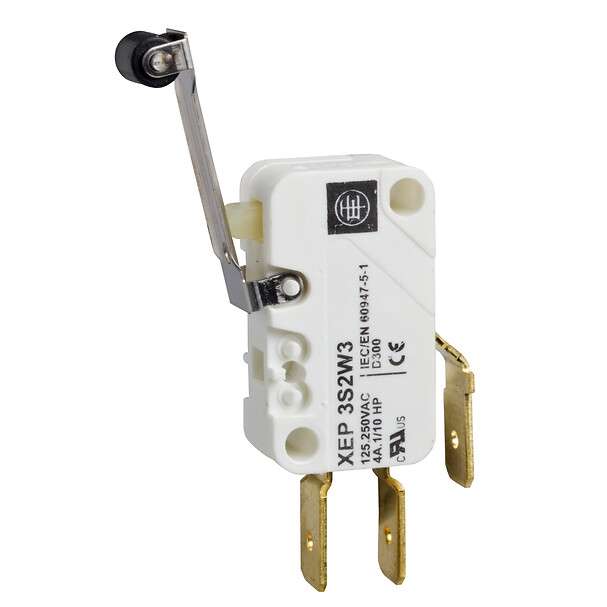
Telemecanique XEP3S1W2B529 Microswitch: Snap-Action 1 C/O Industrial Limit Switch
Mechanical limit switches continue to play a critical role in industrial automation systems where physical confirmation of motion, positioning, or mechanical engagement is required. The Telemecanique XEP3S1W2B529 microswitch is designed as a compact snap-action switching device featuring a 1 C/O (changeover) contact configuration and plunger-type actuator. Within automated machinery, it provides deterministic switching performance through direct mechanical interaction rather than optical or electromagnetic sensing.
The Telemecanique XEP3S1W2B529 microswitch belongs to a category of precision miniature switches engineered for consistent repeatability, mechanical durability, and stable electrical response in industrial environments.
Mechanical Construction and Operating Principle
The core function of the Telemecanique XEP3S1W2B529 microswitch is based on a snap-action mechanism. When the plunger actuator reaches its defined operating point, internal spring tension causes a rapid transition between contact states. This rapid switching prevents slow-contact arcing and reduces electrical instability that may occur in slow-make mechanical contacts.
- Contact configuration: 1 C/O (Single Pole Changeover)
- Operating mode: Snap-action
- Actuator type: Linear plunger head
- Electrical connection: Solder terminals
- Mechanical durability: High-cycle industrial design
The snap-action design ensures that the Telemecanique XEP3S1W2B529 microswitch provides clean signal transitions suitable for PLC digital inputs or relay interface circuits.
Electrical Characteristics and Integration Strategy
The 1 C/O contact configuration of the Telemecanique XEP3S1W2B529 microswitch allows system designers to select either normally open (NO) or normally closed (NC) logic depending on safety philosophy and control architecture. In safety-relevant circuits, NC wiring is often preferred to detect wire break conditions.
Proper electrical integration includes:
- Ensuring load ratings remain within specified switching capacity
- Using interposing relays for inductive or high-inrush loads
- Maintaining consistent wiring standards across machine platforms
Because the Telemecanique XEP3S1W2B529 microswitch connects via solder terminals, installation should be performed with controlled soldering practices to prevent cold joints and mechanical stress on terminals.
Mechanical Installation Governance
Reliable performance of the Telemecanique XEP3S1W2B529 microswitch depends heavily on mechanical design discipline. The actuator must be engaged within specified force and travel limits. Excessive force can shorten lifecycle expectancy, while insufficient overtravel may lead to intermittent switching under vibration.
Recommended installation practices include:
- Designing cam profiles with controlled approach angles
- Allowing sufficient overtravel beyond operating point
- Preventing lateral force on the plunger actuator
In high-cycle automation systems, consistent mechanical alignment is critical for maintaining repeatable switching thresholds.
Typical Industrial Applications
The Telemecanique XEP3S1W2B529 microswitch is widely applied in:
- End-of-travel detection in actuators
- Mechanical safety interlocks
- Position confirmation in assembly stations
- Guard monitoring systems
- Machine tool limit detection
In environments where optical or inductive sensing is impractical due to physical constraints, mechanical microswitches provide a direct and dependable alternative.
Lifecycle and Maintenance Considerations
Mechanical switches require periodic inspection in high-cycle machinery. The Telemecanique XEP3S1W2B529 microswitch should be inspected for:
- Actuator wear
- Bracket alignment drift
- Terminal integrity
Preventive maintenance routines reduce unexpected downtime and extend operational reliability.
For complementary industrial sensing technologies and integration guidance, explore the Telemecanique sensor product ecosystem.
FAQ
- What is the contact configuration of the Telemecanique XEP3S1W2B529 microswitch?
It features a 1 C/O (changeover) snap-action contact. - What type of actuator does it use?
It uses a linear plunger actuator. - Is it suitable for PLC input circuits?
Yes, it provides stable snap-action switching compatible with PLC digital inputs. - How is it electrically connected?
Through solder terminals. - What is the main installation risk?
Improper actuator alignment causing excessive mechanical stress.
When integrated with proper mechanical governance and electrical load management, the Telemecanique XEP3S1W2B529 microswitch delivers predictable, repeatable limit detection performance in demanding industrial automation environments.