
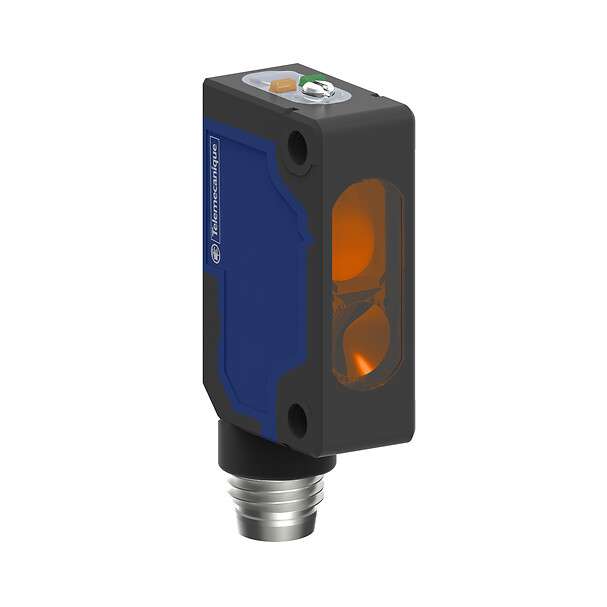
Telemecanique XUM6APXBM8 Photoelectric Sensor: Miniature Diffuse Detection Up to 1.1 m with PNP Output
When a production line has limited mounting space but still needs stable presence detection, miniature photoelectric sensors become a practical engineering choice. The Telemecanique XUM6APXBM8 photoelectric sensor is part of the XU family and is defined as a miniature, general-purpose, single-mode device using a diffuse detection system. It is designed for DC control architectures with a 3-wire wiring technique, a PNP discrete output, and an M8 connector interface for modular maintenance. These core characteristics are documented in the manufacturer reference and product datasheet.
Product Identity and Technical Characteristics
The Telemecanique XUM6APXBM8 photoelectric sensor is specified as a miniature diffuse sensor with Smax = 1.1 m, a PNP discrete output type, and a male M8 connector with 4 pins. It supports a programmable discrete output function (1 NO or 1 NC) and operates on 12…24 V DC with reverse polarity protection.
- Detection system: Diffuse
- Sensing distance: Smax 1.1 m
- Output: Discrete, PNP; 1 NO or 1 NC programmable
- Wiring technique: 3-wire
- Electrical connection: 1 male connector M8, 4 pins
- Switching frequency: ≤ 1000 Hz
- Delay response / recovery: 0.5 ms / 0.5 ms
- Current consumption: 20 mA no-load
- Voltage drop: < 2 V
- Switching capacity: ≤ 100 mA with overload and short-circuit protection
- Protection rating: IP65 and IP67
How Diffuse Sensing Behaves in Real Installations
Diffuse photoelectric detection typically relies on light returning from the target surface. That means the practical sensing margin can change with target color, gloss, and angle. The advantage is mechanical simplicity: you do not need a reflector, and you can often mount a single device on a bracket without building an optical corridor. For compact stations, this is exactly why the Telemecanique XUM6APXBM8 photoelectric sensor is used as a baseline presence device: the footprint is small, and setup is fast.
However, diffuse sensors benefit from governance. You want a stable detection window, not a “just barely works” threshold. The datasheet specifies sensitivity setting by potentiometer, which enables controlled tuning for the actual target and background in your machine.
Integration Details That Affect PLC Behavior
The Telemecanique XUM6APXBM8 photoelectric sensor supports PNP output and offers 1 NO or 1 NC programmable logic. In practice, this is not just a wiring choice; it is a diagnostic policy choice. Many teams standardize “input ON = object present” to reduce troubleshooting time across shifts. Others prefer NC-style logic for certain fault-detection strategies. The key is consistency: define one convention for the machine family and document it in the electrical standard.
Timing data matters as well. With a switching frequency up to 1000 Hz and 0.5 ms response/recovery, the sensor can support fast-moving parts without forcing extreme PLC scan tuning. If you apply aggressive PLC input filtering “just in case,” you may unintentionally mask short events that the device can reliably detect. A governed approach is to set filtering based on measured line speed and part spacing.
Environmental Robustness and Mechanical Envelope
The Telemecanique XUM6APXBM8 photoelectric sensor is specified for IP65 and IP67, and includes vibration and shock resistance figures aligned to industrial standards. Temperature ranges are listed as -30…55 °C for operation and -40…70 °C for storage, and immunity to ambient light is specified up to 40,000 lux sunlight and 10,000 lux incandescent light. These values are useful when you are deploying sensors near doors, skylights, or inspection lighting where ambient conditions can vary.
Dimensional constraints can be critical in miniature designs. The datasheet lists a width of 10 mm, height of 44 mm, and depth of 20 mm for the device envelope. In tight fixtures, those numbers help avoid late-stage interference with guards or tooling.
Commissioning and Maintenance Practices
A practical commissioning routine for the Telemecanique XUM6APXBM8 photoelectric sensor includes three steps: (1) mount the sensor rigidly to avoid drift, (2) tune sensitivity with the potentiometer using the darkest or least reflective product variant, and (3) validate switching at maximum line speed with both “product present” and “no product” conditions. Sensitivity tuning is a controlled action, not a guess, and it should be recorded so a replacement unit can be returned to the same operating margin.
For additional context across the sensor ecosystem and related selection patterns, use this internal reference: Telemecanique sensor.
FAQ
- What type of sensor is the Telemecanique XUM6APXBM8 photoelectric sensor?
It is a miniature photoelectric sensor using a diffuse detection system with a discrete PNP output. - What is the specified sensing distance?
The reference lists Smax = 1.1 m for the diffuse sensing configuration. - How fast can it switch?
Switching frequency is specified up to 1000 Hz, with 0.5 ms response and 0.5 ms recovery. - What connector is used?
It uses a male M8 connector with 4 pins. - Which IP ratings are specified?
IP65 and IP67 are specified.
By combining a compact mechanical envelope, controlled sensitivity tuning, and fast timing characteristics, the Telemecanique XUM6APXBM8 photoelectric sensor supports reliable presence detection in space-constrained automation stations while remaining maintainable through its M8 modular connection.