
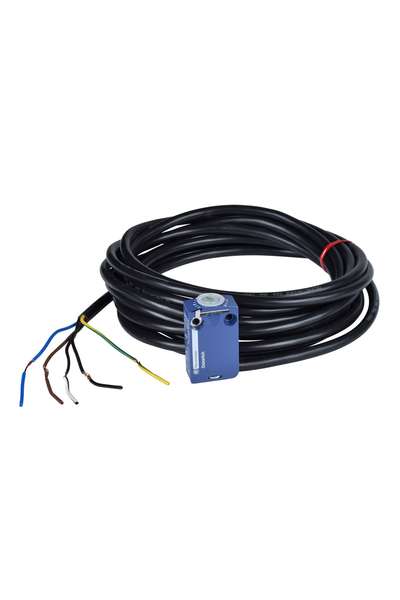
Telemecanique XGCS491B201 RFID Smart Antenna: 13.56 MHz Standalone Identification with PNP Output
Traceability and identification are no longer “nice to have” features in industrial automation. They are operational governance tools: they reduce mix-ups, enable automated routing, and create audit-ready records for quality and compliance. RFID systems are often chosen when barcodes struggle—dirty environments, poor line-of-sight, or the need to identify items without visual access. The Telemecanique XGCS491B201 RFID smart antenna is specified as a panel mounting smart antenna (RFID compact station) operating at 13.56 MHz in standalone mode, providing a discrete PNP output for PLC integration.
This technical overview explains how the Telemecanique XGCS491B201 RFID smart antenna is specified, what standalone operation means in practice, and how to engineer mounting and spacing to avoid typical RFID performance pitfalls.
Technical Identity: What XGCS491B201 Is
The product data sheet describes XGCS491B201 as a panel mounting smart antenna in the Telemecanique Radio frequency identification XG range. It is specified for RFID frequency 13.56 MHz, standalone operating mode, and a nominal sensing distance of 10…70 mm. It uses a male connector M12 (5-pin) and a 24 V DC supply (PELV).
- RFID frequency: 13.56 MHz
- Operating mode: Standalone
- Nominal sensing distance: 10…70 mm
- Supply voltage: 24 V DC PELV (limits 19.2…29 V DC)
- Output: Discrete, PNP, 1 NO; switching capacity 300 mA
- Electrical connection: 1 male connector M12, 5-pin
- Protection: IP65
Compatibility is also documented for several RFID microchip families and tag standards, including ISO 14443 and ISO 15693, with automatic detection of tag type. For engineering teams, this means the device is intended to work across common HF RFID tag ecosystems used in industrial identification.
Standalone Operation: Why It Matters
Standalone mode is listed explicitly. In practical terms, standalone RFID devices are commonly used for simpler identification tasks where a discrete “tag detected” output is sufficient to trigger a sequence step. This is often valuable when the PLC program only needs a deterministic presence/identity confirmation rather than complex data exchange logic.
Governance still applies: define what “tag detected” means in the process. For example:
- Routing confirmation at a diverter.
- Fixture presence validation before machine cycle start.
- Carrier arrival confirmation in a transfer line.
The goal is to create deterministic logic: identification as a controlled gate, not a “best effort” event.
Telemecanique XGCS491B201 Mounting and Spacing: Avoiding Performance Degradation
RFID performance is highly influenced by mounting environment. The data sheet includes explicit clearance guidance. It states a minimum distance between two identical smart antennas of e1 = e2 ≥ 310 mm, and for mounting on a metal structure it specifies e > 20 mm. These are critical governance constraints: ignoring them can cause cross-interference or detuning effects that look like “random missed reads.”
A professional installation approach therefore includes:
- Designing mechanical fixtures so tags pass through the 10–70 mm read corridor consistently. ([ic-components.com]
- Respecting multi-antenna spacing rules in dense stations.
- Providing clearance from metal where specified to preserve the antenna field behavior.
Electrical Integration: PNP NO Output and M12 Pin Discipline
The device provides a discrete PNP NO output and uses an M12 5-pin connector. ([ic-components.com] The wiring diagram specifies pin roles (24 V, 0 V, and PNP output, with reserved pins). ([ic-components.com] From a governance standpoint, the key is to treat reserved pins as non-functional and to standardize your cordset and I/O mapping to avoid field improvisation.
Because switching capacity is listed as 300 mA with protection, the output is designed for industrial control signaling. Still, best practice is to drive PLC inputs or properly rated interface relays rather than ad-hoc loads.
Operational Reliability: Turning RFID into a Stable Process Gate
Telemecanique XGCS491B201 RFID becomes powerful when it is implemented as a governed gate with defined acceptance criteria. A reliable workflow includes:
- Validating tag type and placement during commissioning (orientation, distance, mounting position).
- Testing worst-case speed and vibration conditions if carriers move dynamically.
- Documenting spacing and metal-clearance constraints in the maintenance record.
For broader ecosystem context across sensors and industrial detection components, see Telemecanique sensor.
Telemecanique XGCS491B201 FAQ
- What is the operating frequency of the Telemecanique XGCS491B201 RFID smart antenna?
It is specified as 13.56 MHz. - What read distance is specified?
Nominal sensing distance is 10…70 mm. - What output does it provide?
Discrete PNP output, 1 NO, with 300 mA switching capacity (protected). - What spacing rule applies between two antennas?
Minimum distance between two identical smart antennas is e1 = e2 ≥ 310 mm. - What is a common cause of missed reads?
Ignoring clearance and spacing constraints, especially mounting too close to metal or placing antennas too close together.
When clearance rules and tag geometry are engineered intentionally, the Telemecanique XGCS491B201 RFID smart antenna provides stable HF identification as a deterministic automation gate in standalone PLC architectures.