
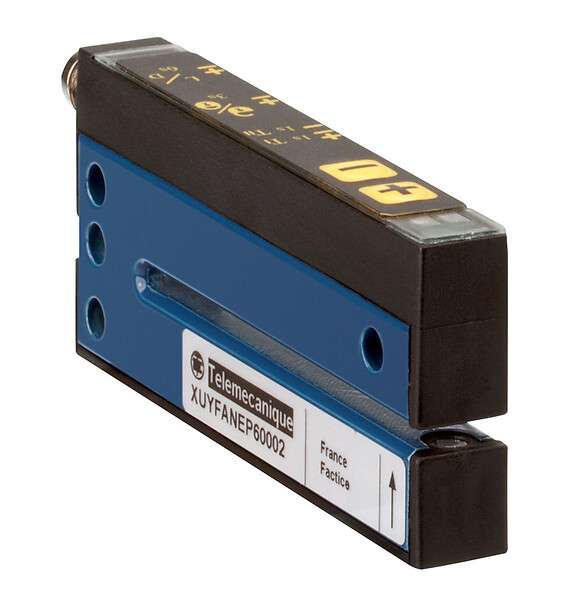
Telemecanique XUYFANEP40002 Fork Photoelectric Sensor: 2×42 mm Thru-Beam Detection with Teach-In for Labels and Reference Marks
High-speed web handling, labeling, and small-part transport require sensing that is both fast and mechanically repeatable. In these scenarios, a fork sensor reduces alignment variability because the transmitter and receiver are fixed in a single mechanical frame. The Telemecanique XUYFANEP40002 fork photoelectric sensor is specified as a thru-beam infrared fork with teach-in setup, designed for precise detection of labels, reference marks, and double-sheet conditions.
This technical article details the specification set of the Telemecanique XUYFANEP40002 fork photoelectric sensor, how teach-in changes commissioning behavior, and which integration practices help maintain stable detection over long production runs.
Technical Identity: Fork Geometry and Thru-Beam Principle
The Telemecanique product page describes XUYFANEP40002 as a fork photoelectric sensor with teach adjustment and a 2×42 mm slot format. A detailed characteristics view also lists: fork design, thru-beam detection system, and infrared LED, modulated emission.
- Sensor design: Fork
- Detection system: Thru beam
- Emission: Infrared LED, modulated
- Supply: 12…24 V DC with reverse polarity protection
- Outputs: PNP and NPN, 1 NO or 1 NC programmable
- Connection: 1 male connector M8, 4 pins
- Setting-up: Self teaching
In practical terms, the Telemecanique XUYFANEP40002 fork photoelectric sensor creates a controlled optical gate. Detection is based on interruption (or modulation change) across a fixed slot rather than reflective intensity. That reduces sensitivity to target color and gloss compared with many diffuse configurations, which is why fork sensors are common in label detection and small web material tracking.
Application Fit: Labels, Reference Marks, Double Sheet
The product-specific application list includes detection of double sheet, labels, reference marks, small conveyor detection, and vibrating rail detection. This is a strong clue to the intended operational behavior: the sensor must remain stable even when the mechanical environment introduces vibration or when the target is thin and fast-moving.
In label detection workflows, a common governance requirement is consistent contrast management. Teach-in helps because you can train the device using real production material rather than relying on a generic factory threshold. The commissioning outcome is improved repeatability across material batches and supplier changes.
Teach-In Commissioning: Turning Setup into a Repeatable Process
Self teaching is specified as the setup method. A disciplined commissioning approach is:
- Install the fork so the web path is centered through the optical axis.
- Run the actual label or reference-mark media and perform teach-in under real line tension.
- Validate switching at maximum production speed and with the worst-case print contrast.
Teach-in should be treated as an engineering record. Capture the setup state (media type, speed, and sensor mounting reference). This prevents “mystery changes” when maintenance re-teaches the sensor with a different material sample.
Output Governance: PNP/NPN and NO/NC Choices
The sensor supports PNP and NPN outputs and programmable NO/NC. ([telemecaniquesensors.com] This flexibility is powerful but introduces a governance need: standardize what output ON means across your machines. For example:
- Output ON = label present (or mark detected)
- Output ON = beam blocked (web present)
Either convention can work. The operational risk is mixing conventions across lines, which multiplies troubleshooting time when a fault occurs at 2 a.m. Standardization reduces diagnosis steps and improves restoration speed.
Mechanical Integration: Slot Management and Contamination Control
Fork sensors often operate near adhesives, dust, and paper fibers. Even with modulated infrared, contamination on the optical faces can shift the detection margin. A practical maintenance routine includes periodic cleaning aligned to line contamination rates. The goal is not cosmetic cleanliness; it is margin preservation.
The M8 4-pin connector supports modular replacement and fast swap testing. For uptime-driven environments, that matters because a suspected sensor can be replaced quickly without re-terminating field wiring.
For broader ecosystem references and selection logic, see Telemecanique sensor.
FAQ
- What is the detection principle of the Telemecanique XUYFANEP40002 fork photoelectric sensor?
It is a fork sensor with a thru-beam detection system. - What light source is specified?
Infrared LED, modulated. - What outputs are available?
PNP and NPN with 1 NO or 1 NC programmable function. - How is the sensor adjusted?
Self teaching (teach-in) is specified. - What is a typical cause of missed label detection?
Teach-in performed with non-representative material or contamination build-up on the optical faces.
When teach-in is governed and the slot corridor is kept clean, the Telemecanique XUYFANEP40002 fork photoelectric sensor provides repeatable 2×42 mm thru-beam detection for labels, reference marks, and thin-material applications.